Everybody’s something
Other People“Everybody’s something” is Sharon’s compact expression of a lesson she says she has learned from life. Spoken while she helps Mary Lamb remove a complicated arrangement of bands and clips, it offers reassurance without denying Mary’s helplessness: difference and difficulty belong to everyone, not to Mary alone.
Context and First Use
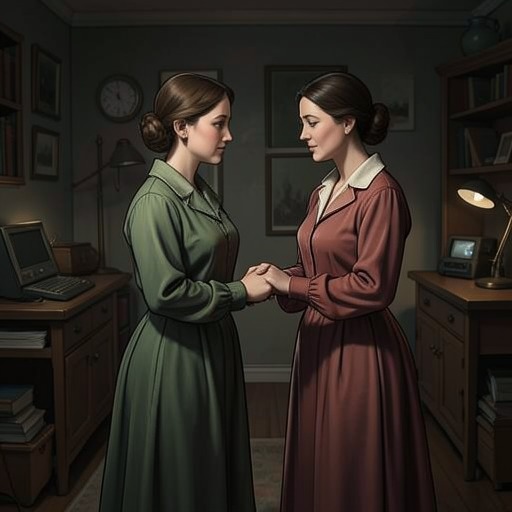
Sharon first says the phrase after Mary describes her pain as “Just a simple pain.” Sharon teases her for being “simple,” then reaches for Mary Lamb’s waist with hands gentler than Mary feared. As Sharon helps her out of her skirt and sees the bands and clips beneath it, she calls her a mess and says she must have been “in somewhere.” The phrase follows this mixture of bluntness and practical care: Sharon presents it as “one thing I’ve learnt from life,” broadening the exchange beyond Mary’s immediate condition.
Repetition as Reassurance
The wording returns when Sharon slips her fingers into the central band and it begins to come away. Mary cries, and Sharon tells her there is “no need to cry now,” then repeats, “Everybody does it. Everybody’s something.” The recurrence gives the expression a more immediate purpose than the earlier general observation: it is meant to comfort Mary through a vulnerable, unfamiliar experience by making that experience seem shared rather than singular. Sharon also promises that they are going to take Mary away and get her “fixed up,” joining reassurance to concrete help.
Humor and Ambivalence
Sharon’s kindness is not solemn or carefully phrased. She calls Mary silly and helpless even as she looks after her, so the expression’s comfort arrives wrapped in teasing. She links it to a rhyme her granny used to say: “Everybody’s queer dear, except you and me dear, and even you dear look a bit queer dear.” The rhyme turns the claim of ordinary difference into a joke that catches its speaker too: nobody stands entirely outside the category of the queer or peculiar. In this scene, “Everybody’s something” is both a kindly leveling gesture and a reminder that care can come in Sharon’s irreverent, imperfect language.