Garcia café
Other PeopleGarcia café gives Mary more than a job. After wandering into a busy district of ramshackle houses and cavernous shops, she sees a waitress vacancy and is offered a chance to start the next day. The café becomes a place where routine and company make time feel lighter, while encounters with Alan, her coworkers, and Prince connect its everyday life to the wider story.
Setting and first opportunity
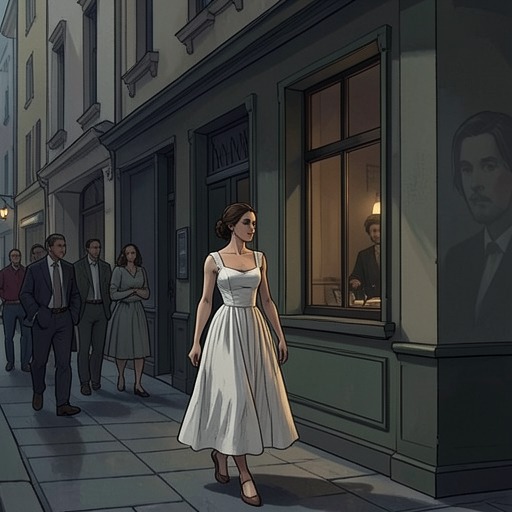
Mary comes upon the café while avoiding the familiar routes and landmarks that have served as handholds in the city. The surrounding area is crowded with informal commerce: people display their belongings on racks in the road, passers-by contribute to the noise, and a raised street cuts upward through the scene. Against this setting of movement and exchange, a dark window holds a message advertising work. Sunlight briefly obscures the words; when they become legible again, Mary reads that a waitress is wanted.
She goes inside to inquire. Before her eyes adjust to the dimness, a young man has looked her over, consulted a woman behind the counter with a nod, and asked whether she can start the following day. Mary says she can and turns to leave before anything can go wrong. The man calls her back to ask whether she wants to know about money and time. Her interest in those terms makes the offer concrete: this is not simply a hopeful sign, but a possible means of support. The café is where Mary finds the break she has been seeking.
Work and daily rhythms
Mary loves her job, in part because it gives her a place within a network of familiar acknowledgments. People know one another; greetings recur in the morning and evening; ordinary contact creates a sense of inclusion. The work also changes how time feels. Rather than only something to endure or exchange for money, it becomes lighter through repetition and company. The summer sun falling at an angle across the dishes Mary has wiped supplies a particular image of that daily rhythm.
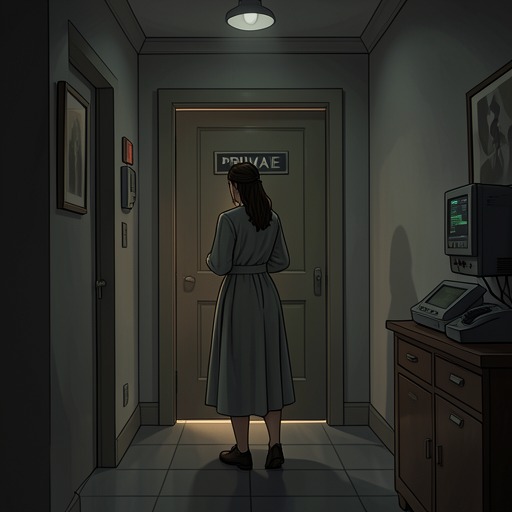
The café’s routines are visible in its rooms and regulars. Alan sits in a small office beyond the kitchen, looking out of the window and worrying about losing his hair. Mary watches him repeatedly reach for it, inspect what he has pulled free, and drop his hand back to the desk. She notices that the same gesture does not trouble her when she tries it herself: her own hair seems plentiful to her, while Alan treats his as scarce. The office’s position beyond the kitchen places his private anxiety within the working environment Mary observes each day.
Coworkers and borrowed books
The café’s social world includes Alan, Russ, and a quartet of very old cabbies who regularly sit by the window near the door. Mary serves the cabbies a tray piled with plates and thinks of their long lives and the anger they seem to have carried. Her observations reveal how closely she attends to the people around her, even as she makes broader judgments about age and gender that the scene does not establish as fact.
On payday, Mary is pleased that she will go drinking with the boys that evening. She is even more pleased by the result of a request she made the previous afternoon: she asked whether they had books she could borrow. Their startled response had left her wondering whether she had made a mistake, but the next morning they arrive with three books apiece and tell her she can keep them as long as she likes. Alan brings Life at the Top, Kon-Tiki, and Management: An Introduction; Russ brings Sex in the Cinema, Inside Linda Lovelace, and Britt. With Sunday ahead, Mary expects to have time to begin reading. The exchange extends the café’s fellowship beyond work: a request that might have exposed her to ridicule instead produces a generous, practical welcome.
Mr Garcia and the café’s social texture
Old Mr Garcia appears in the cramped cloakroom beside the front door. He is often difficult to understand when he speaks, but Mary takes his intentions to be kind. He offers reassurance through familiar physical gestures; Mary responds with a warm smile before hurrying into the café’s low hall. The moment adds a more complicated note to the place’s atmosphere: the café’s intimacy is expressed through casual familiarity, though the interaction is brief and filtered through Mary’s response.
The cramped cloakroom, low hall, kitchen, office, and window-side tables give the café a pattern of thresholds and gathering places. People cross between work and sociability, and Mary’s role as waitress lets her move among them while remaining attentive to their habits. Its ordinariness is important: the café’s welcome takes form not through a dramatic rescue but through a job, repeated greetings, borrowed books, and a place in the day.
Prince’s appearance and narrative significance
The café also becomes the setting for Prince’s unexpected appearance among the regular customers. On a good morning, when Mary is carrying plates to the cabbies, she hears him address her from behind. Unable to turn immediately, she hesitates; one of the cabbies reaches for his plate and identifies himself instead, but Mary knows the voice belongs to Prince. When she turns, she sees him seated with his chair leaning back against the wall, composed among the other people, with his newspaper, coffee, and cigarette.
His presence interrupts an otherwise ordinary workday without displacing its details: the plates still need serving, the cabbies remain at their table, and Mary is still inside the social world she has built through work. Garcia café therefore functions as both refuge and meeting point. It gives Mary employment and a repeatable structure for daily life, while allowing the story’s larger connections to enter through the familiar setting of a table, a cup of coffee, and a coworker’s greeting.