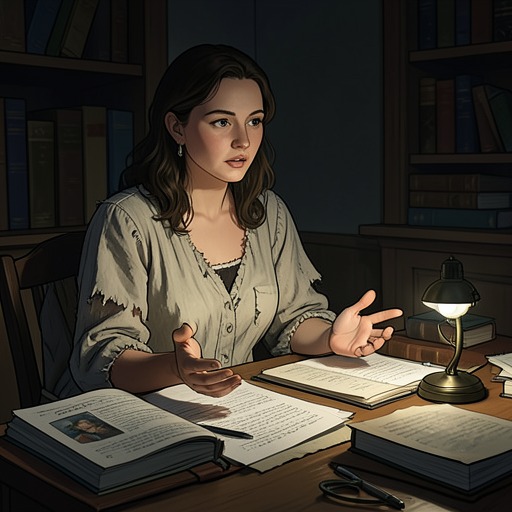
Jamie
Other PeopleJamie is presented through abrupt shifts of mood: he can rage against Michael Shane, boast about having money, make an awkward attempt to explain Mary Lamb to a group, and then find himself laughing painfully over a book. His drinking recurs alongside these changes, but the evidence does not reduce him to it. He is also a participant in the uncertain, crowded social world Mary enters, and eventually her closest companion in a flat from which everyone else has gone. Their growing intimacy brings comfort and dependence, but also isolation and imbalance.
Identity and Introduction
Jamie first appears in a volatile encounter connected to Michael Shane. After following Mary Lamb through an outer room and closing the door, he turns toward it as though it were an opponent, then directs a furious outburst at Michael. He complains that Michael makes him collect safari suits from Sketchley’s and treats him badly. The grievance is petty in its immediate particulars, but Jamie’s agitated manner makes clear that he experiences it as part of a larger indignity. He tells Mary he is leaving and insists that he has plenty of money, joining anger to a conspicuous claim of independence.
That declaration sits uneasily beside the dependence that later shapes his life with Mary. Jamie is shown in a social environment where people have their own habits and allegiances, while he and Mary remain uncertain in how they move through it. The narration marks him as restless, and his behavior repeatedly changes register: confrontation gives way to sociability, and then to melancholy. The shifts make him difficult to read as a stable guide to his own circumstances.
Drinking, Mood, and Brief Openings
Jamie’s drinking is a repeated feature of his days. When he telephones Mary to invite her to lunch, he reports an intense hangover while treating it as preferable to having nothing at all. Later, after drinking heavily, he identifies himself as depressed the following morning. Mary believes him, while also observing that he is suffering the effects of the previous night. The scene presents low mood and drinking together without supplying a single explanation for either.
In that same morning scene, Jamie picks up a book and begins to read. After a few minutes he laughs aloud, then rereads the passage and laughs again, each burst making him wince. The moment does not resolve his depression, but it offers a small, concrete counterpoint to his drinking and gloom: language briefly catches his attention and gives him pleasure, even as his body registers the cost of the laughter. His response is spontaneous rather than triumphant, and its brevity preserves the scene’s uncertainty.
At a gathering, Jamie crouches beside Mary and observes the people around them. He claims that everyone in the group has been involved with everyone else, then asks Mary whether she has been involved with anyone there. His remark presents the gathering as a closed network of mutual entanglements, while also distinguishing Mary as someone not yet absorbed into it. Jamie is both an observer of the group and a participant in its gossip and judgments.
Relationships and Social Friction
Jamie’s relationship with Michael Shane is marked, in the available scene, by resentment and a sense of being used. His complaint about collecting clothes gives the anger a mundane focus, but his repeated insistence that he can leave and has money suggests how forcefully he needs to assert his freedom in that moment. The scene offers his perception of Michael’s treatment, not an independent account of their relationship, and it leaves the conflict unresolved.
His dealings with Mary are more sustained and more complicated. In a conversation with a group of women, Jamie starts to withdraw, hesitates, and then tries to clarify an earlier generalization about women’s laughter. He singles Mary out, saying that she does not read or do things and therefore laughs only when she likes someone or feels well. The attempt to explain himself is accompanied by visible eagerness and shame; the women sigh and turn away. Jamie’s comment is at once an act of attention to Mary and a limiting judgment about her. He recognizes something particular in her response, but frames it through a disparaging assumption about women and their activities.
Mary and Jamie share a flat with other people before the household empties for Christmas. Mary is pleased when the others leave because she will have Jamie to herself. Without considering the act at length, she cuts the telephone cord to make their separation from the outside world more complete. Jamie later speaks of their money as a source of security and tells her to take plenty. His confidence in their resources contrasts with the narrowing of their world: they have cash, yet Mary has deliberately severed an ordinary means of contact.
Christmas and the Changing Balance
Once the others have gone, Mary’s sense of the flat changes. She expected it to feel larger, but it seems smaller; the physical space contracts in the same movement that their companionship intensifies. The narration describes the two as alone together, and Mary’s desire to keep Jamie close becomes increasingly evident. She stops washing, cooks, closes the windows, and turns up the heat. She also makes Jamie wear a dress left behind by Augusta. He initially does not want to, but comes to acknowledge its comfort. These details show Mary reorganizing the household around her own priorities and Jamie adapting to the new domestic order.
Their closeness is not simply reciprocal ease. Mary initiates physical intimacy when Jamie initially resists, and the episode establishes a troubling imbalance in how their shared life is being directed. The narrative does not present the increasing closeness as an uncomplicated mutual choice. Jamie’s diminished resistance and Mary’s determination to keep him near belong to the same tightening isolation that began when she cut the telephone cord.
At their final meal together in the scene, Mary carefully chooses food by its color and carries it to Jamie. The flat feels so small that they eat facing one another, their knees touching. As they eat, Mary tells him the whole story she has recovered: her death, her new life, her murderer, and the redeemer she expects to come for her. Jamie does not touch his food. His silence and withdrawal leave Mary without the recognition or response she might have hoped for, and she is overwhelmed by sounds she cannot control. The episode ends not with Jamie answering her story, but with Mary facing a mirror and recognizing that she has recovered herself.
Narrative Role and Ending
Jamie’s role is consequential because he becomes the person beside whom Mary’s return to herself takes place, without being able to complete or affirm that return for her. Earlier he can notice her social difference, share money, and occupy the intimate space of the flat; at the end, when Mary lays out her account of who she is, he remains disengaged from the meal and then lowers himself to the floor. The contrast makes their closeness feel insufficient: proximity has not guaranteed understanding.
Across these scenes, Jamie’s money, drinking, anger, reading, and dependence each offer a different measure of his unsettled position. He can insist that he has the means to leave, yet later lives within a shrinking domestic world; he can be sunk in a hangover, yet briefly laugh at a book; he can try to speak for Mary, yet define her through a narrow judgment. His final withdrawal is not given a separate explanation or resolution. Instead, it forms the bleak counterpoint to Mary’s recovery: she emerges from the episode with a renewed sense of identity, while Jamie is left outside that change, physically near but unresponsive to its meaning.