Jo
Other PeopleJo is defined by motion, self-sufficiency, and a bluntly practical command of the world around her. She moves from tennis and remote drives to guns and fuse boxes without treating any of them as exceptional, a breadth of activity that makes her a striking counterpoint to Jamie’s fear and to his narrow ideas about women. Her competence is not merely a pose: when the flat loses power, she steps in and restores the light herself. Yet Mary Lamb / Amy Hide later bears the marks of a beating Jo gave her, making Jo’s forcefulness consequential as well as impressive.
Identity and Daily Life
Mary Lamb / Amy Hide has never met or heard of anyone who does as many things as Jo. Jo has money of her own, unlike the other people in the flat, including Mary Lamb / Amy Hide, who depend on Jamie’s money. The distinction gives her an independence that is material as well as personal: she can drive away in her own large, powerful car to remote places that are virtually unreachable, and her days are not organized around Jamie’s resources. Jo’s activity spans sport, travel, domestic work, and practical skills. She plays tennis, squash, golf, and rides; in the evenings she sings hymns under a hot shower, then changes into a chunky sweater and jeans and helps Lily supervise dinner. She may knit while watching television, thread fish-hooks, restring tennis rackets, or oil guns. At precisely half past eleven she gets up, stretches, and goes to bed. The routine is striking for its variety and its order: Jo fills her hours with chosen tasks, then ends the day on her own schedule. She also goes out with her man, though these outings and his visits to the flat are described as occasional. Her physical presentation reinforces the impression of solidity and force. Mary Lamb / Amy Hide notices Jo’s shoulders, short brown hair, jawline, and exceptionally good teeth; the comparison to a war hero captures the toughness Jamie also fixates on, though his interpretation turns that toughness into a denial of Jo’s womanhood.
Competence and Conflict with Jamie
One Sunday night, the fuses fail while Mary Lamb / Amy Hide and Lily hold candles. Jamie approaches the fuse box only to extend his trembling fingers and snatch them back, intimidated by the box’s stubborn gleam in its recess. Jo enters carrying a gun, with three dead pheasants swinging from her belt. She shoulders Jamie aside and restores the light with one swipe. Jamie falls over; Lily helps him up. Jo’s intervention resolves the immediate practical problem, while the contrast makes Jamie’s helplessness conspicuous. He responds by insisting that Jo is not a girl but a man, and suggests she should change her name to match his judgment. Jo only laughs and goes to her room; soon afterward she leaves again, with other things to do. Jamie also interprets Jo’s pursuits as a way of avoiding thought. He says that her diving, mountaineering, potholing, and hang-gliding fill the days so she does not have to think, and questions whether she likes the man she goes out with, whom he calls a robot. This is Jamie’s account of her, not an explanation Jo gives herself. His language reduces her independence to a disguise or a symptom, while the narrative has already shown her moving confidently among activities and responsibilities. The fuse-box episode sharpens that divide: what Jamie treats as evidence that Jo is not properly feminine is, in practice, the ability to act when he cannot.
Past Relationship and Later Conflict
Jo and Jamie were once a couple, though the relationship ended long before the events in the flat. When Mary Lamb / Amy Hide asks why they stopped being together, Jo says Jamie was not man enough to work at the relationship. She describes their shared task as a massive construction job and judges him unable to take it on. Her metaphor makes intimacy a form of sustained labor, a challenge Jamie, in her view, failed to meet. The passage gives Jo’s direct explanation but does not describe the course of the relationship or establish that her account is the only one. Jo’s remarks also enter a conversation about wanting a baby. Mary Lamb / Amy Hide says that she wanted a baby and he did not, then asks Jo about the possibility of having one with him. Jo dismisses the prospect with an image of pigs with wings and calls him a little wanker. She is changing out of an explorer’s outfit and into tennis clothes as she answers, a small return to the activity-filled life that sets her apart from Jamie. The exchange confirms her contempt for him but does not provide further detail about the disagreement over a child.
Violence and Narrative Significance
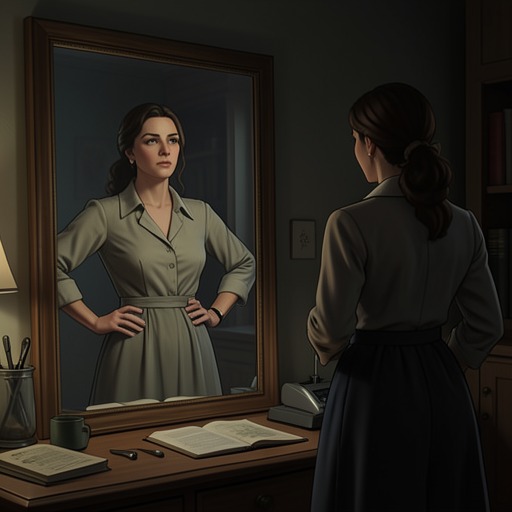
On New Year’s Day, in the flat, Jo gives Mary Lamb / Amy Hide a beating described as skilful and virile. The account supplies no further explanation for the violence, so its cause cannot be assigned from these details alone. Its consequence remains visible later: at the mirror, Mary Lamb / Amy Hide still has discolorations on her right temple and soft chin. She does not blame Jo for the injuries or for the beating. That refusal to blame does not erase the violence; it establishes how Mary Lamb / Amy Hide understands it afterward, even as she prepares to apologize to Jamie for her own part in events and hopes to see him when he is well. Jo therefore resists a single, reassuring interpretation. Her resourcefulness is concrete, from the flat’s restored lights to the varied work and recreation of her daily routine, but her capacity to act also includes physical violence. Jamie tries to explain her energy by turning it into a masculine defect or an escape from thought; Jo’s own account of their failed relationship instead emphasizes his inability to work at it. In Mary Lamb / Amy Hide’s later recollection, Jo remains the person who injured her, yet not someone she chooses to condemn. The tension between independence, competence, and harm is what gives Jo’s presence its force.