Jock and Trev invade the Botham home
Other PeopleJock and Trev’s invasion of the Botham home turns Mary’s brief experience of domestic safety into an abrupt assault, leaving the family injured and her refuge lost. The scene makes the violence both anticipated and sudden: the men have planned their attack, but inside the home its consequences arrive in a few chaotic minutes.
Causes and Background
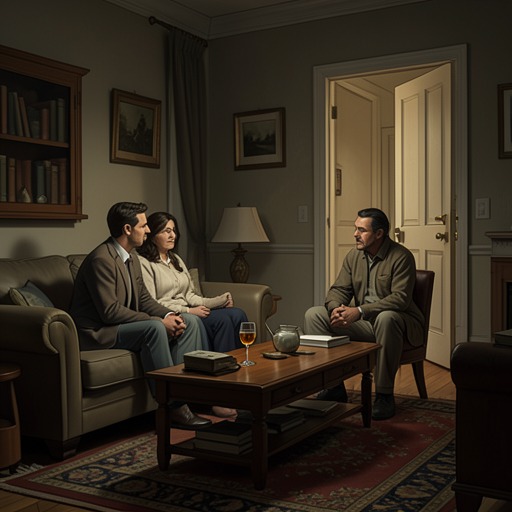
Before the invasion, Mary sits with Gavin, Mr Botham, and Mrs Botham in a room whose ordinary comforts—the tea, the fire, and the company—have made her feel, for a moment, that what she has found might be enough. A hundred yards away, on a stone terrace beside a three-walled wasteland strewn with discarded furniture and mangled prams, Jock and Trev wait for their chance. Their exchanged looks register a shared plan, but not an equal appetite for it.
Trev intends to inflict what the narrative calls special damage on Mary. He remembers their earlier encounter, in which he assaulted her and she struck back with a brick; his mouth still throbs from the injuries she caused. His pain has not made him reconsider. Instead, he plans to take time and leisure to harm her, and entertains the possibility that the two men may take her with them when they leave.
Jock is participating chiefly because Trev wants him to. Trev assumes that his friend shares his enthusiasm, but Jock has little taste for the venture and is comparatively at ease with the prospect of confronting the older Bothams. Their different motives give the planned intrusion an uneasy imbalance: Trev is intent on Mary, while Jock follows his companion into an attack he does not truly want.
The Invasion
The sound of the door changes the room before the attackers appear. Mary feels its tranquillity recede; Mr and Mrs Botham straighten together, and Gavin looks up from his magazine. In her gaze, the familiar room becomes at once stark and fleetingly permanent, as if she can already see it as something lost. Mrs Botham expects Sharon and threatens trouble, but Mr Botham goes to answer the door. His slow walk suggests no awareness of danger. The household hears the door open, a muffled shout rising from the passage, and then two thuds, the second more abrupt than the first. Mrs Botham has only time to begin screaming before Jock and Trev enter.
The attack unfolds in a few violent, uneven movements. Jock unexpectedly finds himself in front; Trev has stayed in the hall, stomping, and Jock runs miserably across the room to attack Mrs Botham. Her foot shoots up in immediate self-defence and strikes him between the legs with its heavy black brick. Jock gasps, clutches himself, and drifts away before sinking to his knees. When Trev reaches the doorway, he is already winded by his own exertion. Seeing Mary, he lumbers towards her, apparently ignoring Gavin, who rises and punches him in the lower face. Trev is flung backwards through the air and lands upside down and motionless by the passage. Jock vomits into the ornamental coal-scuttle; Mrs Botham screams louder, while Gavin rubs his knuckles and steps over Trev into the passage. Mary does not move.
Consequences and Aftermath
Mary remains motionless through the attack. The next day, however, she has to move: there is no choice, and she finds herself alone again. Her departure turns the invasion into more than a burst of violence; it destroys the shelter she had just begun to believe might last.
On the journey back with Gavin Botham, the damage becomes inseparable from Mary’s sense of responsibility. Gavin has made a statement but does not want to discuss it, and neither of them speaks much on the Underground, which Mary has never ridden before. The passage through the tunnels—people carried underground in steel cages, doors cracking shut, cold air mingling with heat from the earth—sharpens her thought that life is delicate and easily broken. She thinks she has broken the law, and also that she broke Mr Botham’s back: in her reasoning, Trev will receive prison time, but she too will be made to pay in her own way. She knows Mr Botham’s condition is considered most serious, yet imagines how much worse it could have been if she had broken his heart or nerve. The thought does not lessen the injury; it shows how quickly Mary turns harm around into an accusation against herself.
The consequences extend into the Botham family’s livelihood and home. Mr Botham had been a carpet-layer when he could find work, but his serious back injury now threatens his ability to work at all, and nobody knows whether he will recover. Mrs Botham stays at the hospital day and night beside her husband, drinking more heavily—or at least more openly. The house is empty, and its strained, vulnerable appearance reflects a change that Mary cannot undo. There is, as she recognizes, little left there for her to remain with.
Mary still asks Gavin why they cannot stay and hope Mr and Mrs Botham will return. His answer is practical and rejecting: they cannot afford to keep her, and the household has never had any leeway. Mary apologizes, then, when he asks where she will go, answers by taking out the piece of paper she has been given. His startled response marks the moment when her next refuge becomes immediate rather than hypothetical. The invasion thus ends not with the attackers’ defeat alone, but with an injured household, an absent couple, and Mary once again forced to leave the place where she had felt safe.
Narrative Significance
The scene’s force depends on the abrupt collision between a private feeling of sufficiency and the violence already gathering just beyond the room. Mary has been taking in the fire, tea, furniture, and company as signs that her present shelter might be enough; the narration cuts from that inward calm to Jock and Trev waiting a hundred yards away. The distance is small enough to make safety feel provisional, while the shift in focus turns Mary’s unspoken hope that the moment might last into a question the narrative answers with the approaching attack. Domestic peace is not gradually eroded: it is interrupted.
The narration also sets two measures of time against each other. The attackers have earmarked only a few noisy minutes for their assault, while Trev imagines having time and leisure to harm Mary. Against those intentions stands the household’s fragile interval of ordinary life, which Mary sees as both vivid and already lost when the door sounds. Her stillness during the invasion gives the scene a final contrast: the violence is enacted in sudden, forceful movements, but its consequence for her is a rupture in the continuity of shelter. The event makes the Botham home more than a temporary refuge; it shows how quickly a place that had seemed sufficient can become inaccessible.