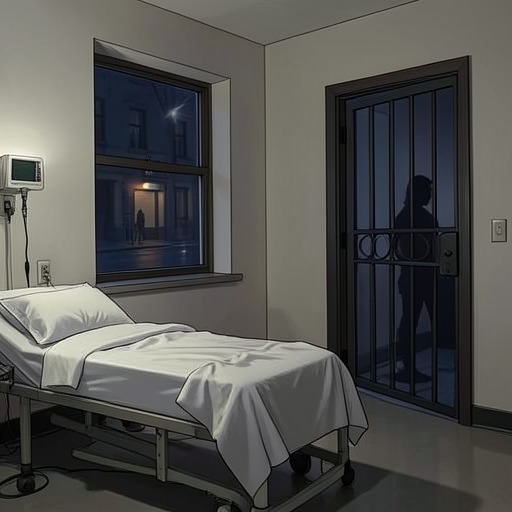
John Prince releases Mary after her arrest
Other PeopleJohn Prince releases Mary after her arrest at a moment when she has lost both her freedom and the protection she thought Sharon might offer. The encounter does more than get Mary off a police bus: it reunites her with the man from her first recovered memory, while leaving her with a warning, a question of belonging, and a newly recognizable link to the hospital where she woke without her memory.
Causes and Circumstances
Mary’s detention follows a night in which Sharon brings her into the company of Jock and Trev, then abandons any appearance of loyalty. Trev regards Mary as something to be traded or used, and Sharon reinforces his entitlement by calling Mary simple and saying he can do what he likes with her. The danger is not simply a misunderstanding between strangers: Sharon’s betrayal and the men’s treatment of Mary leave her exposed to people who see her vulnerability as an opportunity.
The narrator identifies Trev and Jock as criminals whose actions are bound up with money and risk. Jock has made a practice of attacking people he considers weak, especially older women; Trev is driven by drink and fighting and has a record of violence against women. The narration emphasizes that Mary is not yet equipped to deal with people like them, and that the police are close behind such criminals. That warning gives the shift from Trev’s threat to Mary’s removal into custody an uneasy double edge: she is taken away from immediate danger, but not yet into a situation she controls.
Removal to the Bus
After the confrontation with Trev, Mary is hurried out into the street. A hard hand clamps her shoulder, and someone presses against her back; believing she is about to be assaulted again, she has no reason at first to understand the intervention as protection. The man holding her speaks in an indifferent, reassuring tone, calling the procedure routine and promising that she will be sorted out quickly. The words do not explain what is happening so much as ask her to submit to it.
She is led to a black bus, where two men in silver-studded blue suits lounge by the entrance. The bus opens to admit her, and Mary obeys when told to climb aboard. Inside, she sits on a narrow ledge opposite a square figure. Sunlight comes through the caged windows, and for a few dizzy seconds she does not realize she is not alone. The physical details make the transfer feel both official and confining: the open door has become a barred window, and Mary has moved from the danger of Trev’s immediate reach into an unfamiliar form of custody.
Prince’s Intervention
The man facing Mary is John Prince. He asks what has brought her among these people and whether they are her kind. Mary answers that she does not think they are. Prince tells her to stay with her own kind, warns that there will be trouble if he sees her again, and then directs Dave to let her go because she is not one of them. His warning and his order sit together: he does not offer Mary an explanation or a promise of continuing protection, but he does use his authority in the moment to end her detention.
The release reverses the scene’s immediate balance of power. Mary had been carried onto the bus under another person’s grip and had followed instructions because she feared further harm. Now Prince opens the way out for her. The intervention is decisive but narrow: it restores her freedom to leave, while his warning makes clear that he expects her to keep away from the people he has just separated her from. The scene does not present this as a formal account of the arrest or establish what procedure follows; its focus is the sudden, personal decision that Mary is not to be held with them.
Recognition and Aftermath
Mary walks erectly down the street, aware of eyes prickling on her back. Only after turning the second corner does she lean against a wall and press her hand to her forehead. The pause follows her release rather than cancelling it: outside the bus, she can stop and register what has happened, but the encounter has left her shaken.
What stays with her is Prince’s breath. Its smell matches the first memory she has recovered: waking two days earlier in a white room, with someone beside her asking whether she was all right and telling her to be good. She now connects that voice and presence to the man who has just released her. The recognition gives their meeting a history Mary did not know she possessed, even though it does not restore her wider memory. She thinks that she will try her best and walks on.
The memory is accompanied by a disturbing contrast. Mary recognizes Prince through the smell of his breath, yet thinks that everyone else’s breath is alive and his is dead. The sensory clue establishes him as the person from her hospital awakening while keeping him strange and difficult to read. The episode therefore ends with two changes held together: Mary is free of the bus, and she has recovered a fragment of personal history, but the rescuer who makes both possible remains unsettling to her.