John Prince’s pink letter to Mary
Other PeopleJohn Prince’s pink letter to Mary is the first concrete link between Mary Lamb / Amy Hide and the missing woman Amy Hide. It does not settle who Mary is or what happened to Amy. Instead, its tentative wording, divided pages, and confronting photograph make identity a physical problem Mary must face: a name, a missing-person description, and a face that seems at once hers and not hers.
Arrival and First Reading
The letter arrives on the seventh day. Trudy tells Mary that it is for her; Mary recognizes her name and address on the white envelope, though the news does not immediately make the contents intelligible. Its arrival interrupts her uneasy attempt to make sense of herself. Shortly beforehand, Mary has been looking through Honey’s pamphlets and has understood that an activity connected with them is a memory game she cannot play. She has also wondered whether she had once chosen to be sexually exposed, as Trev claimed, but cannot recover any memory that would confirm or refute him. The letter therefore arrives in a period when she is already confronted by claims about a past she cannot remember.
Opening it proves unexpectedly difficult. Sitting on her bed, Mary tries to control the envelope and ease the letter out, but it jumps in her hands and acquires small rips. She loses her nerve and pulls the paper free with force, tearing it across the middle. The damage matters to the scene: the message is not received as a clean, authoritative document. Mary has to lay its two scraps together on a blanket and read them as separate pieces, while feeling that she has done something terrible. The object’s fragile, damaged form accompanies the uncertainty of what it can establish.
A Tentative Identification
The letter is signed by John Prince. Its first portion addresses Mary as Miss Lamb, but Prince immediately qualifies the name, asking whether it is accurate and whether she remembers having seen him before. He allows that he may be mistaken and says he will look into the matter and contact her again. The letter thus offers no confident explanation of Mary’s identity. Prince presents a possible connection and acknowledges uncertainty; his promise of further inquiry leaves the question open rather than resolving it.
Mary reads those lines several times without understanding them. Only when she turns over the lower half of the torn sheet does she find the more consequential information: a description of a girl called Amy Hide, aged twenty-six and five feet seven inches tall, described as dark, British, and having no distinguishing marks. Amy has recently become a missing person. The police suspect that she was murdered, though the letter makes clear that they are not certain. These particulars make the letter more than a personal note. It carries a fragment of an investigation into a disappearance, but the police’s uncertainty also prevents the fragment from serving as a final account of Amy’s fate.
The placement of this information on the reverse of the lower half gives the discovery a step-by-step quality. Mary first encounters Prince’s hesitation about her name and their possible prior meeting; she then discovers that the same pink sheet concerns a missing woman. The torn paper has to be turned and reassembled to reveal the connection. Its arrangement makes the reader’s discovery follow Mary’s handling of the object, while keeping the proposed identification incomplete.
The Photograph and Mary’s Response
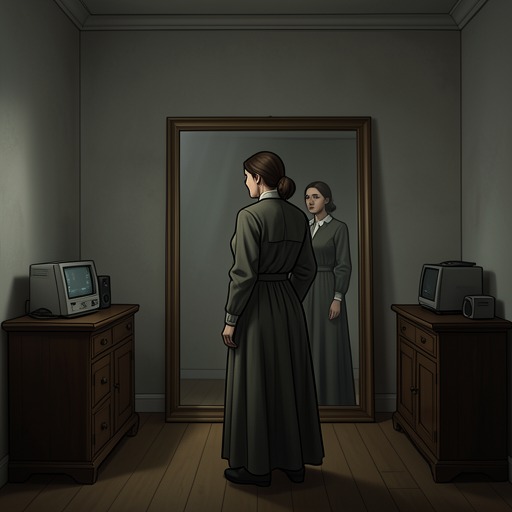
On the reverse of the upper half, Mary finds a photograph of a girl. She recognizes the pictured person as herself, then questions that recognition and returns to it. Later, at night in the basement bathroom, she holds the pink letter beside her face in the mirror. The photograph appears to show an older version of her: it shares the mole beneath her right temple, but the mole is on the opposite side, and the pictured woman’s eyes and mouth seem different. Mary studies these discrepancies rather than treating resemblance as proof. The photograph proposes a connection that her own perception cannot comfortably absorb.
The confrontation also makes the image an object to compare, not merely evidence to read. The reflected face, Mary’s living face, and the photographed face occupy the same moment, yet they do not make identity feel settled. The letter supplies external details—Amy’s age and description, her missing-person status, and the police’s suspicion—but the portrait produces a more intimate uncertainty. Mary thinks of her own face as belonging to someone good and experiences the photographed expression as incompatible with that belief. The difference she perceives is moral as well as physical, although the letter itself does not explain what Amy did or establish that the two women are the same person.
Significance of the Object
Mary’s response culminates in distress and sickness after she recognizes that the photograph may force her to reconsider her life. Her reaction does not confirm the identification; it registers its emotional force. The letter has supplied neither a complete history nor a decisive answer, but it has made the possibility of a past self difficult to keep at a distance. Its promise that John Prince will be in touch further leaves the inquiry unfinished.
As an object, the letter joins evidence to uncertainty. Its address identifies Mary as a recipient; Prince’s signature gives the inquiry a source; the description introduces Amy Hide’s disappearance; and the photograph makes the proposed relationship visible. Yet every element stops short of certainty: Prince may be mistaken, the police are not sure what happened to Amy, and Mary cannot reconcile the pictured face with her own. The tear across the sheet and the need to turn its separate halves make this incompleteness tangible. Rather than restoring Mary’s memory, the letter opens a question about the identity and history she may have lost.