London
Other PeopleLondon is rendered as a city of crossings, circuits, and unequal kinds of time. Mary Lamb experiences it from street level and through the Underground, moving between work, temporary shelter, and confinement; later, its pull is visible in the daily commute that structures life in a dormitory town. The city is not a stable home so much as a geography that people traverse, endure, or leave each morning to earn a living.
Streets, river, and changing weather
When Mary goes to see Michael Shane, his workplace is just across the river and not far from the former Botham home. The distance brings back her uncertainty about where the people who once sheltered her have gone and whether she will see them again. The river is roughened by a swiping wind, and its surface resembles chainmail; clouds overhead seem like the ghosts of living creatures. The shift in weather gives the crossing a larger emotional charge: Mary feels that her own stretch of life is narrowing and growing colder even as the air changes around her.
On the way, she recalls stopping in a courtyard, arrested by the strange quality of the light. The thought turns the city into a measure of time as well as distance: seasons may return a person to the past, but Mary is unsure whether she has a past to return to. She is tired of the shallow, repetitive life represented by passing seconds and by Alan paddling through his limited world. A gull drops toward the water for scraps, then hurtles close past Mary's face after she has watched it. The encounter sharpens her sense of being observed in turn. When she asks a tall old man for directions, he bends down, points the way, and remains bent after she has gone; even a brief exchange with a stranger becomes part of the city's unsettling passage.
The city as circuit and institutional route
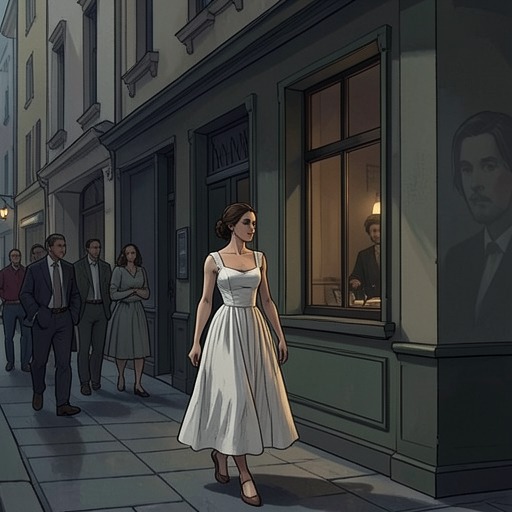
After Alan's death, Mary's journey through London lasts several days. She rides the tubes repeatedly, taking the Circle Line until its loops make her head reel, yet the circular route seems to take her nowhere. On foot she crosses the congested concrete of Piccadilly and Leicester Square. Her movement through recognizable streets does not give her freedom: she sleeps in a crowded room, leans against a wall beside other girls, and declines two different men who ask whether she is free.
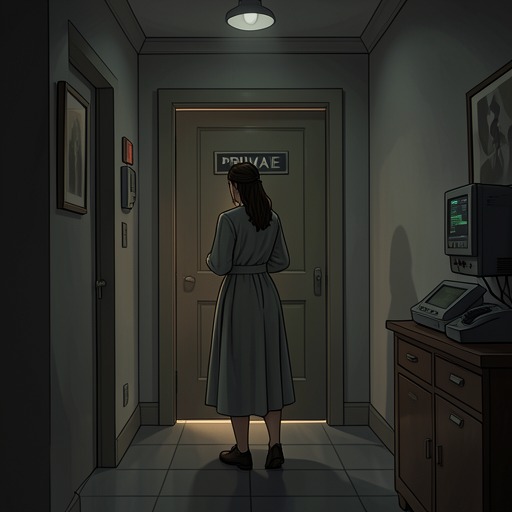
The journey then breaks into a series of enclosed stages. Mary is taken by van to a place where she must empty her pockets and bag and submit to a search, and is locked in overnight with a weeping woman. The next morning she is made to undress for an examination whose authority she does not understand. Another van takes her to a room of women whose cries fill the night. Her possessions are returned in a brown envelope along with yellow pills that make the present recede; she spends time in a garden or in a green room where lights and faces flicker. The contrast between the city's open routes and these controlled interiors makes London a place where movement can continue without amounting to escape. Prince eventually comes to the institution and gets her out.
London and its sleeping hinterland
The novel later sets London's working life against a remote dormitory town: a planned, modest world of baubelled hedges, carefully divided grass, right-angled streets, and slow cars that veer for dogs and cats. London earners return there exhausted to sleep in rows, while people elsewhere in the world rise to keep its workings going. The town is not presented as the capital itself, but as one of the places shaped by its daily demands.
Prince shows Amy Hide the town's considered precincts and mezzanines, where there is one of everything and little need to travel farther. Yet the connection to London remains insistent. Prince rises at seven, shares breakfast with Amy, reads newspaper reports aloud, and drives toward the capital just as it gets light, joining the queue of commuters. Amy stays behind to wash up and prepare for the day. In the evenings they read and listen to music, and sometimes watch Michael Shane reporting from places where the world is on fire. London thus has two linked faces: the crowded city Mary experiences as a frustrating circuit, and the distant source of work that draws Prince away from Amy each morning.