Mary Lamb and Sharon
Other PeopleMary Lamb and Sharon’s relationship is a brief, consequential passage from protection to betrayal. Sharon first intervenes when Mary is vulnerable, drives off a man who approaches her, and takes her away. She then offers practical help and reassurance. But at the pub, her attention shifts to drink and male company, and she presents Mary as something the men can use. The reversal leaves Mary without the protection she had seemed to find and makes Sharon’s care inseparable from its limits.
A rescue that creates trust
Sharon enters as someone Mary recognizes as being like her, though markedly imposing: large, with vivid red hair and an arresting manner. When Neville lunges toward Mary, Sharon knocks him away and rebukes him, then leads Mary from the gathering. Her intervention is physical and immediate; she does not wait for Mary to explain herself or ask for help. For Mary, who has been exposed to hostility, the distinction matters. She follows the woman who has made the immediate danger recede.
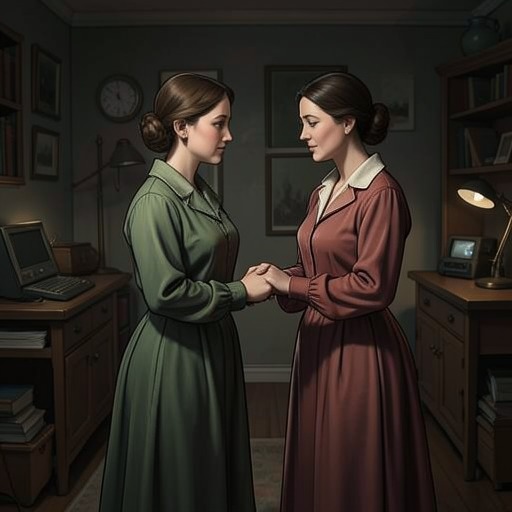
Once they have turned away from the others, Sharon asks Mary’s name and begins looking after her. She helps her out of a complicated arrangement of bands and clips beneath her clothes, notices how helpless and disordered she seems, and says she will take her away and get her fixed up. Her manner mixes kindness with blunt teasing: she calls Mary simple, but handles her more gently than Mary feared. The teasing does not cancel the assistance. At this point, Sharon’s rough familiarity gives Mary a measure of safety and a possible route back into the surrounding world.
That care extends to practical needs. Sharon notices that Mary lacks shoes and is cold, and says she has clothes she can lend. She plans a wash, offers her white boots, her mother’s red dress, and a white polo-neck, and considers how Mary will look when dressed. The attention is intimate and directive: Sharon decides what Mary needs and supplies it, while Mary has little ability to direct the exchange. Even so, Mary is pleased that someone is making concrete plans for her. The offer of clothes and sheltering attention helps her feel less afraid of returning to the present.
Care shadowed by Sharon’s drinking
The apparent rescue is complicated by Sharon’s own relationship with alcohol. She admits that she repeatedly returns to the drinking circle, often waking without knowing how she got there. Later, when she denies being an alcoholic, Mary privately recognizes the denial as unconvincing, and the narration identifies Sharon as an alcoholic. That account presents drinking as an escape from the difficulty of being oneself, while also stressing that drinkers have varied reasons for drinking. Sharon is therefore not only the person who helps Mary; she is also caught in a pattern that shapes her judgment and conduct.
At the pub, Sharon is familiar and valued, with enough credit to obtain drinks by pleading at the bar. Mary leaves her own drink after a few cautious sips, while Sharon continues drinking and describes it as something that puts her in the mood. She insists that she only likes a good time, but her account of repeated encounters with men becomes distressed: she says she has contracted diseases and cannot make herself stop. She recalls having once imagined becoming a nun and wonders whether it is too late to change. Her tears and self-questioning show a vulnerability that parallels Mary’s, but they do not lead Sharon to protect Mary when the men arrive.
The turn at the pub
When Jock and Trev join them, the balance of the relationship changes. The narration makes clear that Sharon is no longer on Mary’s side, though it leaves open whether she ever fully was. Sharon has brought Mary as far as she intends to, and Mary is alone again. This is the central reversal: the woman who had separated Mary from danger now places her among men who present a danger of their own.
Sharon helps make Mary available to them. She describes Mary as attractive and worth money, reminds Trev that she has cleaned her up for him, and encourages Mary to speak for the men. When Jock asks whether Mary has sex, Sharon first responds indignantly, giving Mary reason to think she is still defending her. She then tells Trev that Mary is simple and will not mind what he does. That assurance strips Mary of meaningful protection: Sharon converts Mary’s vulnerability into permission for the men, rather than recognizing it as a reason to intervene.
The transaction sits within the men’s criminal pursuit of money and their intended attack on the Botham home. Trev and Jock are not merely intimidating companions; the narration identifies them as criminals, and Trev intends to inflict what it calls special damage on Mary. Their plans make Sharon’s betrayal consequential beyond a moment of social abandonment. By bringing Mary into their company and representing her as available, Sharon helps expose her to a threat she is not equipped to manage. The narration explicitly regrets that Mary has been taken up by such people and fears the further danger of police involvement.
Consequences and significance
Mary’s understanding of Sharon changes in stages. At first she is relieved to have someone beside her, and even when Sharon’s talk is confusing, she welcomes the reassurance that everyone is something. At the pub, Mary briefly feels pleased when Sharon appears to defend her. The apparent loyalty lasts only until Sharon tells Trev that he can do what he wants. Afterward, Sharon is described as gone and on the other side. The phrase marks more than a quarrel: the person who had served as Mary’s guide has become part of the situation Mary must survive.
The relationship also places Sharon’s vulnerability beside her capacity to harm. Her drinking, distress, and wish that change might still be possible complicate her portrayal, but they do not erase the choice she makes in the pub. Nor does her earlier help make Mary safe in retrospect. The episode shows how care can be real in one moment and unreliable in the next, especially when Sharon’s needs and drinking direct her attention elsewhere. For Mary, the cost is renewed isolation at the precise moment she has begun to trust someone.
The contrast resonates later in the Botham home. Mrs Botham speaks of Sharon as someone she had wished would attend Al-Anon, but says Sharon was too drunk to go. Mrs Botham also describes her own history of alcoholism and her commitment to sobriety; Gavin Botham bluntly identifies her as an alcoholic, while Mr Botham calls her an ex-alcoholic. This later family discussion places Sharon within a wider pattern of drinking and contested recovery language, without undoing Mary’s direct experience of her. In the relationship itself, the decisive fact remains that Sharon first acts as Mary’s protector and then abandons that role, turning assistance into exposure.