Mary and Jamie's Christmas isolation
Other PeopleMary and Jamie’s Christmas isolation is a withdrawal from the ordinary world that becomes the setting for Mary’s recovery of her identity. With the other residents gone and the telephone disabled, the two shape their days around drinking, food, sleep, and their increasingly close companionship. The enclosed routine ends not in a reunion with the outside world, but in Mary’s recognition that she has found herself again.
The flat emptied for Christmas
Christmas approaches as the people around Mary and Jamie make plans to leave. Jo goes skiing in Switzerland with her partner; two men take Augusta to a country house; and Lily and Carlos leave to stay with Bartholomé in the North Sea. Mary and Jamie see them off in a taxi. Their departure gives Mary what she has anticipated: Jamie to herself. Yet the flat, rather than seeming more spacious without the others, feels smaller. Its narrowing becomes part of the event’s central condition: isolation is both chosen and increasingly enclosing.
Mary cuts the telephone cord without pausing to consider what she is doing. The gesture makes their separation practical as well as emotional, ensuring that the flat cannot easily reconnect them with anyone outside. Jamie, meanwhile, draws attention to the money he keeps in his pockets and tells Mary to take plenty. His comments turn their material security into a refrain: they have money, and he imagines that this fortune will keep them safe. The surrounding circumstances suggest otherwise. Money supplies food and shelter, but does not open the flat or restore a shared measure of time.
A life arranged outside the clock
Mary and Jamie’s routine dismantles the distinction between day and night. Around noon, after several hours of drinking, they prepare their first meal. Jamie eats little; Mary then leads him to the bedroom, and they sleep for as long as six or seven hours through the afternoon. They rise in the evening and remain awake through the night until dawn. The pattern repeats, replacing the clock’s ordinary divisions with a private cycle of drinking, eating, sleeping, and waking.
Food becomes one of the few activities Mary directs with confidence. She cooks late at night in the cramped kitchen, combining ingredients in unusual ways and deciding when each dish has reached the right colour. The competence she experiences there contrasts with the restricted world beyond the kitchen: the flat feels increasingly small, while her decisions over its meals remain her own. At the same time, the inhabitants’ routines reinforce their withdrawal. Jamie sometimes moves towards the balcony, but Mary stops him from going out; the windows stay shut and the heat is turned up. The isolation is not merely an absence of visitors. It is maintained through repeated choices that keep the pair inside.
Addiction and the problem of being oneself
The Christmas enclosure echoes the book’s earlier treatment of alcohol as a way people avoid being themselves. The narrator’s account of alcoholism presents drinking as more than an individual habit: it describes a condition in which the drinker’s identity is absorbed by drink, while also acknowledging that people have different reasons for seeking that escape. This perspective shadows Mary and Jamie’s shared drinking, but their closed routine gives it a particular function: it helps suspend ordinary time and makes their life together feel self-contained.
The Botham household provides a more domestic version of the same conflict. Mrs Botham recalls a woman who could remember almost nothing after a blow to the head, while Gavin dismisses the story and calls his mother an alcoholic. Mr Botham distinguishes an ex-alcoholic from someone still drinking; Mrs Botham rejects the idea that alcoholism can be left behind and recalls her own past consumption of dangerous household substances before describing sobriety as a value she now treasures. Her account of recovery is complicated by Mary’s observation that Mrs Botham is drunk again and repeats herself. The pamphlets Mrs Botham reads from Al-Anon and the material Mary encounters about Alcoholics Anonymous likewise offer frameworks for understanding drink, memory, and the hope of change. Against this background, Mary and Jamie’s isolation is not presented as a settled recovery. It is an enclosure in which drinking and closeness temporarily replace a life organized by the outside world.
The last meal and Mary’s return
The confinement reaches its decisive point over a meal Mary calls their last. She prepares brains, tripe, and lightly heated veal, then brings the food to the sitting room. The flat has become so constricted that Mary and Jamie sit facing one another with their plates on their laps and their knees touching. During the meal, Mary tells Jamie everything: her death, her new life, her murderer, and the redeemer she believes will come for her. What had been held within her account of herself is now spoken to another person, even though the evidence does not show Jamie responding with an equivalent confession or recognition.
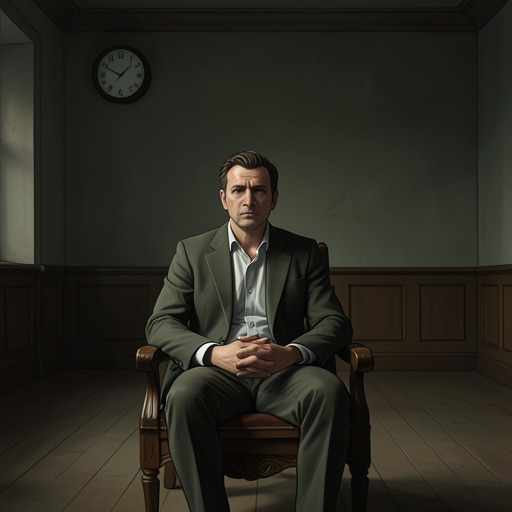
Jamie does not touch his food. He lowers himself back to the floor, leaving Mary standing over him for a long time. The scene marks the limit of their shared arrangement: physical closeness has not guaranteed a shared understanding, and her disclosure does not produce the response she may have hoped for. Mary makes sounds that frighten her, then later stands before the darkened bathroom mirror. When she switches on the light, she sees a face marked by relief, terror, and exultation. The narration identifies this moment as her passage back from the other side and her recovery of herself.
The event therefore joins separation to recognition. Mary has cut the line that connects the flat to the outside world, and her private cycle with Jamie has tried to suspend the ordinary passage of time. Yet she finds her way back not through continued enclosure but through telling her story and confronting the identity that story contains. The Christmas isolation ends as a threshold: the flat has held her apart from others, but it has also become the setting in which Mary recognizes herself again as Amy Hide.