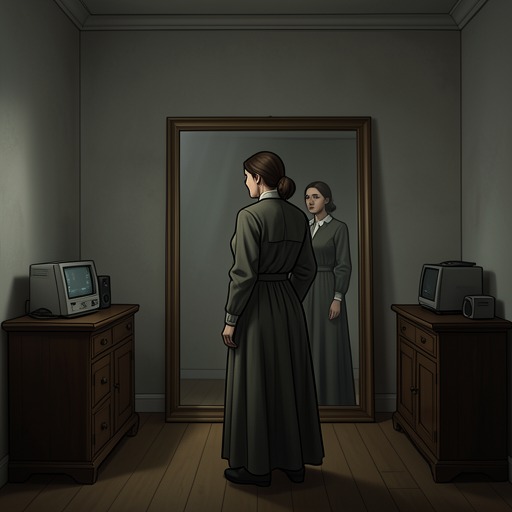
Mary discovers her possible identity as Amy Hide
Other PeopleMary Lamb’s possible identity as Amy Hide emerges not through recovered memory but through a damaged letter and a photograph. John Prince’s message links Mary to a missing woman believed to have been murdered, while the image offers a likeness strong enough to unsettle Mary and differences she cannot explain. The discovery changes her uncertainty from a question about who she might be into a confrontation with visible evidence, without giving her a conclusive answer.
The letter arrives
The letter comes on the seventh day. Trudy tells Mary that it is addressed to her, and Mary recognizes her name and address on the envelope. Its arrival is a small, ordinary event in form, but Mary has no settled framework for receiving this particular message: she knows neither why it has been sent nor what it might connect her to. The envelope itself becomes the first obstacle between her and an account of her past.
Alone downstairs, Mary sits on her bed and tries to open it. Her hands make the envelope jump and turn; efforts to ease out the letter leave small tears, and eventually she pulls it out roughly. The paper splits across the middle. She treats the damage as a serious mistake, aligns the two pink pieces, and smooths them on the blanket before trying to read. The physical break precedes the revelation, dividing the message into parts that Mary must handle and interpret separately.
Prince’s uncertain identification
The letter is from John Prince. He addresses Mary as Miss Lamb but immediately questions whether that name is accurate. He says that he has seen her before and asks whether she remembers, while allowing that he could be mistaken. Rather than presenting an established identity, Prince offers a provisional connection and says that he will investigate and contact her again. His uncertainty matters: the letter proposes a lead, not proof, and leaves Mary waiting for information that has not yet arrived.
The message’s layout makes that uncertainty more consequential. Mary reads the first part, which does not explain the situation, and then turns over the lower half of the torn sheet. There she finds a description of Amy Hide: twenty-six years old, five feet seven inches tall, dark, British, and listed as having no distinguishing feature in the brief notation. Amy has recently become a missing person. The police believe she was murdered, although the letter makes clear that they are not entirely certain. The possibility of Amy’s death gives the proposed identification a grave context, but the letter does not establish what happened to her.
The photograph and the double
Mary turns over the upper half and finds a photograph. The woman in it is recognizably Mary, yet the recognition does not settle who she is. Mary reads the letter several times, still unable to make sense of it, and repeats to herself the question of whether the pictured woman is really her. The scene holds resemblance and estrangement together: the photograph appears to identify her and, at the same time, presents a face she experiences as not quite her own.
Later, in the basement bathroom, Mary holds the pink letter beside her face and compares herself with the image. She sees an older version of herself, including the mole beneath the right temple, though it appears on the opposite side in the photograph. Other differences deepen the distance: the pictured mouth seems looser, and its expression carries a confidence absent from Mary’s own sense of herself. The eyes seem older and knowing. Mary cannot make these features into a remembered history; she can only examine the evidence in front of her and register that likeness has not restored recognition.
What the revelation changes
Before the letter, Mary’s missing past is an absence that leaves many possibilities open. The earlier question of whether she had ever entered an intimate situation, and Trev’s insistence that she had done so before, had already shown how little she could verify about her own history. Prince’s letter supplies a specific candidate for that unknown past, but it does not fill the gap with memory. Instead, it places Mary beside Amy’s particulars, uncertain fate, and photograph, making the gap more sharply defined.
The revelation therefore establishes a possible identity rather than a final answer. Amy Hide is a named missing woman; Mary is the recipient of a letter that asks whether the name Miss Lamb is accurate; and the photograph resembles Mary closely enough to provoke an immediate, troubled recognition. Yet Prince himself leaves room for error, the police are not certain Amy was murdered, and Mary does not remember the woman in the picture. The event’s force lies in that unresolved combination: an external record seems to know something about Mary that she cannot know from within, while the evidence makes identification possible without making it complete.