Mary stays with the Botham family
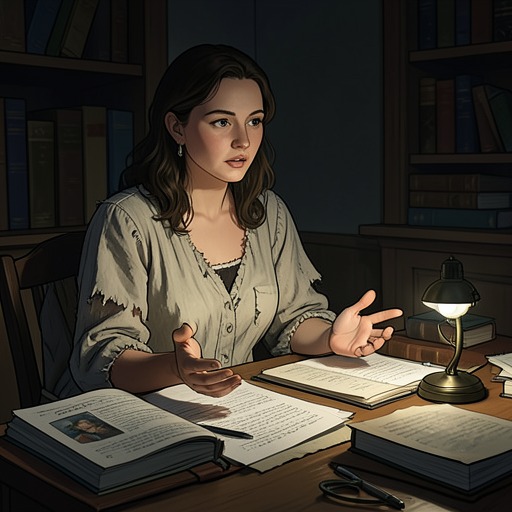
Other PeopleMary Lamb's stay with the Botham family gives her a temporary place to belong at a moment when she has lost her memory and cannot read the ordinary ties between people. The Botham home is warmer and more welcoming than she expects, yet its crowded rooms, family commotion, and restrictions on leaving prevent refuge from feeling simple or secure. Mary is repeatedly treated as a familiar guest, even as she wonders what the family wants from her and remains alert to danger.
Arrival and the Botham Home
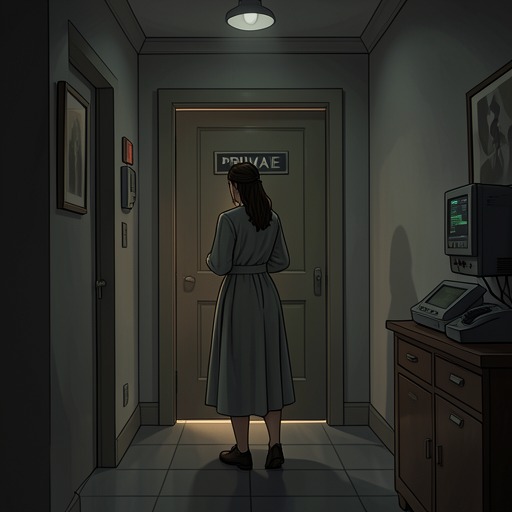
Sharon brings Mary Lamb to the Botham home and announces their arrival with delighted certainty. Mary follows her into a cuboid vestibule, where she encounters an interior unlike the exposed streets: everything is padded or reinforced, and the house is hotter than she expected. The domestic space is physically enclosing, but at first its unfamiliarity is also a puzzle. Mary has been wondering what these places are like inside; now she is there, without the knowledge that would make a home feel ordinary.
The welcome begins in confusion. A man comes bowling down the passage, while voices and bodies crowd together in a noisy family reunion. Gavin Botham eventually comes down the stairs and disentangles the people below. Mary watches with provisional panic: the scene looks like danger to someone accustomed to finding traps in the streets, although the others appear to understand it as familiar family disorder. The gap between her reading of the commotion and theirs makes clear that entering a household does not immediately give her the instincts or assurances of someone who belongs there.
The confusion soon gives way to companionable squabbling in the lounge, a cramped inner room that Mary finds visually difficult to take in. Mr Botham and Mrs Botham do not demand an account of her presence, nor do they ignore her. Instead, they repeatedly call her by name and enlist her as a witness in their cheerful complaints about Sharon. Mary cannot see why she should be expected to confirm things they already know. Their references to one another as a daughter, father, and mother make the family bond explicit, but do not make it intelligible to her. She is reassured by being called Mary and still wonders whether she is being used for some purpose.
Welcome, Care, and Uncertainty
Gavin Botham stands apart from the household's bustle. Mary is struck by his eyes, which seem to know things that the other eyes she has encountered do not. This impression gives him a distinct presence in the house, though it does not resolve her uncertainty about herself or her surroundings. His calm exemption contrasts with the family's noisy familiarity and with Mary's continued sense that the world is full of hidden dangers.
Sharon acts as Mary's intermediary. When Mr and Mrs Botham's attention turns to Mary, Sharon announces that her friend would like a hot bath. Mrs Botham responds with sympathy and asks how Mary came to be in this condition. Sharon offers the explanation that Mary had a little accident. The exchange provides the parents with a simple account while leaving Mary's deeper circumstances unspoken. Sharon's intervention gets Mary practical care without requiring her to supply a history she does not possess.
The domestic welcome is not free of unease. Sharon opens a cupboard door so that Mary can see her reflection, and Mary quickly turns away. Sharon urges her to look and compliments her appearance, saying she will attract attention when they go to the pub. The mirror makes Mary confront an image of herself that she does not yet recognize; Sharon's teasing, by contrast, treats that body as socially legible and desirable. For Mary, the difference between being looked at and knowing herself remains unsettled.
Leaving and the Limits of Shelter
Sharon warns Mary to be ready to leave in a hurry. When they reach the stairs, Mr Botham is already waiting by the front door and insists that Sharon is staying home. His opposition turns the house's welcome into a question of control: the same family space that has taken Mary in can also block the way out. A half-hearted scuffle follows. Mrs Botham limps down the passage to join the protest, and Mr Botham declares that Sharon will not pass unless she steps over his dead body. Sharon goes through the door anyway, and Mary leaves with her.
Mrs Botham begs Mary not to go and warns that she will regret following Sharon. Mary is fairly sure Mrs Botham is right, but she goes all the same. The episode confirms her suspicion that houses are difficult to enter and may be just as difficult to leave. The warning and the attempted obstruction do not cancel the welcome Mary has experienced; they complicate it. Home is neither simply sanctuary nor simply prison in her view. It is a place of care and attachment whose emotional claims can become barriers to movement.
Staying and the Meaning of Home
Later scenes show Mary settled with the Bothams, accepting tea from Mrs Botham and being asked how she is getting on. The modest exchange marks a change from the uncertain arrival: Mary can now participate in the household's everyday routine. Her place remains unusual, but she is treated as someone to include rather than as an intruder who must explain herself.
Mrs Botham's talk of sobriety repeats even as she becomes drunk again. Mary has already heard an explanation of sobriety, and now watches Mrs Botham's numb, lost face while practicing the skill of appearing to listen without taking in the conversation. Mrs Botham, for her part, seems content simply to talk and says she likes having someone to talk to. Their interaction is not a mutual exchange of confidences; it offers Mary a role as a listener and Mrs Botham an audience. Mary does not resent this. She is grateful for the welcome Mrs Botham has given her, even while recognizing the mismatch between the subject of sobriety and the speaker's condition.
The house's evenings have their own repeated pattern. At nine, Mrs Botham goes into the kitchen to avoid the television news, which Mary also fears as a window onto everything happening elsewhere. Half an hour later she returns with a tray: two stacks of buttered toast, strong pink tea, and brown biscuits. Gavin tells Mary that Mrs Botham gets drunk again while alone in the kitchen, a report Mary believes. These concrete rituals give the stay a daily shape, but they do not make the outside world less threatening to Mary; the television remains a view of events on the other side that she tries to keep out.
Mary and Gavin Botham share a room and a bed. Gavin tells her that he is queer, but this does not immediately make Mary feel safe: she is still terrified and sees no reason to assume that she will not be sexually assaulted again. Her fear persists inside the very household that has welcomed her. The stay therefore offers practical care, conversation, and routine without erasing the vulnerability that Mary carries into it. The Botham home becomes a provisional refuge, but not a place where she can surrender vigilance or mistake hospitality for complete security.