Mary—Alan
Other PeopleMary Lamb and Alan’s relationship is an intimate, unsettled attachment in which the two assign different meanings to their closeness. Alan hopes it will become lasting love; Mary is bewildered by his devotion, sometimes accepts his company without knowing what she wants, and ultimately ends their nights together. His death turns that mismatch into a source of grief and guilt, while Mary’s later idea of love as imperfect mutual protection suggests a more generous bond she had not managed to express in time.
Formation and Unequal Expectations
The relationship takes shape after Mary has been threatened by Trev. Alan comes to her room in distress, and Mary lets him share her bed as a place of refuge. The scene distinguishes his need for comfort from Trev’s earlier violence: Alan wants to hide with her, not hurt her. For Mary, this closeness is immediate and limited; the next section frames Alan and Mary as a couple and questions whether the attachment is a good idea for either of them. The difference between them is present from the beginning: Alan treats intimacy as a promise, while Mary has not decided what it means.
Alan makes his hope explicit when he tells Mary that he loves her and would die for her. Mary asks what that declaration means, a question that exposes the gap between his absolute language and her uncertainty. When she asks him to forget what has happened and return to how they were, he agrees to do anything except that. Mary cannot identify another thing she wants from him, and eventually relents. His tears bring her no clarity; instead, she begins to wonder what she has entered into. The relationship advances through his insistence and her accommodation rather than through a shared understanding.
The Household and Russ
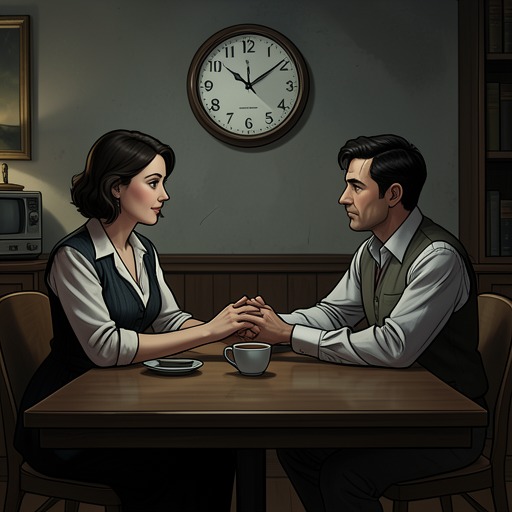
Their closeness becomes visible in the shared house. Alan holds Mary’s hand and stays close to her, while the other residents respond with a mixture of knowing approval, disdain, indifference, and coarseness. Russ reacts with particular anger. His response is sharpened by his previous involvement with Vera: he had regularly spent nights in her basement room, but one night found Paris there instead. Soon afterwards, he sees Alan and Mary coming down to breakfast hand in hand. The sequence links Russ’s resentment to a change in his own arrangements as well as to the newly public couple.
The narration also describes Russ’s envy of Alan’s literacy and his fixation on Alan’s hair and sexual adequacy. These private suspicions feed his brooding and thoughts of revenge, making the house’s intimate arrangements a source of rivalry rather than a private matter between Mary and Alan. Later, in the communal sitting-room, Mary sits on Russ’s lap. She has little sense of what she is expected to do and does not know whether the arrangement matters. Alan had tried to seat her on his legs, but his knees trembled so badly that she got up; Russ, by contrast, makes her feel physically settled. Russ disparages Alan, while Mary has no answer. The evenings repeatedly end in this uneasy arrangement, which the boys seem to enjoy and which Mary herself cannot explain.
Mary Sets a Boundary
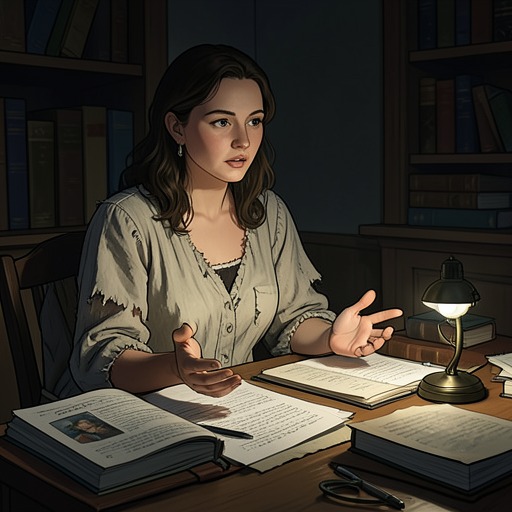
Mary eventually decides that Alan can no longer come to her bed at night. She has been waiting for him in the one part of the day she has to herself, and the smallness of that private interval helps make the decision concrete. When Alan arrives, she tells him she cannot have him in her bed any more and hopes he understands. His response is grief, but also an attempt to accept what has happened. He says he had hoped their relationship would continue without ever believing it would, and that he is glad it happened because Mary was the only beauty in his life. His words confirm how much the attachment has meant to him while making clear that Mary’s decision cannot restore a balance between them.
The breakup is not a declaration that Alan means nothing to her. After parting from Jamie, Mary thinks of love as a circle of people joining arms to protect one another. She imagines herself among those who would protect Alan and hopes he would also stand among those protecting her. The circle is imperfect, with broken links and people who have no one to hold; its value lies in the effort to become complete, not in any guarantee that it will be. Mary resolves to go directly to Alan and tell him this. The thought marks a change in her understanding of their relation: she can imagine care that is neither romantic possession nor a simple return to their former routine.
Alan’s Death and Mary’s Guilt
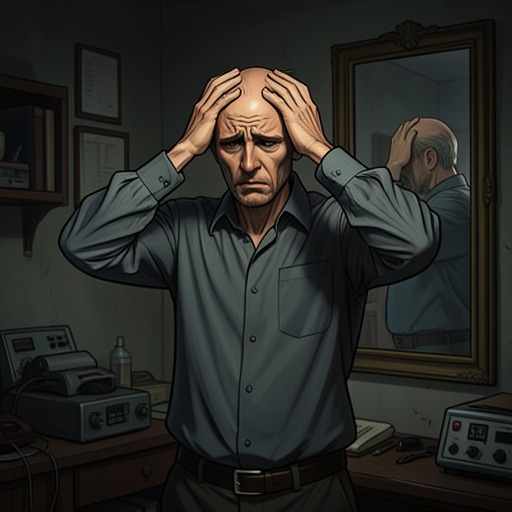
Mary does not reach Alan before discovering that he has died by suicide in his room. A note on the table is about his hair. The discovery follows her intention to describe a sustaining, if imperfect, connection, giving her newly formed understanding no opportunity to become a conversation between them. Alan’s death closes the relationship abruptly and leaves Mary to confront its meaning without him.
During the police inquiry, Mary struggles to explain what happened. She wonders whether Alan’s hair was responsible, as he had claimed, but doubts that explanation; she also thinks that she herself must have caused his death and writes that she did not mean to. Her account expresses confusion and remorse, not a settled explanation of the suicide. Russ accuses her of causing Alan’s death and not caring, deepening the pressure around her uncertainty. The relationship thus ends not with mutual understanding but with Mary’s unresolved guilt, Russ’s accusation, and the loss of the person whose devotion she had only begun to reinterpret as part of a larger, fragile circle of care.