Mary—Russ
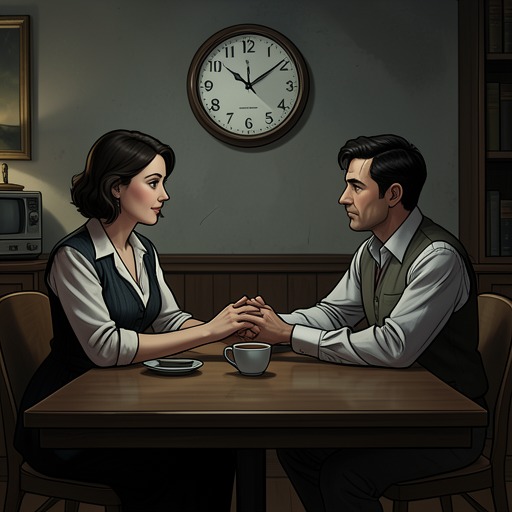
Other PeopleMary Lamb and Russ share a physically familiar but unresolved relationship that takes shape while Alan is pursuing Mary. Russ’s jealousy makes their closeness a rivalry with Alan as much as a connection between themselves, while Mary’s comfort with Russ’s attention coexists with confusion and unease. The narrative shows touch, play, possessiveness, and a promise made to Alan, but does not establish that Mary and Russ become a couple.
Formation and Rivalry
Russ’s anger intensifies after Alan and Mary appear together. Until recently, Russ had spent three or four nights a week in the basement with Vera. One night he finds Paris occupying Vera’s bed; the next morning, Alan and Mary come down to breakfast holding hands. The juxtaposition gives Russ a reason to reconsider his position among the housemates, and the sight of Alan and Mary together becomes the immediate focus of his resentment.
That resentment is tangled with admiration and insecurity. Russ is illiterate, and the narrative says he is covertly impressed by Alan’s ability to read and write. After an unpleasant remark from Vera, he also begins to doubt himself in comparison with Alan. Rather than dismissing the new couple’s closeness, Russ broods over it and imagines revenge. His response is therefore not simple dislike: Alan is both a rival and someone whose attributes Russ respects, an uncomfortable combination that sharpens his jealousy.
Alan’s attentions to Mary become conspicuous through the Sunday that follows. He stays close to her or holds her hand, and the other residents react in different ways. Russ, in particular, watches Mary with disgusted disbelief. Mary is bewildered both by Alan’s persistence and by the way other people read the relationship. When she asks Alan to forget what happened and return to how things were, he refuses that retreat, even while promising to do anything else for her. The triangular strain is already present: Alan insists on their attachment, Russ resents it, and Mary cannot readily say what she wants either man to do.
Familiarity and Unequal Positions
Russ and Mary’s physical ease contrasts with Alan’s difficulty approaching her. Mary knows Alan will try to join her in the garden, although she also understands that she does not want him there at that moment and that his attention increases her pity and weariness. She expects him to act because he loves her, while also thinking Russ may approach her if Alan does not. The contrast does not make her choice straightforward; it reveals how little control she feels she has over the situation’s momentum.
Russ’s familiarity with Mary is more casual and public. She has spent entire evenings sitting on his lap, and she acknowledges that it is comfortable. He can take the initiative without the visible hesitation that marks Alan’s attempts. When Alan tries to seat Mary on his legs, his knees tremble so violently that her voice quavers; she gets up and moves to Russ instead. Russ’s embrace makes the physical arrangement feel secure to her, but the ease of that contact does not settle what it means.
Their play also occupies an ambiguous space. Russ pinches and tickles Mary, and they spend about twenty minutes laughing and rolling about. Afterwards he leads her back inside by the hand. Mary enjoys his humour in the moment, yet her account of their closeness is not an account of a settled romance. She does not know what she is supposed to do about being placed on his lap, or whether the arrangement matters. The distinction between being comfortable with Russ and choosing a relationship with him remains unresolved.
Alan as Rival and Audience
Russ makes the rivalry explicit by belittling Alan in Mary’s presence. He points to Alan as a wreck and mocks his appearance, then turns to degrading boasts about his own masculinity and comparisons with Alan. The performance casts Mary as the audience whose approval Russ wants, and Alan as the man to be diminished. Russ’s earlier private insecurity thus becomes a public contest: he tries to make himself seem the more desirable alternative while forcing Mary to witness his contempt for Alan.
Mary does not answer Russ’s attack with an endorsement of either man. When Alan stands before her with an outstretched arm, she takes his hand partly to stop it shaking and leaves with him. That gesture is practical and immediate; it does not erase the ease she has shown with Russ, but it gives Alan a form of care at the moment Russ is humiliating him. The contrast leaves Mary caught between two kinds of attention: Russ’s confident, physically playful familiarity and Alan’s anxious, vulnerable attachment.
Promise and Aftermath
The uncertainty persists into Mary’s conversation with Alan. He asks her not to start anything with Russ, and she promises that she will not, even swearing on her mother’s life when he presses her. The promise confirms that Alan sees Russ as a real threat to their bond. It does not, by itself, prove that Mary and Russ have begun an affair; rather, it gives clear form to a possibility already suggested by their repeated closeness and by Russ’s attempts to displace Alan.
After Alan’s death, Russ’s relation to Mary turns sharply accusatory. As she writes an apology, Russ says that he cannot write, points at her, and blames her for Alan’s death, insisting that Alan was only twenty-one and that she does not care. The earlier rivalry is no longer a contest for Mary’s attention. It becomes a judgment delivered against her at the moment she is already expressing remorse. Across these scenes, the relationship’s defining feature is its instability: Russ can be a playful and physically comfortable companion, a jealous competitor, and, after Alan’s death, an accuser. Mary’s willingness to sit close to him never resolves that instability or removes her uncertainty about what their closeness means.