Mary’s Detention After Alan’s Death
Other PeopleMary’s Detention After Alan’s Death is a period of forced passage from the aftermath of Alan’s suicide into institutional custody, where Mary Lamb / Amy Hide is questioned, confined, examined, and given medication before Prince gets her out. The episode turns grief into procedure: first Mary must make a statement, then she is carried through a sequence of rooms and vehicles in which other people determine what happens to her.
The inquiry after Alan’s death
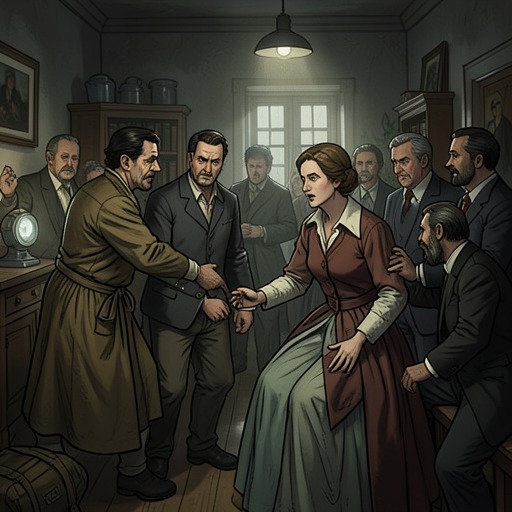
The first demand made of Mary Lamb / Amy Hide after Alan’s suicide is that she give an account of it. A policeman, uncertain and apologetic about the task, tells those present that speaking is not compulsory but begins organizing statements from the residents of the squat. He initially tries to take their accounts individually; after hearing Paris and Ray give substantially identical descriptions of finding Alan, he distributes paper and pens instead. Mary sits at the long table among Russ, Ray, Paris, Vera, Charlie, Alfred, Wendy, and Norman, with no idea what she will write.
The process is interrupted when two uniformed men carry a stretcher downstairs. Russ gets to his feet, drops his pen, and accuses Mary of having caused Alan’s death while insisting that Alan was only twenty-one. His words are a grief-stricken accusation, not an established finding about Mary’s responsibility. The inquiry offers no immediate resolution for her: it is followed by an abrupt change from the shared room and written statements to a journey through the city and a series of custodial settings.
Confinement and loss of control
Mary’s journey lasts several days. She rides the Underground repeatedly, including the Circle Line, whose circular route makes her feel dizzy without taking her anywhere. She walks through Piccadilly and Leicester Square, sleeps in a crowded room, and leans against a wall beside other girls. Two men approach and ask if she is free; she refuses both, and they leave. These brief encounters occur within a stretch of time that Mary experiences as divided into boxes, each bringing another imposed transition.
A van takes her to a place where she must empty her pockets and bag and submit to an examination of her belongings. She is locked in overnight with a woman who repeatedly weeps and gets up to use the pot beneath her bunk. The next morning Mary is made to undress and is examined by a woman, an act whose authority Mary does not understand. Another van carries her to a white ward shared with other women, whose shouting and calling continue through the night. The passage gives no formal account of the decisions behind these transfers; it instead follows Mary through their concrete effects and her limited ability to question them.
Her possessions are returned in a brown envelope, together with yellow pills that make the present seem more distant. She spends an extended period moving between a garden and a green room where lights and faces flicker. The account does not specify a diagnosis or explain the precise legal status of her confinement. It does show a sustained loss of ordinary choice: other people search her, examine her, medicate her, and decide where she may go.
Release and its immediate aftermath
Prince eventually arrives and gets Mary out. The institution has to admit him and allow him to take her away, making his intervention the turning point in a sequence Mary could not end by herself. In his office afterward, he remarks on her changed manner and notices that she has begun smoking. Mary has learned the habit during the preceding days, from the people around her, and values the occupation it gives her hands and mouth. Release therefore ends the confinement but does not erase its immediate effects: Mary returns to Prince with a new habit acquired inside it and with the present still something she has been trying to keep at a distance.
Memory, addiction, and the language of explanation
The novel places Mary’s custody within a wider set of arguments over how altered states are named. Earlier, Mrs Botham tells Mary about a woman from the clinic who suffered a blow to the head and could remember almost nothing, including her husband and children. Gavin Botham dismisses the episode as drunkenness; Mrs Botham insists it was amnesia. Their disagreement offers Mary an example of memory loss being interpreted through competing explanations, though the account does not establish that it causes or determines the later treatment of Mary.
The Botham household also makes addiction a contested identity. Gavin calls Mrs Botham an alcoholic, Mr Botham describes her as an ex-alcoholic, and Mrs Botham rejects the idea that alcoholism can be left behind. She recalls drinking dangerous household and medicinal substances before declaring sobriety her highest value; Mary, meanwhile, recognizes that Mrs Botham is drunk as she repeats her account. The narration broadens this conflict into a general reflection on drink as an escape from being oneself, while acknowledging that drinkers have different reasons for drinking. Set beside Mary’s journey through custody, these scenes distinguish the stories people tell to classify a person from the experience of being subject to others’ decisions. The detention is rendered less as a resolved medical or legal explanation than as a sequence in which Mary’s own account and agency remain sharply constrained until Prince intervenes.