Mary’s detention over Alan’s death and release by Prince
Other PeopleMary’s detention over Alan’s death and release by Prince turns a demand for a statement into several days of disorienting confinement, then releases her into a life from which both her job and her squat have disappeared. The sequence joins uncertainty about Alan’s death to Mary’s vulnerability before institutions and other people: John Prince can get her out, but he cannot return what has been lost or make her next destination certain.
The statement and the journey into custody
The first consequence Mary faces after Alan’s suicide is the requirement to make a statement. The policeman overseeing it calls the process a formality, says she is not obliged to speak, and admits that the matter is not really his province. His hesitations offer little clarity or reassurance. Mary sits across the table from Russ, whose face is wet, and cannot decide what to say.
The scene also makes the question of responsibility press upon her without resolving it. As two uniformed men carry a stretcher downstairs, Russ stands, drops his pen, and accuses Mary of having caused Alan’s death and of not caring. He stresses that Alan was only twenty-one. His accusation is not established as fact; it is what Mary confronts amid the immediate aftermath, when the official request for a statement and a friend’s condemnation leave her with no clear account to give.
What follows is rendered not as a single, clearly explained legal procedure but as a journey lasting several days. Mary rides the Underground back and forth, including the Circle Line, which seems to circle without taking her anywhere. In the city she walks through Piccadilly and Leicester Square, sleeps in a room crowded with strangers, and leans against a wall beside other girls. Two men ask whether she is free; she shakes her head, and they leave. These encounters belong to the same unsettled interval, in which movement through London does not amount to escape or direction.
Confinement and institutional scrutiny
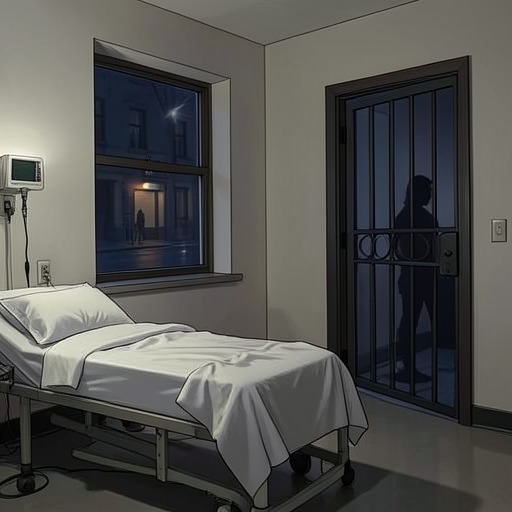
The journey narrows into successive enclosed places. Mary rides in a van to a place where she must empty her pockets and bag and submit to an unspecified scrutiny; she spends the night beside a girl who repeatedly cries and gets up to use the pot beneath her bunk. In the morning, Mary is made to undress while a woman examines her. Mary does not know by what right the woman does so. The absence of explanation is part of the experience: other people set the terms, and Mary is left without an account of the authority being exercised over her.
After another van ride, she sleeps among a row of women who yell through the night. A woman beside her repeatedly calls her hard and unkind, though Mary already knows the accusation. The scene gives confinement a social as well as physical pressure: Mary is surrounded by other distressed people, yet their proximity brings neither understanding nor comfort.
Her possessions are eventually returned in a brown envelope, accompanied by yellow pills that make the present recede. Mary spends a long, unspecified period in a place where she can walk in a garden or sit in a green room, with lights and faces flickering continually. The account does not explain each institutional stage or give a precise timetable. Instead, the repeated van journeys, searches, examination, sleeplessness, and pills make the interval feel like a sequence of imposed containers, in contrast to the circular but open movement through the city.
John Prince’s intervention and the case against Mr Wrong
John Prince finally comes to get Mary out. In his office, he remarks on her changed manner and notices that she has taken up smoking. Mary has learned to smoke during the preceding days under the instruction of the disturbed people around her. She likes the activity because it occupies her hands and mouth, especially her mouth; the gesture offers a small, immediate occupation within circumstances she cannot control.
John Prince then tells her that Mr Wrong has recanted. Mr Wrong, identified as the author of the confession to Mary’s murder, now says he did not do it. The reversal destabilizes the certainty that might have seemed to follow from his earlier confession. John Prince explains that Mr Wrong had said he committed the murder because Mary asked him to, and Mary’s tears fall onto her lap and cigarette as she listens. The news does not settle her circumstances: Mr Wrong is still imprisoned, and John Prince says the authorities waited because he still had time to serve and they wanted to catch him for another offense.
The information arrives alongside a second, more immediate loss. John Prince tells Mary that her job is gone and that her squat has also disappeared, explaining that trouble at such a place has consequences. He says there is nowhere for her to go and that she seems to have used up her good luck. His ability to release her is therefore sharply limited: the intervention ends her confinement but cannot restore her work, shelter, or security.
A precarious release and a new destination
Mary remembers that Jamie had told her she could call and come over at any time. John Prince puts a telephone in front of her and challenges her to make the call. Jamie answers readily and agrees that she can come. His welcome contrasts with Mary’s recent experience of official uncertainty and social accusation: the narration observes that, whatever else people had done to her, they had not lied to her. Mary sees John Prince, seated opposite her, as the one person in the immediate situation who is engaged in deception, a judgment sharpened by the news and losses he has just delivered.
The call does not erase the unsettled consequences of the detention. Jamie asks what will happen to Mary’s belongings, and she blushes at the question. Even the practical business of moving on remains awkward and unresolved at the moment of release. The action thus ends not with vindication or a recovered home, but with a place to go offered by Jamie and the next problem already in view. Its central reversal is limited but real: Mary passes from institutional confinement into a possible refuge, while the circumstances that made her vulnerable remain in place.