Mary’s visit to Michael Shane
Other PeopleMary’s visit to Michael Shane turns her search for Amy Hide from a question of identity into an encounter with someone who remembers Amy as a person: talented, volatile, and capable of an unexplained cruelty. Michael’s recollection offers no neat explanation, but it gives Mary a concrete fragment of the childhood friend she is trying to recover.
Seeking Michael’s account
The contact begins with Mary asking to speak to Michael. She had stayed up late the previous night to watch him on television: introduced by brooding guitar chords, he sat on the edge of a squeaky black armchair while three panelists occupied conspicuously high stools, and a large screen displayed his recent exploits. Michael and the panelists grew angry with one another during the discussion; the programme ended while they were still gesticulating. Mary thought he had acquitted himself remarkably well, especially since he seemed only about twelve.
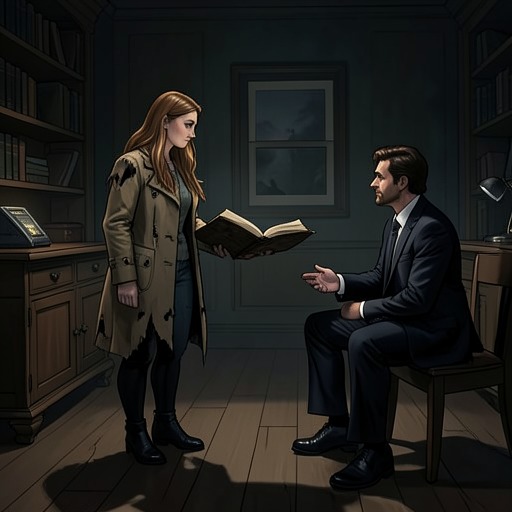
When Michael’s assistant says he is going into conference, Mary gives her reason for calling: she wants to talk to him about Amy Hide. The conversation that follows makes clear that the request is personal, not simply an inquiry into the public case. Mary tells Michael that she knew Amy as a child, then went to live somewhere else and heard nothing from her until the events that brought Amy back into her life. Although Mary has looked into their family connection, she changes how she presents herself, straightening her cardigan and trying to appear quieter, milder, and more sane. Michael says she looks more like Baby, then asks what she wants to know. Mary asks what Amy was like.
The story of the play
Mary presses Michael to tell her the worst thing Amy did. He examines her for several seconds before agreeing, and his manner suggests that this is a story he may not have told before. He recalls writing a play throughout the year he was with Amy. Its central figure seemed to have everything while, in Michael’s view, lacking something essential. He was revising the manuscript in a borrowed country cottage where they were alone, and he had no copy.
One day Amy locked herself in his study. Michael heard paper being moved around and heard her say through the door that she was going to burn the play. Her voice seemed mad to him, unlike her usual manner. As the fire crackled, he pleaded with her to stop. She began reading passages aloud in a terrible imitation of his voice, continuing for an hour as smoke and ashes came under the door. When she finally let him in, the play was gone, the grate was overflowing, and Amy pointed at him and giggled. Mary apologizes without meaning to, responding to the distress in Michael’s account before she can shape that response into a deliberate choice.
What the visit reveals
Michael’s memory gives Mary an episode rather than a diagnosis: Amy destroyed the only copy of a year’s work, made Michael listen as she mocked it, and offered no reason for what she did. He even cautions Mary that the story has a trick in its tail, leaving the account unresolved at this point. The absence of an explanation matters. Mary is asking for a description of Amy, but what she receives is a contradiction—an intimate recollection of a girl whose actions could be frightening and whose motives remain inaccessible.
The scene also sets Michael’s public composure against the vulnerability of his private testimony. On television, Mary watched him hold his own in an angry discussion; while recounting the cottage episode, he stops looking at her, and wretchedness shows on his young face. His story cannot restore Mary’s missing past, but it makes that past less abstract: Amy was someone remembered by another person, and the memory is painful enough to alter the mood of the conversation.