Michael Shane
Other PeopleMichael Shane is Amy Hide’s first love, a successful public figure whose polished television image contrasts with the vulnerability of his memories of her. His meeting with Mary Lamb turns into an account of love, heartbreak, and a play Amy destroyed; the narrator then revises that account, showing that Michael’s version protects him from the full force of what happened.
Identity and Introduction
Mary first encounters Michael again through television. He has recently returned from Ethiopia with a two-part report, and the screen presents him in a carefully posed photograph: chin resting on his knuckles, his gaze patient and serious. The public image prompts a private recognition. Remembering Prince’s suggestion that she think about photographs in her old room, Mary recalls Marge identifying the young man as Michael and remembering him as thoughtful. The sequence links the reporter on television to the person in Amy Hide’s past before Mary has spoken with him.
The distance between broadcast and life narrows when Michael answers Mary’s call. She introduces herself as Mary Lamb, a cousin of Amy Hide’s, and says that she wants to talk about Amy. Michael recognizes the name immediately and describes Amy as his pet topic, inviting Mary to meet. For Mary, the conversation demonstrates that television is not wholly a world on the other side: a voice and a remembered person can still be reached through its apparent distance. Michael’s readiness to talk makes him a route into Amy’s history, though what he can offer is shaped by his own perspective.
Amy Hide and the First Love
At their meeting, Michael calls Amy his first love in every sense and says that she broke his heart. He insists that the good parts remain unforgettable as well as the pain. His remembered Amy is funny, exciting, expressive, wild, and passionate; he pauses over that portrait in a reverie before the telephone interrupts. The affection in his account is genuine, but so is its rehearsed quality. Mary senses that he has told this story many times and used it many times before, suggesting that Amy has become a familiar part of the story Michael tells about himself.
When Mary asks what Amy did that was worst, Michael examines her before agreeing to tell her. His manner changes: he stops looking at Mary, and misery becomes visible in his face. The narrator observes that this part seems less rehearsed than the rest, and that in the moment Michael appears his real age. The contrast distinguishes his practiced reminiscence from a more painful memory he has not, or has not often, put into words.
The Play and the Burning
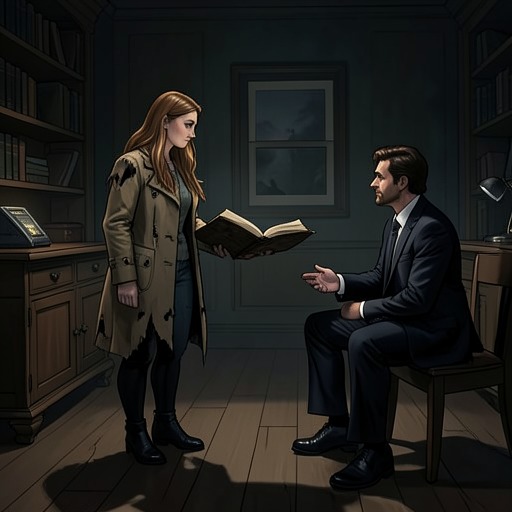
Michael recounts writing a play throughout the year he was with Amy. It concerned a man who seemed to have everything but, as Michael begins to explain, did not; Michael later identifies its title as The Man Who Had Everything. He describes borrowing a country cottage to read through and correct the script. One day Amy locked herself in his study. Michael banged on the door while she said she would burn the play. He says she knew there was no other copy and recalls hearing the fire as she read passages aloud in a terrible, distorted version of his own voice.
The episode lasts an hour in Michael’s telling. Smoke and ashes come under the door; when Amy finally lets him in, the play is gone, the grate is overflowing, and she points at him and giggles. The account makes the destruction both an assault on his work and a disturbing performance staged for him: the pages are not simply burned but read aloud before they disappear. Michael presents the act as inexplicable and Amy’s voice as unlike herself. His recollection therefore conveys the shock of the event while leaving its meaning unresolved in his version.
Revisions and Narrative Significance
After Michael’s account, the narrator explicitly corrects two inaccuracies. First, Michael says that he thought he had gone queer for about a year afterward. The narrator says this is misleading: Michael did go queer and never returned to not being queer. The narrator further suggests, from personal dealings with Amy, that this was what she had been probing for in him. That reading gives the episode a significance beyond romantic injury, while remaining the narrator’s interpretation rather than Michael’s stated understanding.
The narrator also corrects Michael’s claim that he burned the play a week after Amy’s destruction of it. The play was indeed burned, but Amy made him do it; Michael did not want to, and she made him. This changes the remembered sequence from one in which Amy destroys the script and Michael later disposes of it himself into one in which she compels the final act as well. The correction exposes the limits of Michael’s self-account: its emotional truth does not make its details reliable. When the telephone interrupts his story and Jamie arrives, Michael ends the meeting politely, turns his attention back to pink paper, and asks Jamie to see Mary out. His brief encounter has supplied a vivid memory of Amy, but the narrator’s intervention makes clear that it cannot stand as the complete or unchallenged account.