Nothing to do and "need not"
Other People“No need” describes more than idleness: it is a condition in which activity continues but its urgency or purpose seems to have fallen away. The idea connects the flat where Mary lives with the novel’s contrasts between paid work, poverty, and inherited wealth. It also unsettles the assumption that freedom from necessity is simply good. For some, it means keeping time from the market; for others, it becomes a source of passivity and unease.
Work, Time, and Refusal
The novel first sets this idea against the tramps, whose lack of money is linked to their refusal to sell what others sell: their time. They retain that time, but their choice does not free them from thinking about money. Their way of life therefore holds two conditions together: resistance to the ordinary exchange of labor for money, and continuing attention to the resource they lack. The narrative presents their refusal neither as uncomplicated liberation nor as mere deprivation; it is a different, increasingly common arrangement with its own costs.
A brief encounter makes money’s immediate uses visible. When Sharon finds two scraps of paper, she considers what they might buy, weighing drinks before Mary agrees to get spirits. The money is not an abstract marker of class here: it is a means of choosing what to consume at that moment. Later, while staying with the Botham family, Mary learns to notice bargains and takes pleasure in how money can be saved even while it is spent. Mrs Botham, by contrast, repeatedly rails against money. Their difference shows that money acquires meaning through circumstance: for Mary it offers practical possibility and a small competence; for Mrs Botham it remains an object of resentment.
The Flat and the Meaning of Doing Nothing
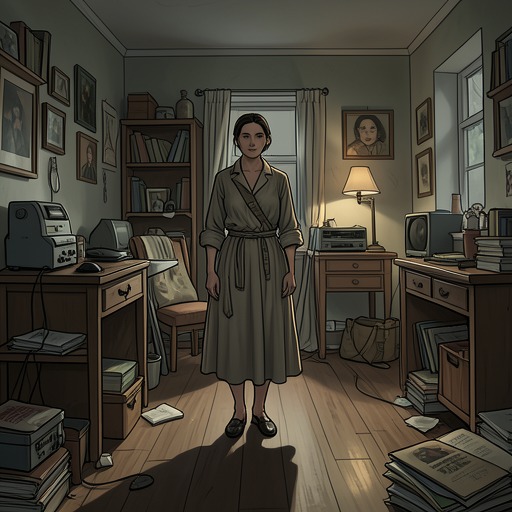
In the flat, the distinction between being active and doing something consequential becomes the concept’s central paradox. Mary comes to understand that the residents do things, yet do not seem to do anything; they are neither wholly inactive nor engaged in purposeful action. Her explanation is stark: there is no need. The phrase does not describe an absence of all demands. Lily, for example, gives much of her time to Carlos, who needs her attention as he learns to walk. Rather, the flat’s atmosphere suggests that the residents lack a larger imperative directing their lives, even as particular needs and routines persist.
A man in the flat turns this condition into an argument: since nobody does anything and nobody is going to do anything, he reasons, they might as well do something else. The logic converts inaction into permission, but it does not supply a purpose beyond the immediate alternative. Mary’s recognition that the household includes others who likewise do not do anything makes the condition seem shared rather than a single person’s failing. The repeated insistence on there being no need gives the phrase a double edge: release from pressure can also leave people without a reason to move.
Poverty, Wealth, and Unequal Necessity
Mary’s changing understanding of poverty clarifies that material hardship and the experience of necessity are not evenly distributed. She had thought life itself was poor; she comes to see that it need not be poor in that way. Money appears to offer access to a fuller life, yet what she says she wants from the well-kept is their time, not their money. The distinction returns the discussion to time as something people can possess, spend, or be denied, rather than treating wealth as a simple solution to poverty.
Jamie embodies a different side of “no need.” He does not work now, though he once took jobs, including one for Michael Shane. The money he has was already waiting to become his; he did not earn it. The novel links this inherited security to a world in which things move too slowly and in which the rich have their own terrors. His position is not the tramps’ refusal to sell time: it is the privilege of having money without earning it. Both situations stand apart from ordinary wage labor, but for opposite reasons, and the contrast makes clear that freedom from work does not guarantee freedom from unease.
At Christmas, Jamie explicitly recognizes the practical shelter his money provides. He gives Mary notes to spend and says their money makes it fortunate that they have it, while also expressing dread of the holiday and expecting to drink. The scene complicates the notion of abundance as ease: money can meet immediate needs, but it does not dissolve Jamie’s fear or make the season welcome. “No need” thus names neither a uniform class condition nor an uncomplicated comfort; its meaning changes with the resources and anxieties surrounding it.
Books and the Buyable Present
Mary’s reading adds a cultural dimension to the idea. She discovers that books are about the living world of power, boredom, and desire, and that the books she has taken for ideal or morally spacious are not set apart from ordinary life. They, too, belong to the buyable present. This recognition parallels the novel’s treatment of money: neither books nor wealth exist outside the social world that gives them value and limits what they can offer.
The motif ultimately refuses to equate having no task with having no constraints. The tramps keep their time but lack money; Mary learns to value small economies while longing for time; Jamie possesses money without having earned it, yet remains troubled. In the flat, meanwhile, people can be busy with immediate routines and still experience no larger need to act. The phrase gathers these differences into a single tension: necessity can press people into labor, but its apparent absence may leave them without direction.