Park
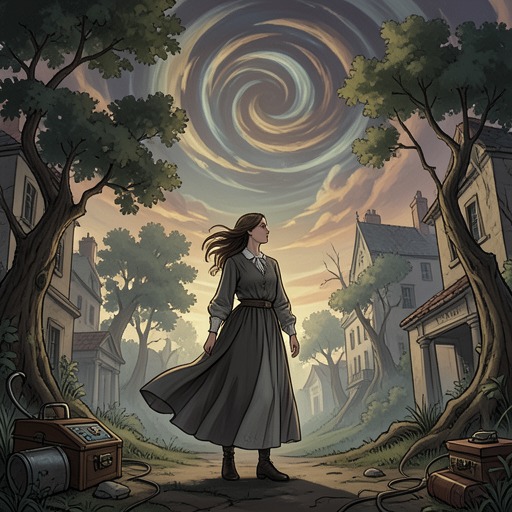
Other PeopleThe Park is a recurring setting in which solitude and connection come into sharp contrast. Its water and paths first give Mary Lamb a way to imagine belonging to a couple; later, its misty center becomes the setting for a small gesture of intimacy with Jamie. In the final scene, the Park is where Amy Hide sits apart from the world, experiences an overwhelming recognition of its independent beauty, and is joined by Prince.
Paths, Water, and the Possibility of Belonging
Mary walks through the great Park on a route she has memorized from Norman’s book of graphs, though she eventually lets her mental notes blur and asks other people for directions. The route takes her through an inhabited public landscape: solitary people linger with newspapers near the entrances and exits, while people with families or lovers venture farther in. The arrangement gives the Park a social geography, dividing those who appear alone from those who move through it in pairs or groups.
Mary watches couples and wonders what it would be like to belong to one. The pair circling the water at the Park’s heart seems to embody an intimacy built from simple presence: being together, rather than elsewhere, and being themselves, rather than someone else. Their ease sharpens Mary’s memory of being with Alan. She had never felt part of a couple or of anything in that relationship; their sexual encounters had involved pain, and they had not lightened one another’s burdens. Yet her concern for Alan remains: as she imagines the closeness she has missed, she hopes he will be all right.
The Park as a Place of Approach
The Park returns as a quieter, more personal setting when Jamie walks Mary halfway home, as far as its misty heart. Calm again, he asks whether she minds holding hands, and she agrees. The moment is modest, but its directness contrasts with the painful, unreciprocated sense of couplehood Mary has associated with Alan. Here, the question is asked and answered; the Park’s center marks a tentative movement toward mutual contact rather than an intimacy endured without shared ease.
The Flat Park and Amy’s Release
Much later, Amy sits on a bench in the flat Park. An old man bothers her perfunctorily, then leaves off almost as quickly as he began. Amy remains still as the afternoon changes: colour drains from the grass, and the green expanse takes on the look of a milky lake beneath a blank sky. The open setting does not collapse into a private possession. Instead, Amy feels that the trees, distant rooftops, and sky are pressing toward her while remaining separate from her, and finds beauty in that separateness.
The experience turns toward death and release. Amy feels dead, judges that life is not too short but too long, and believes she has lived enough. Prince sits down beside her, breathing fast and rhythmically, and apologizes. Amy tells him that everything is all right now. In the Park, the earlier image of couples sharing a place gives way to a different form of relation: Amy’s recognition that the world is not hers to own, followed by Prince’s arrival beside her.