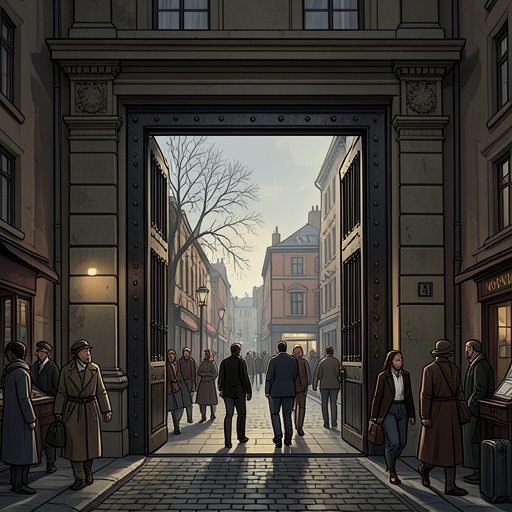
Prince takes Mary on a tour of London and explains the Amy Hide case
Other PeoplePrince takes Mary on a night tour of London that changes the scale of what she thinks she knows. He directs her attention from street scenes to the city’s hidden infrastructure and stark inequalities, then uses their journey to explain the Amy Hide case. The tour ends not with a solution but with its central absence: a confession to murder without a body, and Mary’s unsettling questions about whether the murdered can be punished and what law takes from those who break it.
The city as evidence
The tour begins with Prince pointing Mary toward an open doorway across the street. A man comes out hurriedly, followed by a woman who tries to stop him; another woman intervenes, and the two women embrace after the man leaves. The episode remains unexplained. Prince treats it as one of the strange things to be found in the city, establishing a method for the night: Mary is asked to look, but not every scene comes with an account that settles what it means.
The journey soon makes a larger impression on her. She had not understood the city’s divisions or the scale of its energies and material abundance. Watching with Prince, she begins to see that circumstance and origin matter beyond an individual’s private experience; the city’s different lives are bound up with a wider social balance. The tour therefore works as more than a sequence of unusual sights. It alters Mary’s attention, making visible conditions she had previously treated as ordinary or irrelevant.
Money, infrastructure, and hardship
From a bar on the forty-fourth floor, Prince points out a red-haired girl in a pink dress with a wealthy man. He describes how an agency has charged him fifty pounds to bring her there, while she will receive five pounds or less for going out with men like him. A later arrangement may bring her a hundred or a hundred and fifty pounds for four or five hours at his hotel. She is expected to return afterward to her husband and children; Prince says the husband does not object, or cannot afford to object. The figures give the scene its force: the apparent price of an evening is divided sharply between the agency, the customer, and the woman whose time is being sold.
Beneath the streets, Prince unlocks a door in the ground under a bridge and shows Mary the pipes and cables carrying water, electricity, and gas. His large ring of keys suggests access to spaces normally concealed from passers-by, while the exposed lines make the city’s ordinary functioning look dependent on a buried system. The tour moves between visible people and unseen structures, connecting the social world above ground to the services running beneath it.
In a guarded compound near the airport, Mary sees a woman carrying a bundle of sticks and a crying baby through a crowded dormitory. Prince explains that the woman pinches the child to make him cry louder for money and also as punishment associated with belief in previous lives. His account joins immediate deprivation to an explanation that assigns moral meaning to suffering. It offers no comfort or resolution; instead, it leaves Mary facing how hardship can be interpreted through beliefs about a life beyond the present one.
Another sight is a naked man in a dark street, weeping as he burns banknotes with a lighter while bystanders watch. Prince calls attention to the apparent mismatch between the man’s conduct and the idea of being well-adjusted, then wonders what could have brought him to this action. The episode echoes the tour’s other scenes without explaining the man’s circumstances. Mary is shown not just poverty or commerce but a public act whose causes remain unknown.
Chinatown and Mary’s changed perspective
Prince and Mary eat in a vast restaurant spanning a city block in Chinatown, where thousands of Chinese diners are present. Mary has previously treated nationality as no more significant than physical traits or luck. Here, that assumption shifts: she recognizes that where people come from matters both to them and to the wider balance. The crowded meal makes that recognition part of the tour’s movement from observation to altered understanding.
Mary has eaten little but feels too full to eat more. The narration connects this physical fullness to the pressure of the present: experience itself can be more than she can take in. The moment prepares the turn from the city’s many scenes to the case Prince has brought her to understand. Before explaining it, he asks whether she is ready to begin, and Mary agrees.
The Amy Hide case and the meaning of time
Prince asks how much Mary knows about Amy Hide. Mary says the photograph has been enough. Prince explains that investigators know something about the sort of things Amy did and the people she was with, and that she went too far one night, but the circumstances remain uncertain. The case reverses the usual order of a murder investigation: instead of finding a body and searching for the murderer, the investigators have a man in a cell who has confessed and explained what he did, but no body to find. The unresolved question is where Amy Hide is.
Prince also tells Mary that investigators have found no records to establish whether Amy had dental trouble or had seen a doctor. He asks Mary to show her teeth; she does so, feeling detached from the gesture, but he says their appearance provides no help. The examination makes the search for identity concrete while emphasizing its limits: a possible resemblance or bodily clue cannot supply the missing records or establish what happened to Amy.
Mary asks whether it is a crime to be murdered and whether a victim can be punished. The question startles Prince, who asks why she said it; Mary says she only wants to know. After he tells her she will see, she asks what someone gets for breaking the law. Prince answers that the result is time. Asked what someone gets for murder, he answers life. The exchange turns the city tour toward the case’s unresolved stakes: the state can hold a confessor in a cell, but the absent body leaves the victim’s fate uncertain. Mary’s questions make that absence more than a procedural problem, connecting it to punishment, duration, and her own uncertain place in the story.