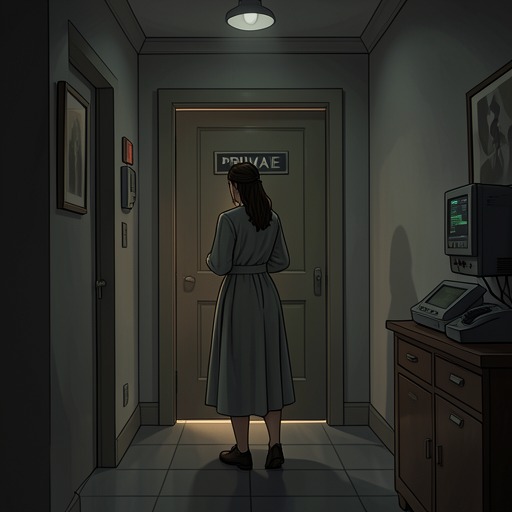
Prince's house
Other PeoplePrince's house gives Amy Hide a place to inhabit after a life of instability, but it is not merely a shelter: its ordered routines make domestic life newly legible while leaving room for solitude, memory, and uncertainty. The house is presented through ordinary gestures—a fire watched in the garden, tidying in the sitting room, shared breakfasts, and a bed in which Amy wakes beside Prince. Those details establish a home whose calm is real but never entirely separate from the past or from the world outside.
Setting and Domestic Space
The house includes a square garden, a walled path leading towards the road, a kitchen reached by a creaking door, an ordinary sitting room, and Prince's bedroom. In the garden, Amy stands in wellingtons, jeans, and a man's blue sweater, watching rubbish burn. The neighbours' cat, David, slips through the kitchen door and into the house; Amy looks up at the sky and begins to hum as smoke rises from the fire. The scene places her within a domestic environment, but its open sky and burning rubbish keep the image from being purely settled or decorative.
The house belongs to a larger, carefully planned dormitory town: a remote, pleasant but fallen world where Dogs and Cats move among people on equal terms, cars yield to them in the right-angled streets, and small patches of grass divide the hedges. Prince has shown Amy the town's considered precincts and mezzanines. Its amenities suggest a place designed to contain everyday needs, even as its residents commute elsewhere to work. The house is therefore both a private refuge and part of a wider landscape organized around sleep, routine, and the daily journey to London.
Household Routines and Money
Prince's daily schedule gives the house its rhythm. He rises at seven without fail, and Amy gets up partly for his company and partly to share the breakfasts he makes. In the morning he reads aloud from the newspaper delivered by a boy, selecting accounts of greed, spite, and folly and commenting on them in a manner that unsettles the apparent distinction between good and bad. As the light comes up, he drives away to join the queue for London. Amy washes up and prepares to face the day in the house without him.
Prince gives Amy a weekly sum for housekeeping. She takes an active interest in what money can do, testing it against the world of things that can be bought. Although people in shops and coffee-bars speak bitterly about money, she considers it versatile: it can be spent, saved even while being spent, and enjoyed whether it is used or held back. Her perspective is informed by having had both too little and too much money in the past. The household allowance is thus not just a practical provision; it gives her a way to think about choice and material life on her own terms.
In the evenings, the house becomes a shared but uneven space of leisure. Amy does most of the reading while Prince does most of the listening; they also listen to music and sometimes watch television. Prince's wish to watch television without needing a particular programme gives their routine a deliberately undirected quality. When they watch Michael Shane reporting from places where the world is on fire, Amy tells Prince that Shane is an old flame of hers. The domestic setting receives the past as a fact she can disclose, rather than sealing her off from it.
Waiting, Intimacy, and the House's Limits
When Prince returns, Amy is often reading on the sofa with her legs tucked up, occasionally looking across the quiet road at the toy-town houses opposite. She hears his car, looks away, and continues reading because she does not want him to think that she has spent the whole day waiting for him; the narration also insists that she does not. The small performance of not waiting marks a boundary within their closeness. Prince comes in, puts his briefcase on the armchair, unbuttons his overcoat, and greets her. The house supports their companionship without making Amy's day reducible to his return.
A later scene shifts from the ordinary sitting room to Prince's bedroom. Amy wakes in the dark, exhausted after little sleep, and recognizes that she is in Prince's bed. Prince is sitting naked at its edge, shoulders bunched, and she can see from his forehead that he has been watching her for a long time. He asks how she is feeling. The moment makes the bedroom a site of direct, bodily intimacy, distinct from the public routines of breakfast, commuting, and evening reading. The evidence leaves the exchange at his question, so the room's significance lies in the closeness and uncertainty it brings into view rather than in a stated resolution.
Narrative Significance
Prince's house gathers together a tentative domestic life and the unresolved history Amy carries into it. Its repeated actions—making breakfast, washing up, reading, listening, tidying—give time a dependable shape, while Amy's thoughts about money and her admission about Michael Shane show that she remains a person with a past and independent concerns. The contrast between the quiet house and the distant, burning places on television also makes the domestic world feel sheltered without suggesting that it is sealed away from wider experience.
The house's order is not presented as a cure or a final answer. Amy tidies reflexively even when there is little to tidy, and she resists being seen as someone who waits all day for Prince. Such details keep her agency visible inside a life partly structured by his routines and support. As the setting moves from garden to sitting room to bedroom, it traces different degrees of openness and closeness: Amy alone with the fire and sky, sharing ordinary hours with Prince, and finally waking beside him in the dark. The home matters because it makes those changes of relation and attention tangible.