Sharon
Other PeopleSharon is introduced as a striking, forceful woman whose first encounter with Mary Lamb is an act of protection. She helps Mary away from Neville and tends to her with practical familiarity, seeming to offer the friendship and care Mary needs. That promise is later betrayed: Sharon presents Mary to Trev as worth money. The reversal makes her significance lie not in a stable role as either rescuer or enemy, but in the painful gap between her protective gestures and her exploitation of Mary.
Identity and Introduction
Mary initially recognizes Sharon as someone like herself, a woman belonging to the same broad category of people on the margins. Sharon has been hanging back from the others, and Mary reads her as possessing a sense of exclusiveness and drama. Her size makes an immediate impression: Mary regards her as one of the largest people she has ever seen. Her red hair falls in unruly spirals, and her eyes are described as ice. This imposing appearance prepares for the physical confidence she displays when she intervenes.
Sharon’s first words to Mary are an instruction to get up and come with her. The directness is brusque, but it is followed by action on Mary’s behalf. When Neville makes another attempt to reach Mary, Sharon strikes him and drives him away. She tells him to leave Mary alone, calls her someone who needs a good friend to look after her, and challenges Neville when he continues grumbling. Her protection is not a quiet offer of comfort: she asserts it openly, in front of the people around them, and makes clear that she is prepared to defend Mary herself.
Protection and Care
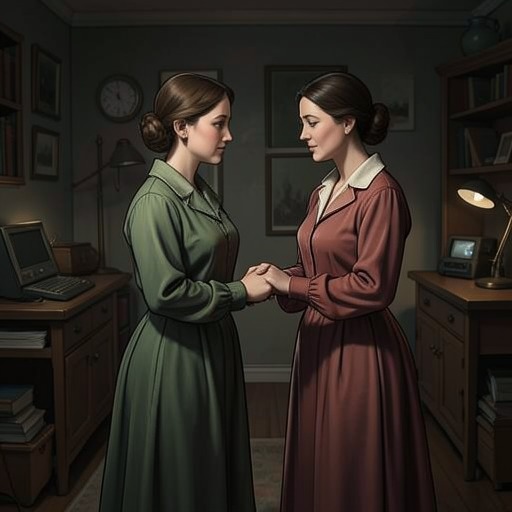
Once away from Neville, Sharon attends to Mary’s physical condition. She asks whether Mary’s back is injured and what kind of pain she feels. When Mary calls it a simple pain, Sharon responds with teasing disbelief, then reaches for her waist more gently than Mary expects. As she helps Mary out of her skirt, they see a complicated arrangement of bands and clips. Sharon recognizes that Mary has been through some kind of institution or treatment, though the precise circumstances are not established in this exchange. She judges Mary to be in a mess and helpless, and says that she needs looking after.
The care is specific rather than abstract. Sharon helps remove the bands, guides Mary through the movements required, and notices that Mary is crying. She tries to reassure her by presenting the procedure as something ordinary and by invoking a saying she learned from her grandmother: everybody is something, and even people who regard themselves as normal may seem queer. The saying gives her practical kindness a broader, rough-edged philosophy of difference. Sharon also compliments Mary’s appearance and says that she will take her away and get her fixed up. At this point, her words and actions create the expectation of safety: she has helped Mary stand, defended her from Neville, and taken responsibility for her immediate needs.
The Reversal with Trev
That expectation collapses when Sharon later turns Mary’s vulnerability into an offer to Trev. Trev remarks on Mary’s appearance, calling her like a film star. Sharon answers by saying Mary is worth a tenner and urges Trev to act, adding that she has cleaned Mary up and reminding him of an earlier promise involving Janice. The exchange presents Sharon not merely as failing to protect Mary, but as actively arranging for Trev to take advantage of her. Trev rejects the reference to money, while Jock makes a disparaging comment about Janice; neither response restores Mary’s safety.
The contrast with Sharon’s first intervention is stark. Earlier, she had framed Mary as someone who needed a good friend and protection from Neville. Later, the same Sharon describes Mary in terms of her monetary worth and her prepared appearance. The practical attention that once seemed to be care—helping Mary get cleaned up and dressed—now carries a darker implication because Sharon explicitly connects it to Trev’s interest. Her earlier assertion of authority over the men has not become sustained solidarity with Mary; it has instead made Sharon capable of directing Mary’s exposure to danger.
Conflict and Narrative Significance
Sharon’s characterization depends on this sharp change in the meaning of her actions. Her size, confidence, and willingness to confront Neville initially make her look like a reliable ally in a setting where Mary is physically vulnerable. Her later conduct shows that forcefulness alone does not guarantee loyalty: Sharon can use her power to shield Mary in one moment and to facilitate her exploitation in another. The story does not supply a settled explanation for the change, so her betrayal is best understood through what she does and says rather than through an assumed motive.
Later, in the Botham home, Mrs Botham reacts tensely to the possibility of Sharon’s arrival and says she will murder her if the person at the door is Sharon. This establishes Sharon’s name as a source of alarm in that household, though it does not by itself identify who arrives or establish Sharon’s part in the ensuing intrusion. The moment extends her threatening presence beyond Mary’s immediate encounter with Trev without resolving the circumstances. Across these scenes, Sharon’s role is defined by unstable protection: she can recognize Mary’s need, provide hands-on help, and confront a man on her behalf, yet she also treats Mary as something to be traded. That contradiction makes the promise of friendship itself uncertain.