Sky creatures
Other PeopleSky creatures are the recurring white figures that Mary Lamb / Amy Hide sees above the city, where they transform an ordinary sky into a shifting spectacle of beauty, menace, and uncertainty. Their changing outlines accompany both the apparent collapse of her surroundings and the routines of her daily life. The narrative gives them the presence of living beings without settling whether they are creatures, clouds, or something produced by Mary’s way of seeing; that unresolved status is central to their effect.
Appearance and Transformation
In one extended vision, the sky begins as a calm blue distance above steep canyons. The Sky creatures are white, fat, and sleepy, hovering, cruising, and basking in the air. Their leisurely movement belongs to a vast scene whose scale is already unsettling: slow-moving crucifix-like forms pass across them, and they seem to owe allegiance to a stormy yellow source of energy so bright that looking toward it hurts Mary’s eyes.
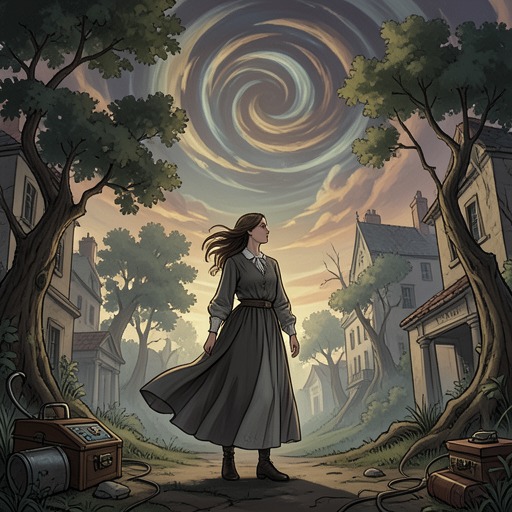
The scene does not stay calm. The creatures lose their outlines and drift upward, first making a white shawl across the dome of the air, then melting into an unbroken grey slope beneath the sky’s master. That source, too, changes: it loses its power and boils red. The transformations are presented alongside signs that the city is coming apart. People hurry in fear; familiar pigments seem to drain away; passages and high glass walls appear to change places; roadsters split and race away as ghosts. The sky’s alteration and the apparent disorder below it unfold together, making the creatures part of a world whose ordinary boundaries no longer hold.
Later in the same vision, after Mary has run beyond the remaining people and reached green land, the creatures have crept back beneath their spangled roof. They are now heavy and red, while the figure that had ruled above them appears sombre silver in a lake of darkness. This return is not a restoration of the earlier calm: the creatures reappear in altered colors and under an altered sky. As Mary hides beneath a leaning tree, convinced that death is coming, the air hums with iron and flame and the points of life go out one by one above the vampiric sky. The passage associates the creatures with an ending, but does not explain whether they cause it or merely form its terrible backdrop.
A Changing Sky in Daily Life
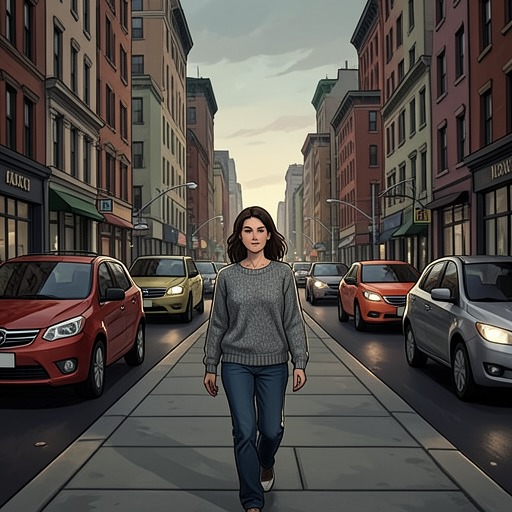
The figures also recur outside that crisis vision. On the streets, when Mary has no money and is looking for work, the Sky creatures are present above a markedly ordinary scene: children play, housewives carry their shopping, men stand idle near betting shops and closed pubs, a dog pants in the gutter, and ants move over the pavement’s cracks. Their presence spans the whole scene. Mary sees them as not having been left behind, even as she watches people whose days are shaped by work, goods, and money. Against this street-level detail, the figures make the sky seem like a constant presence in a life where she has time to sell but does not know who might buy it.
Their appearance shifts with the hour. On the way to work in the morning, the sky looks like heaven: the white beings ride a blue vault in yachts and galleons, or sun themselves in poses of ease and freedom. On Mary’s evening journey back to the hostel, they lose their outlines against the western sky. They form a steep red fault into the chaotic night, giving the same overhead world a hellish aspect. The distinction is not simply between two kinds of sky: the creatures themselves change from distinct, almost playful figures to a diffuse part of the darkening landscape.
That daily pattern has an exception. On bad days, Mary feels battered by thoughts of what she might have done with her life, and clouds prevent her from seeing the creatures at all. Their visibility therefore belongs both to the weather and to the emotional conditions through which she experiences the day. The text does not make the sky a mere reflection of her mood: it supplies concrete weather and color, while placing these appearances within her changing sense of possibility and regret.
Relation to Mary’s Perception
Mary’s encounters with the Sky creatures are intensely visual, but they are not described as detached observations. Their movement coincides with bodily unease and alarm. When the city opens into a great breezy rift, she feels her body hum and wants to run; the sight below resolves into a turbid, boiling expanse with birds wheeling above it. The scene does not identify those birds as the Sky creatures. Instead, it places Mary among several unstable forms of life and motion, where looking outward affects her physically and threatens the sense that the world is secure.
In the more catastrophic vision, Mary wonders whether the sky’s master is dying as it turns red, then sees changes below. That uncertainty matters: the scene offers a possible interpretation from within her perception, not a settled explanation of what the sky is doing. Elsewhere the figures can be observed during workdays and commutes, with the imagery of sails and sunbathing giving them a serene, almost leisurely character. Across these different moments, Mary does not receive a definitive answer about their identity. The same figures can seem autonomous and alive, or like shapes made legible by color, weather, and imagination.
Narrative Significance
The Sky creatures give the city a second, shifting register. Streets, windows, roads, work, and poverty belong to the visible human world; above them, the creatures supply images of distance, freedom, and vast change. Their calm morning forms offer an idealized counterpoint to the constriction of ordinary life, while their red evening outline turns the journey home into a passage toward darkness. When the sky becomes grey or the figures disappear behind clouds, that imagined alternative is temporarily inaccessible.
Their most dramatic transformation extends this function into terror. The creatures rise, dissolve, return in altered color, and occupy the sky while the world below seems to break apart. Yet the narrative withholds a final distinction between supernatural event and perceptual vision. The creatures are rendered as living presences, but their forms remain close to clouds and changing light. This hesitation lets them carry both wonder and dread: they are not a separate, explained fantasy inserted into Mary’s world, but a recurring feature of how that world appears to her, alternately spacious, beautiful, and close to collapse.