The Man Who Had Everything
Other PeopleThe Man Who Had Everything is the play Michael Shane wrote during his year with Amy Hide, and an object around which one of their most volatile episodes turns. First apparently destroyed in a fire Amy stages, it is revealed to have survived; Michael later burns it for real, though the narrator corrects his claim that this was his own decision. The play’s repeated destruction makes it a measure of the couple’s power over one another and of the difference between Michael’s remembered story and the narrator’s account.
Creation and Subject
Michael says he worked on the play throughout the year he was with Amy Hide. He describes its central figure as a man who appears to have everything but, in some unstated way, does not; his explanation breaks off before he completes the thought. Michael judges the work as probably poor, and the narrator later calls it conscientious and very mediocre rather than awful. The distinction matters: the play is not presented as a lost masterpiece. Its importance lies instead in how closely it is bound to Michael’s labor, self-regard, and relationship with Amy. Michael was staying with Amy in a borrowed cottage in the country when he read the play aloud and corrected it. He had no copy, so the manuscript seemed uniquely vulnerable. That circumstance gives Amy’s threat its force: the pages were not merely one version among several, but the only copy Michael says he possessed.
The Threatened Burning
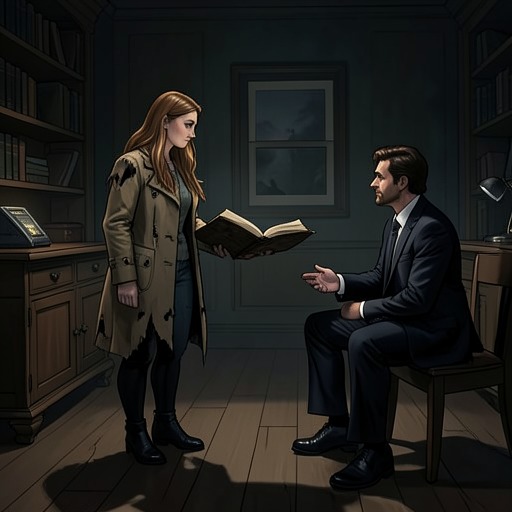
One day Amy locked herself in Michael’s study while he remained outside, banging on the door. He heard papers being handled and Amy say that she intended to burn the play. Michael recalls her voice as mad and unlike her usual manner, and says he could see no reason for what she was doing. Her threat placed the work—and the year of writing invested in it—beyond his immediate control. Amy began reading sections of the play through the closed door, adopting what Michael describes as a terrible version of his own voice. The episode continued for about an hour. Smoke and ash came from beneath the door, strengthening the impression that the manuscript was being destroyed. When Amy finally let him in, the room was difficult to see through, the grate was overflowing, and she pointed at him and giggled. Michael believed the play was gone.
Survival and Reconciliation
The apparent destruction was a deception: Amy had burned blank paper, while the play itself was in another room. She told Michael this after they had fought physically for about an hour and were both too exhausted to continue. Michael recalls lying there in distress when she disclosed the trick; his immediate happiness at finding the manuscript intact sharply reversed the scene’s apparent outcome. The discovery did not simply end the conflict. Michael says they got drunk and went to bed, and remembers the episode as an intense, exhilarating interval that he took for a form of living. He later judged that feeling differently, distinguishing it from life without specifying exactly what he meant. The sequence joins threat, exhaustion, relief, and renewed intimacy, making the manuscript’s survival the pivot between apparent loss and reconciliation.
The Play’s Actual Destruction
Michael tells Mary Lamb that he burned the play a week later and that his relationship with Amy ended around that time. The narrator interrupts this version to correct it: Michael did burn the manuscript, but Amy made him do so. He did not want to destroy it. Thus the first fire was theatrical rather than real, while the later burning was real but not, as Michael presents it, simply his own choice. The narrator also questions Michael’s account of what followed the relationship, noting that his claim to have thought he was going queer for about a year is misleading: he did become queer and remained so. This correction does not alter the play’s fate, but it places Michael’s story within a broader pattern of selective or imperfect recollection. The play’s destruction becomes a point at which the narrator explicitly distinguishes Michael’s version from the account being told.
Narrative Significance
When Mary asks Michael what the worst thing Amy ever did was, he chooses the episode of the play. His telling is personal rather than detached: he has apparently not told this part of the story before, and his face shows distress as he recounts it. The play therefore registers not only Amy’s power to unsettle him but also the pain that remains attached to the memory. The object’s successive states—unique manuscript, threatened loss, apparent ashes, recovered work, and final destruction—give the episode its reversals. Yet the narrator’s correction prevents the play from functioning as straightforward proof of Michael’s version of events. It survives Amy’s staged fire, but not the later act she compels; what remains for Mary and the reader is a story whose emotional force is clear even as its first telling proves incomplete.