The hidden door inside the club
Other PeopleThe hidden door inside the club is both a physical feature and a narrative threshold: it marks a movement into an unseen space, then returns when Mary Lamb confronts the past she has struggled to identify. Its significance grows through recurrence. What first appears as an obscure opening in a club becomes linked to what Mary and Prince know about her earlier life, and eventually to her recognition of the man who has been waiting beyond it.
Appearance and First Encounter
The door first comes into view during a club scene in which a man guides a dancing girl toward the darkest corner of the room. The scene’s movement is gradual: the girl notices a low door, sees it open, and understands that crossing it means going farther than before. The threshold is presented not as an ordinary exit but as a further step into an unknown space. Once the pair have passed through, the door closes behind them, leaving the reader with the opening and its implication rather than an account of what lies beyond.
The club’s atmosphere gives this threshold its first charge. The surrounding scene involves performers and people who are roughed up and paid, and the man’s insistence on taking the girl toward the door makes the passage feel connected to a further, more troubling level of the club’s business. The scene does not explain the room’s precise purpose. Instead, it makes the door’s obscurity part of its meaning: the opening is visible, but what crossing it entails remains withheld.
Mary and Prince’s Interpretation
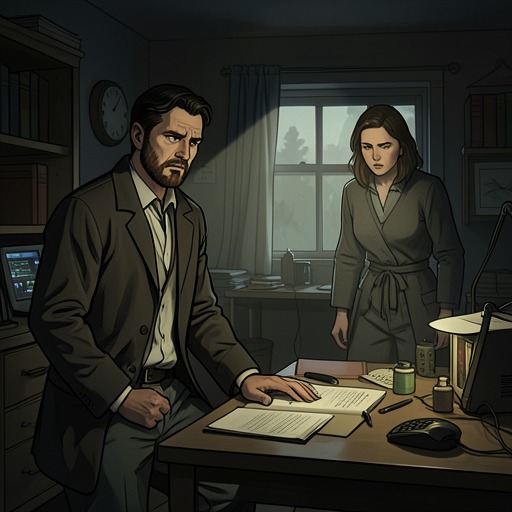
On the return journey, Mary asks Prince what is behind the door. His answer shifts the question from the room’s contents to Mary’s own history: he tells her that he has been behind it and believes she has been there too. The door thus becomes a point of disagreement and recognition. Mary resists his insistence that her present identity might be connected to an earlier one, asserting that whatever she once was, she is herself now. Prince treats that resistance as evidence that the identity he associates with her is still in opposition to him.
Their exchange leaves the door deliberately unresolved. Prince does not offer a clear account of what Mary experienced there, and his later explanation is limited: as far as he knows, the space is now used for sex. His answer reduces the mystery of the present-day room without resolving its personal significance. The important possibility is not that the door conceals a single, neatly explained secret, but that Mary’s own past may be on its other side. Her question makes an obscure feature of the club part of the argument over who she is.
A Threshold in a World of Exploitation
The door’s first appearance sits within a wider narrative of people being treated as sources of money and opportunity. Elsewhere, Sharon turns Mary over to Trev and Jock, presenting her as someone they can exploit because she is vulnerable. The narrator identifies the two men as criminals and explains that their actions are shaped by money; Mary, who does not yet understand money, is poorly equipped to recognize the danger around her. This context does not establish that the club’s door is part of the same criminal activity. It does, however, give the door’s passage into an unseen space a resonance with the novel’s repeated concern with vulnerability, coercion, and what others may do to a person when she cannot protect herself.
That resonance is strengthened by the contrast between visibility and knowledge. The door can be seen, and Mary can ask about it, but neither fact gives her immediate command of what it means. Prince knows more than she does and uses that asymmetry to press his account of her identity. The threshold therefore operates not only as a boundary between spaces but as a boundary between what Mary can presently remember and what other people claim she has lived through.
Return and Recognition
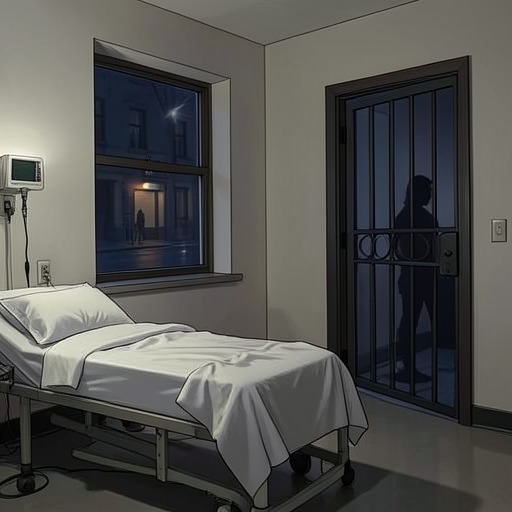
Near the end of the novel, Prince leads Mary into a condemned building and through a trapdoor into a large room. He guides her across the room toward a door, tells her they are going behind it, kisses her forehead, and urges her forward. Once it closes, Mary realizes that Prince is no longer with her; the handle will not turn. The passage has separated her from the person who brought her there and placed her alone in an unfamiliar interior.
Beyond it, a man calls her Amy and asks whether she remembers. Mary sees him at a distance, recognizes him, and confirms that she does remember. The scene makes the door’s earlier association with her concealed history concrete: the passage leads to the encounter in which Mary’s recognition of Amy Hide becomes explicit. The novel does not need to make the door explain every detail of the past. Its function is to bring Mary to the point where recognition can occur.
Narrative Significance
Across these appearances, the door changes from an observed opening into a structure for delayed knowledge. At the club, its darkness and the girl’s decision to cross it establish a movement into an undisclosed space. In the conversation with Prince, it becomes evidence in a dispute about Mary’s identity. In the final sequence, it is crossed again, and the person waiting beyond it calls Mary by the name attached to her past. The repeated passage links an earlier image to a later disclosure without making the door itself a complete explanation.
The threshold also shapes the novel’s handling of agency. Mary asks what lies beyond it, resists Prince’s interpretation, and later enters when he directs her forward. The outcomes differ: her earlier question produces no full answer, while the final crossing results in recognition. The door is therefore neither simply a symbol of danger nor a guaranteed route to understanding. It marks the uncertain interval between what Mary presently knows and what she may be able to remember, a boundary the narrative returns to when her lost identity can no longer remain only an implication.