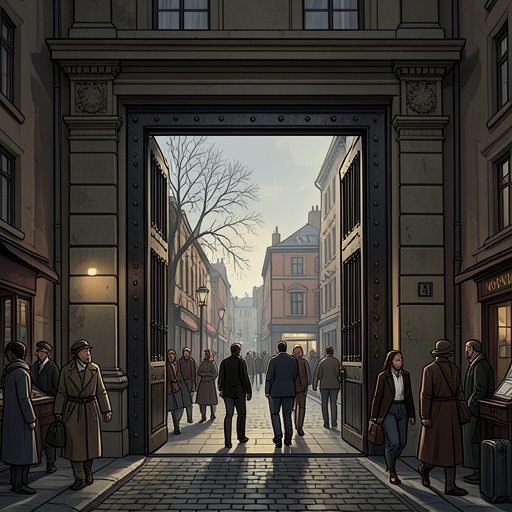
The threshold beyond the door
Other PeopleThe hidden door inside the club is more than a concealed entrance: it marks a passage from a public scene into knowledge Mary Lamb / Amy Hide cannot yet fully face. Its first appearance is bound to a remembered crossing in a club; its later return, when John Prince leads Mary through a door and leaves her alone beyond it, brings recognition close. The repeated threshold joins secrecy to memory, while leaving the encounter’s final outcome unresolved.
The first crossing
In the earlier scene, a low door is almost swallowed by shadow at the edge of a room where people are dancing and kissing. A man guides a girl towards it as they move together. When she sees the door open, she understands the step as a further descent, yet laughs and stretches her shoulders as if preparing for flight. They pass through, and the door swings shut behind them. The passage is presented as a decisive change of space: what had been a visible room gives way to somewhere described as further, more, and beyond the previous limit.
The moment holds opposed meanings without settling them. The girl’s gesture suggests release, but the man is directing her movement, and the door closes behind them. The scene therefore does not present crossing as simple freedom. Its language makes the threshold feel like both an opening and a point of no return: she appears to welcome the next step even as the circumstances limit her control over it. The distinction matters because the door does not explain what lies beyond; it makes the unseen space consequential precisely by withholding it.
Later, driving back with John Prince, Mary asks what is behind that door. His reply makes the image personal rather than merely architectural: he says he has been behind it, and that she has too. The exchange connects the girl’s crossing to Mary’s unknown history without supplying a full account of what happened there. At this stage, the door is a fragment of knowledge that Mary can name and question, but not yet interpret for herself.
A threshold of secrecy and danger
The club scene gives the hidden door a charged setting. The room’s dancing and apparent movement towards pleasure coexist with an account of people being roughed up and used for entertainment. Against that background, the door signals a further step into a hidden arrangement, not an uncomplicated escape from the visible room. The narrative makes the boundary legible while keeping the space on the other side obscured; its danger comes partly from the gap between what Mary sees and what she knows.
That gap echoes the vulnerability surrounding Mary before she has recovered her identity. Sharon first appears to be an ally, then turns against her when Jock and Trev arrive. Sharon presents Mary as someone who will not resist and treats her as something to be offered to the men. The episode establishes how quickly apparent protection can become exposure, and how other people’s descriptions of Mary threaten to replace her own agency. The door is not the same boundary as Sharon’s betrayal, but it belongs to a wider pattern in which Mary is moved across limits by people who presume to decide what may happen to her.
The narrator also situates Jock and Trev within a world organized around money and exploitation, and warns that Mary is not equipped to deal with them. This context sharpens the meaning of an unseen space reached through a door: concealed rooms and concealed intentions are part of the same atmosphere of danger. The door does not itself explain the club’s workings, nor does the text make it a literal cause of the earlier threat. Instead, it gives physical form to Mary’s precarious passage between what is visible and what remains hidden from her.
John Prince’s return through the door
Near the end, John Prince brings Mary to a dark, damp interior. A bare purple bulb comes on; he guides her through deeper shadows towards a door. He tells her that they are going behind it. When she says she is tired, he acknowledges this, kisses her forehead, and turns the handle, urging her forward. Once the door closes, she realizes that Prince is no longer with her. The gesture that had seemed to guide and accompany her ends in separation: beyond the threshold, she must face what is there without him.
On the other side, the space is a long, narrow room, more like a tunnel than an ordinary chamber. A red glow filters through veils or curtains, and someone shifts in a chair at a distance. A man calls her Amy and asks whether she remembers. He wears a hood or cowl and begins moving towards her. She recognizes him, and answers that she does remember. These details give the second crossing a different function from the first: the door now leads not merely to an unspecified further place but to a direct confrontation with a person and a history that recognition has made present.
The exchange turns the threshold into a boundary between Mary’s incomplete present identity and Amy’s recovered memory. The man speaks of her as already dead and describes life as hell and murder, while she asks whether he will kill her. She then moves towards him, apparently to make what comes next happen sooner and save time. The passage ends during this approach. It confirms recognition and a willingness to close the distance, but does not show what follows; the door is a gateway to confrontation, not a device that guarantees resolution.
Repetition and significance
The two crossings differ in who appears to direct them and in what Mary knows. In the club recollection, the girl crosses with a man while the significance of the hidden space remains unclear. Later, John Prince knowingly brings Mary to the door, but his departure leaves her to meet the past without his protection. In the final room, the decisive movement is hers: after recognizing the hooded man, she walks towards him. The motif thus shifts from being carried into an unknown space to moving towards a recognized one.
That shift makes the door a measure of knowledge as well as a boundary. Early on, Mary can ask what lies behind it, and John Prince’s answer tells her only that she has crossed it before. At the later crossing, she can name the memory as memory and identify the man, although the excerpt does not resolve their encounter. The text withholds a complete explanation of the first passage while allowing its image to recur in a changed context. Rather than closing the mystery, the repeated door converts it into a confrontation: what was once hidden becomes recognizable, but recognition does not make the past harmless or the future certain.