Time and the Length of Life
Other PeopleThe novel makes time at once an economic resource and an intimate measure of what a person can endure. For Mary Lamb / Amy Hide, hours change their character with circumstance: they drag when she is poor and unemployed, gain warmth through the routines of work, and become strangely negotiable when she and Jamie abandon ordinary day-and-night schedules. At the end, waiting gives way to a stark revision of the familiar complaint that life is too short. Time is not merely a theme to be contemplated; it governs who can spend a day freely, who must account for it, and how the past returns within the present.
Time as a Resource
The novel’s account of tramps sets up its social argument by linking having no money to refusing to sell one’s time. Most people, the narrator observes, trade time for money; tramps keep their time, but lack money and continue to think about it. This apparent freedom is therefore no simple escape from economic pressure. Their hours remain shaped by deprivation, and their choice not to sell time leaves them outside the exchange through which others obtain a living. The idea of time as a commodity is made concrete in Mary’s search for work: she has time available to sell but does not know where jobs are found or who buys it.
Her days without work make that uncertainty palpable. At the hostel, she must be out by nine and cannot return until noon. With no money and nowhere to be, the hours on the street pass slowly. She watches children playing, housewives moving between shops with their bags, and men gathered outside betting shops or closed pubs. These different forms of activity sharpen her sense that other people have a recognized place in the day, while she does not yet know how to enter the world of paid work. She studies the grocer, bus conductor, street sweeper, dustmen, and policeman as workers whose time is attached to goods, transport, or services as well as to their labor. Her difficulty is not a lack of hours but not knowing how to make those hours valuable to someone else.
Work and the Weight of the Day
Work changes Mary’s experience of time by giving it a shared structure. She loves the familiarity of the café: people know one another, acknowledge one another in the morning and evening, and make the passage of the day feel lighter. The sun’s changing angles on the wiped dishes give this routine a visible measure. Against the isolation of unemployment, the ordinary repetitions of a workplace offer inclusion as well as a timetable. Time is still spent in labor, but it is no longer only an empty stretch that Mary must endure or somehow sell.
The contrast is not simply between work and leisure. Mary’s earlier job search shows how a day can be full of observation and still feel unusable: the city is active, but she has no role in its transactions. At the café, familiar encounters make time socially legible. The change suggests that a person’s experience of duration depends partly on whether the surrounding routine connects her to other people. Paid work supplies money, but the shared acknowledgments of the workplace also alter the felt weight of the hours.
Seasons, Memory, and Duration
Time also moves beyond the scale of a shift or a day. As the weather turns, Mary reflects that seasons may carry people back to earlier moments, if they have a time to return to. She is tired of what she imagines as a narrow gangplank of time and wants to swim deeper rather than drain each passing second. The image joins duration to memory: the present feels thin when it is cut off from a past that can be recalled, while a change in season makes the possibility of return newly perceptible.
The approach of winter gives this larger time a shared, uncertain calendar. People speak of its arrival with resignation or stoical dread, but disagree about when it will begin; there is no fixed date that settles their predictions. Mary is not especially worried and expects the season to be interesting. The contrast matters: time can be counted and anticipated, but not wholly commanded. A calendar names an approaching change without making its precise arrival certain.
The novel’s reflections on age give this uncertainty a harder edge. Youth imagines that old age will not arrive, and the future can seem to end in mist at twenty-five; age nevertheless comes. Suicide, in the narrator’s meditation, is not an abstractly brief exit but a decision requiring nerve, while death is described as lasting only a second and then being gone. Against the imagined length of a life, death appears startlingly short. The juxtaposition does not resolve the question of how long life ought to be; it exposes how differently youth, age, and the prospect of death measure the same span.
Breaking the Clock
In the period when Mary and Jamie live together, their shared routine deliberately loosens the ordinary divisions of the day. After drinking, they eat around noon; sleep may follow for six or seven hours in the afternoon, and they rise in the evening to begin a long night. Dawn finds them still awake. Their schedule makes night and day overlap in practical terms, treating the clock’s divisions as something they can abolish within the flat. The result is not an escape from duration: the nights remain long, and the pattern is sustained through repeated cycles of eating, sleeping, and staying awake.
Their changed schedule also gives time a relational dimension. Mary tends to Jamie and, during their first nights, talks to him for hours; later they talk less, as their closeness no longer depends on those conversations. Time is reorganized around the life they share, even as the flat’s routine becomes distinct from the public day. The narrative’s attention to meals, sleep, and the passage from midnight to dawn makes this altered rhythm specific rather than simply calling it timelessness.
Waiting and the Length of Life
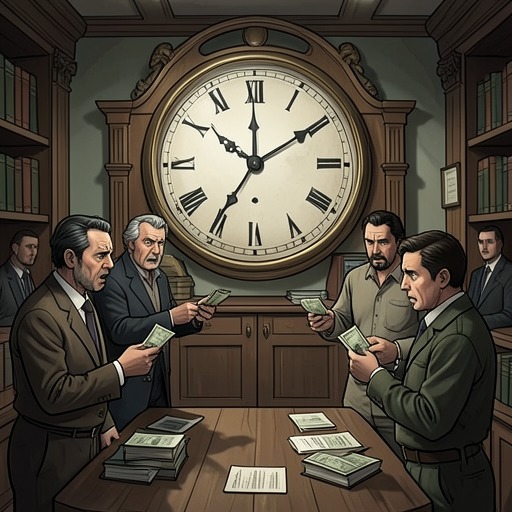
At the close of the supplied sequence, waiting brings the novel’s different measures of time together. Amy expects Prince to come, but he does not arrive during the night. She tries to occupy the hours by reading two books at once, playing a piano concerto on the gramophone, and writing in her diary. None steadies her: the printed lines lose meaning, the music feels open-ended, and the diary seems insufficient to make a past. The clock’s slow movement from two toward three gives the wait a measured face, while the dawn confirms that the expected visitor has not appeared.
In trying to recover her history, Amy can outline a life—childhood with Baby, growing older, meeting a man, and the events that nearly killed her—but cannot remember it as a continuous past. Only separate memories remain: entering a room of people, waking early on a weekend, stopping in a courtyard at the light, crying at school, and wanting to shine a light into other people’s houses. The gap between a sequence she can describe and memories she can actually retrieve makes time inseparable from the problem of personal continuity.
Later, sitting alone in the park, Amy experiences the world as separate from her and feels relief in recognizing that only a little of life concerns her personally. She feels dead and concludes that life is too long, not too short; she has lived enough and is ready for Prince to come. This reversal gathers the concept’s economic and emotional strands without erasing their differences. Time can be something Mary cannot sell, hours she does not know how to use, a workday made lighter by belonging, a night rearranged around another person, or a wait in which the past refuses to become whole. At the end, its length is no longer an abstraction: it is the duration Amy believes she has already endured.