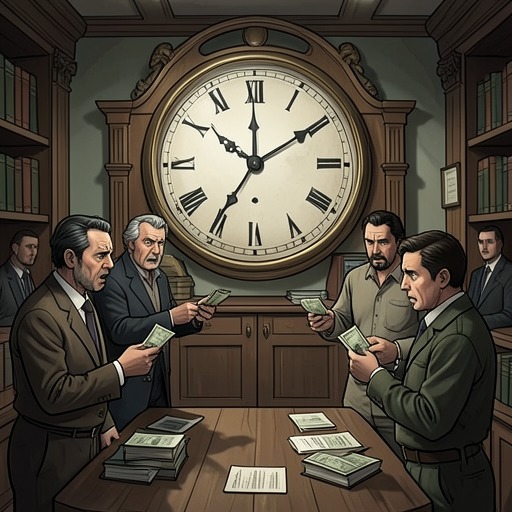
Time as a commodity
Other PeopleTime as a commodity is a governing idea in the novel: people commonly trade portions of their lives for money, while those who refuse the exchange may keep their time but remain preoccupied with money they lack. The idea develops beyond an economic contrast. Through Mary Lamb’s job search, her response to poverty, and her changed daily rhythm with Jamie, the narrative shows time as both a resource people sell and a force that organizes waiting, work, companionship, and escape.
The exchange of time for money
The narrator describes tramps as people without money because they will not sell what others sell: their time. The refusal distinguishes them from the wider society, whose members participate in selling time as a matter of course. Yet keeping time does not free the tramps from economic pressure. They think about money continually, even as they choose not to earn it in the usual way. The arrangement is presented as a contradiction: they retain what others give up, but the lack of money remains part of their daily experience. The narrator also notes that tramp life is becoming more common, making the refusal seem less like an isolated eccentricity than a growing alternative to ordinary economic participation.
This account gives time a double value. It is something that can be sold, but also something retained at the cost of money and access to ordinary material security. For Mary Lamb, who has no settled understanding of her own past, the distinction becomes practical when she looks for employment. She has time available to sell, but does not know where jobs are found or who buys that time. Work appears to her through the tasks and equipment of other people: the grocer handles goods and money, the bus conductor sells both labor and travel, and other workers are paid for their particular forms of effort. The examples make employment look like a set of specialized exchanges, not simply an open market waiting for her to enter.
Poverty and the value of money
Mary Lamb’s understanding of money differs from that of the people around her. In shops, money is treated as if it has committed an offense, and Mrs Botham repeatedly complains about it. Mary privately takes a more forgiving view. Money seems useful and even pleasing because it can be saved through spending wisely; she develops an eye for bargains and is told that her purchases save Mrs Botham money. The irony is that Mary saves money by spending it, while Mrs Botham remains hostile to the very medium that makes those savings legible.
That small domestic distinction anticipates Mary Lamb’s deeper recognition of poverty. She had once thought poverty belonged to life itself; now she understands that life need not be poor in quite that way. The change comes with an awareness of possibility and exclusion: like a person at a poolside who wants to join the swimming and playing, she senses that participation may be possible if she dares. Even so, she does not simply covet the resources of the well-kept people she sees in shops and cars. What she wants from them is time. Money matters because it structures what people can do and where they can belong, but it is not, for her, the final measure of a good life.
Waiting, schedules, and work
The economic value of time is especially visible when Mary Lamb is out of work. She must leave by nine and cannot return until twelve, so the hours outside stretch slowly. From behind diamond-wire she watches children playing, housewives carrying purchases, men standing idle, and a dog and ants occupying the street. The scene places different kinds of time side by side: children seem to move constantly, shoppers accumulate goods, and men appear to have nothing required of them for the moment. Mary, meanwhile, has hours she might sell but no buyer she can identify. Her predicament is not simply having too much free time; it is having time that cannot readily be converted into income.
Work later changes the quality of her days. Mary loves her job in part because people know one another and acknowledge each other in the morning and evening. Such familiar exchanges make her feel included and make time seem lighter; even the summer light falling across the wiped dishes belongs to this experience. The contrast matters: time at work is still organized around labor, but its value to Mary is not exhausted by payment. Recognition and routine alter how the hours feel. The job offers social belonging alongside the sale of labor, complicating any simple opposition between paid time and personal life.
The novel also makes time a formal discipline, not merely an economic abstraction. A speaker compares it to a race that accelerates, with each second straining to keep pace, and to a relay in which moments pass a baton before dropping away. The image turns clock time into movement that presses forward regardless of individual desire. Its insistence that time itself will end places human schedules inside a larger limit: the race is relentless, but not eternal.
Law, money, and unequal possession
The equation between time and money acquires a sharper institutional meaning when Mary Lamb learns that breaking the law brings time. She does not initially understand what the accusation means and asks what follows from breaking the law; the answer makes punishment legible as a sentence of time. The exchange turns the usual economic metaphor inside out. In employment, time is given in return for money; under the law, time is imposed as a consequence. In both cases, a person’s duration is allocated through a system beyond that person’s immediate choice.
Later, money returns as a marker of unequal security. Before Christmas, as others leave and Mary Lamb and Jamie are alone in the flat, Jamie points to the money he carries and urges her to take plenty. He is relieved that they have money, while also saying that Christmas frightens him and that he intends to drink. The money provides practical means, but it does not dissolve his dread or determine what the days will feel like. The scene recalls the earlier distinction between having money and possessing time: resources can ease material constraints without making a person master of either the calendar or the self.
Making time disappear
During Christmas, Mary Lamb and Jamie try to abolish the distinction between day and night. Their schedule reverses ordinary rhythms: after hours of drinking they eat around noon, sleep through much of the afternoon, and rise in the evening to begin the night. Sleep may last six or seven hours, but it falls at a time conventionally assigned to waking life. The routine makes their days difficult to separate into the usual units, and the narration describes them as continuing through the nights until dawn and preparing for another morning.
This attempt to undo diurnal time is not presented as a liberation from every pressure. Their closeness grows inside a narrowed, repetitive life; Mary Lamb urges Jamie to bed, cares for their meals, and spends long hours with him. At first she talks to him about his failure to act on his life and about what she believes he conceals, but eventually they no longer need to talk in the same way. The shared schedule becomes both intimacy and enclosure. Set beside the job that made time lighter through ordinary social recognition, the Christmas routine shows another possibility: time can be made to blur through isolation and repetition. The novel’s concept therefore holds together economic exchange, institutional control, social belonging, and the private effort to escape the divisions by which a day is usually measured.