Time is a race
Other People“Time is a race” is both an image of time’s relentless acceleration and a lens on the different conditions under which people spend it. The expression links the exhaustion of passing moments to the social exchange of hours for money, while the novel’s contrasting rhythms show that time can drag, lighten, or lose its ordinary divisions.
The Race and the Relay
The image makes time a competitor that is always gathering speed: each second seems to gasp as it strains to keep up. The related relay image gives that motion a repetitive structure. One minute passes its baton to the next, then falls back exhausted, its own race finished. The sequence suggests not simply that life moves quickly, but that every moment is used up as it gives way to another.
That forward movement has an ending. The reflection extends beyond human time to bones and air, insisting that even the materials of existence will eventually cease. The repeated prospect that time itself will end turns the race into more than a metaphor for daily haste: its ultimate limit is universal, even as the passage offers no escape from the seconds immediately being spent.
Time Sold and Time Withheld
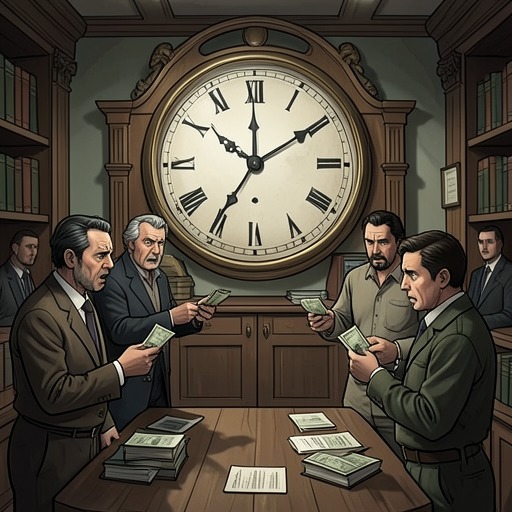
The expression’s social force emerges in the distinction between wage-earning and tramp life. Tramps have no money because they will not sell what others sell: their time. They keep their hours, yet remain preoccupied with money, while the narrator presents selling time as the business in which nearly everyone participates. The paradox is that keeping time does not bring material security; refusing the exchange leaves people without money, even as their way of life becomes increasingly common.
Mary Lamb / Amy Hide encounters this economy as a practical problem when she looks for work. She has time available to sell but does not know where jobs are found or who might buy those hours. The contrast between her uncertainty and the apparent competence of workers makes employment seem like a set of learned arrangements: the grocer sells food as well as labour, while the bus conductor sells time alongside travel. In this account, time is not an equal possession in practice; income and routine depend on finding someone willing to purchase it.
Poverty also changes the speed at which hours are felt. At the hostel, Mary Lamb / Amy Hide must leave by nine and cannot return until twelve. With no money, time on the streets seems to last indefinitely. She watches children, housewives burdened with carrier bags, men idle near betting shops and closed pubs, a panting dog, and ants crossing cracked pavement. The long interval is filled with other people’s movements, but she remains outside the high windows where people are absorbed in their own business. Her search for work is therefore also a search for a way to give empty hours an economic use.
Work, Belonging, and Lived Time
Employment changes more than Mary Lamb / Amy Hide’s income or schedule. She loves her job at the Garcia café because its familiar exchanges—people acknowledging one another in the morning and evening—make her feel included. In that setting, time feels lighter. The summer light falling at an angle across wiped dishes gives ordinary work a recurring measure that is social as well as practical: the day is organized by familiar people and shared tasks, not only by hours available for sale.
This lighter rhythm contrasts with the hours spent waiting for work and the abstract race of seconds. The café’s routines do not abolish time; they change how it is experienced. Repeated recognition and participation give its passing a texture that isolation and enforced idleness lack.
Breaking the Day into Night
Later, Mary Lamb / Amy Hide and Jamie try to abolish diurnal time: the distinction that keeps day and night separate. Their routine reverses the ordinary clock. Around noon, after several hours of drinking, they prepare to eat; afterward, Jamie sleeps for six or seven hours through the afternoon, and they rise in the evening to begin their long night. Dawn finds them still awake and ready for another morning’s drinking.
The altered schedule does not make time disappear so much as rearrange its boundaries. Daylight becomes a place for sleep, night becomes the span of activity, and the familiar sequence of waking and resting is displaced. Their intimacy is expressed in that shared rhythm: as they grow close, they no longer need to talk as they did during their first nights together. Against the relay’s relentless succession of moments, their life together tries to suspend the divisions by which ordinary time keeps experience in order.