Tramps’ Moneyless State of Survival
Other PeopleTramps’ Moneyless State of Survival is defined by an unusual economic refusal: tramps have no money because they will not sell anything, especially their time. This leaves them outside ordinary transactions while making money and time unusually visible in their lives. The novel develops the idea through an explanatory narrator, through Mary Lamb’s search for work, and through later contrasts between poverty, spending, and access to money.
The Refusal to Sell Time
The narrator distinguishes tramps from people who participate in the usual exchange of time for money. Most people sell something, and in the narrator’s account what they commonly sell is their time. Tramps do not want to sell what others sell. Their lack of money is thus presented not simply as an accidental shortage but as the consequence of a refusal: they retain their time rather than exchange it for income.
That refusal does not make money irrelevant. The narrator emphasizes the paradox that tramps keep their time but think about money continually. They choose not to enter the exchange, yet remain aware of the resource they lack. Their position is described as an odd way of living, while also being treated as attractive to those who choose it: the narrator says that being a tramp is increasingly popular and that more people are doing without money. The state combines independence from wage exchange with persistent material deprivation; keeping time does not supply the means that money would buy.
The narrator’s own relation to tramps is uneasy. The narrator says that encounters with them occur frequently because of the narrator’s line of work, but that they are unwelcome because they waste time. The warning to avoid them places the speaker on the other side of the exchange being described: time is valuable to the speaker as well, but the speaker treats contact with tramps as an expenditure to be avoided. The explanation therefore does more than define a social group. It exposes how even a refusal of the money economy is measured by the economy’s vocabulary of wasted and valuable time.
Mary Lamb Among Moneyless Time
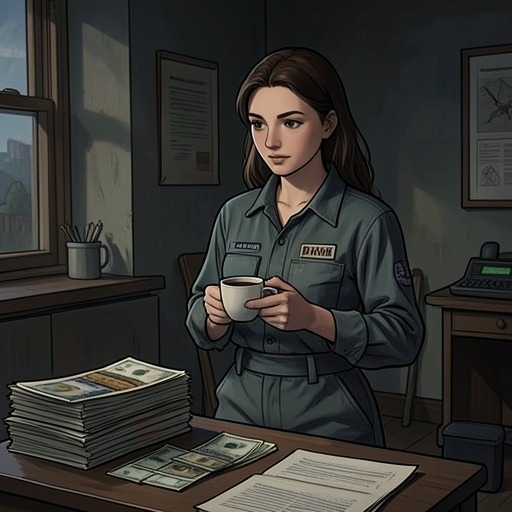
Mary Lamb’s circumstances bring the abstract distinction into daily life. She has time available to sell and is looking for a job, but she does not know where jobs are found or who offers them. The uncertainty makes the economic arrangement feel less like a simple choice than a system whose routes are difficult for her to recognize. She observes different kinds of work and the particular resources each worker can sell alongside time: the grocer has food, the bus conductor has access to the bus and the travel it provides, and other workers have their own recognizable skills or roles. Her attention moves from the fact that people receive payment to the question of how their labor becomes legible and valuable.
The contrast matters because Mary’s immediate problem is not that she has deliberately rejected selling time. She wants employment and wonders who might buy the time she has to offer. In this respect, her moneyless situation overlaps with the tramps’ condition without sharing the same stated motive. Her search also reveals that time alone is not enough to secure income: she can be ready to work and still not know where an exchange can begin. Looking up at people behind high windows, she experiences exclusion from a world of activity and money that remains difficult to enter.
Her days make the difference between having time and having resources concrete. Residents have to leave by nine and cannot return until twelve; without money, the hours on the streets pass slowly. Mary watches children, shoppers, men gathered near betting shops or closed pubs, and workers moving through their routines. These observations are not simply a catalogue of other people’s activity. They sharpen her awareness that time is organized differently for those with work, goods, or somewhere to go than for someone waiting without money. Later, she reads the books available in the common room, but their romantic plots and conclusions at marriage do not answer the questions raised by her own circumstances. Their treatment of stories as something imagined for money and sold time extends the economic idea into the culture she reads.
Money as Purchase, Saving, and Dispute
Money acquires more than one meaning as Mary encounters it in ordinary transactions. At shops, people speak about it with resentment, as though it has done something that cannot be forgiven. Mary privately takes a different view. She likes money and especially likes the apparent ingenuity of saving while spending. At the supermarket she becomes good at finding bargains, and Mrs Botham repeatedly tells her how much money she has saved the household. Mary recognizes the oddity that she is praised for saving while all she does is spend; Mrs Botham, meanwhile, continues to condemn money.
This exchange makes money neither a neutral object nor a simple measure of class. For Mary, it can be useful and satisfying in the small practice of getting value from a purchase. For Mrs Botham, it remains a cause for repeated reproach, even when Mary’s bargain-hunting benefits the household. Their different responses show how the same everyday medium can carry sharply opposed judgments. The detail also gives Mary a modest form of competence within poverty: she learns how to spend carefully, although that skill does not itself end her need for resources.
Sharon’s encounter with two scraps of paper offers another brief view of how scarce possessions become exchangeable. She considers whether they might bring money, cigarettes, or alcoholic drink, then decides to obtain spirits and tells Mary to wait while she goes to get them. The scene links the prospect of converting an object into money or goods with immediate consumption. It is distinct from the tramps’ refusal to sell: here the scraps are assessed for what they can yield, and their value is imagined through possible purchases. Together, these episodes show that money’s significance depends on the circumstances in which it is sought, saved, resented, or turned into something else.
Poverty, Time, and Unequal Possibility
Mary’s understanding changes as she sees more of the difference between her life and that of people who are better provided for. At first, she had thought life itself was poor and that money belonged mainly to books. She comes to understand that life need not be poor in quite that way. Her image of wanting to swim and play, while knowing she could do so if she dared, gives this realization the form of an available possibility that remains difficult to claim. She does not say that she wants the well-kept people’s money; what she wants from them is their time. The distinction returns the discussion to the central exchange, but now from Mary’s perspective: wealth is not her declared goal, while access to a life with more time and possibility is.
The contrast remains unresolved. Mary has learned to save through shopping, has sought a job, and has recognized that poverty is not inevitable in the abstract, but she still lives with its restrictions. Her later circumstances underline that money can ease immediate choices without making vulnerability disappear. Jamie speaks of the good fortune of having money and tells Mary to take plenty, while also saying that Christmas frightens him and that he intends to drink. The exchange presents money as a practical resource available to Mary, but not as a guarantee against Jamie’s distress or the pressures of the season.
The state of moneylessness therefore has two connected meanings in the novel. For the tramps, it follows from refusing to sell time, a choice that preserves one kind of independence while leaving them preoccupied with what they lack. For Mary, having time without money is chiefly an obstacle she tries to overcome by finding work and learning how to manage purchases. The difference prevents her experience from being reduced to the tramps’ principle. Across both, the novel makes time an economic resource and a lived condition: it can be retained, offered for sale, spent slowly in enforced waiting, or desired as something money cannot simply substitute for.