Trev
Other PeopleTrev is a violent companion of Jock whose confidence in his own fighting ability is sharply at odds with the narrator’s account of his repeated failures. Drink and fighting dominate his life, and his assault on Mary Lamb is followed by her resistance and his pursuit of revenge. The novel presents him as both a direct danger to Mary and a figure whose imagined prowess repeatedly exceeds his actual competence.
Identity and Characterization
Trev is described as small and solidly built, with dirty-orange hair. When he first approaches Mary Lamb, he moves close to her and appears intent on coming closer. His physical proximity soon becomes a means of control: as he and Mary walk with Jock and Sharon, Trev keeps an arm pressed against her shoulders to prevent her from getting away. The pairing is based on size rather than hair colour, putting Trev beside Mary while Jock accompanies Sharon.
The account of Trev’s character centres on two persistent appetites: drink and fighting. He cannot explain why he continues to do terrible things. He sometimes attributes his conduct to hatred of strangers, but that explanation fails because he also hates people he knows. The narrative offers no single grievance that makes his aggression coherent; hostility is presented instead as a broad, recurring disposition.
Fighting and Self-Image
Trev believes himself to be a good fighter, but the narrator explicitly undercuts that belief: he is not especially good, and the fights he starts are often finished by other people. The contrast gives his self-image a darkly comic, mock-heroic quality. He acts as though he possesses a skill that the outcomes do not confirm, and his confidence encourages him to keep entering conflicts despite the pattern of failure.
His violence toward women is the exception he counts as success. The narrative says he wins those fights and has had quite a few of them. That distinction does not make him formidable in general; rather, it identifies the unequal conditions in which he directs his aggression. His encounters with women are not presented as sporting contests but as a pattern of violence against people he can overpower.
Encounter with Mary Lamb
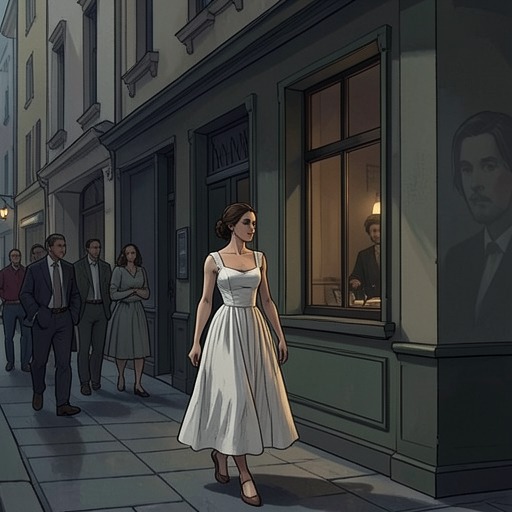
Trev first appears with Jock after Sharon has brought Mary Lamb to them. He asks Sharon where she found Mary, then accompanies her through a narrow passage. The group’s apparent pairing gives way to Trev’s effort to keep Mary under physical control. When Jock and Sharon move farther ahead, Trev attacks Mary. The account of what follows is fragmented in Mary’s recollection, returning later as separated images from a prolonged night; this broken form conveys her disorientation without making the episode a clear or orderly memory.
Trev sexually assaults Mary and strikes her during the attack. Once he has fallen asleep, Mary waits until she hears him begin to wake. She then decides to defend herself, finds a heavy wedge-shaped brick among the rubble, and hits him twice. The immediate reversal is decisive: Trev had treated Mary as someone he could control, but she acts against him and leaves him injured. When Jock and Sharon later wake, Trev is on the floor, and Jock recognizes that he has been badly struck. Mary’s response establishes her capacity to resist even while the assault and its aftermath remain traumatic.
Jock and the Attack on the Botham Home
Trev’s relationship with Jock combines companionship with an uneven understanding of their shared intentions. During the later plan to invade the Botham home, Trev wants to harm its occupants and Mary, while Jock has little taste for the venture and joins largely because Trev wants him to. Trev assumes Jock is as eager as he is, although the narrative makes clear that this is not so. Trev directs Jock toward the older members of the household and reserves Mary as his own target.
The planned attack is also driven by Trev’s memory of his earlier encounter with Mary. His mouth still hurts from what she did to him, and he remembers both the assault and her resistance. He is not sure exactly how she injured him, but he remains certain that he intends to retaliate. His declared aim is to inflict severe harm on her, and he expects to have enough time to do so. The plan thus grows directly out of the reversal in the earlier scene: Mary’s self-defence has not ended Trev’s threat but has become the grievance around which he organizes further violence.
Change and Narrative Significance
Trev does not show remorse or a change of purpose in the supplied episodes. Instead, the injury Mary inflicted becomes, in his mind, a reason to renew his attack. The later threat makes the consequences of her resistance complicated: it stops him in the immediate encounter, yet it also intensifies his desire for revenge. At the Botham home, Trev is again prepared to use violence, while Jock’s reluctance exposes the difference between Trev’s eagerness and the motives of the companion he brings along.
As a character, Trev links the novel’s street-level danger to the threat that follows Mary into a place where she has found temporary shelter. His boastful confidence, habitual fighting, and targeting of women form a consistent pattern, but the account also shows the limits of his control: Mary can act against him, and his plans depend on assumptions about Jock that are not true. His role is therefore not simply to menace her in one episode; he embodies the continuing danger created when a violent aggressor interprets resistance as an invitation to retaliate.