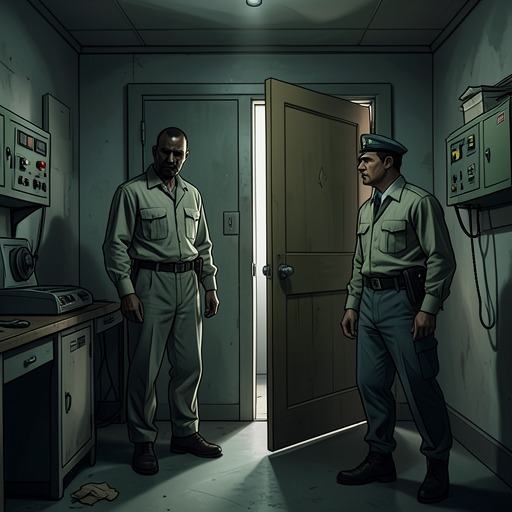
What do you get when you break the law Time.
Other People“What do you get when you break the law? Time.” turns a basic question about punishment into one of the novel’s most compact statements about how time governs life. Prince’s answer names prison time, but its force grows through the book’s other uses of the same word: time can be sold for money, endured in poverty, made lighter by belonging, or blurred in an effort to escape the distinction between night and day. The expression links legal consequence to that wider economy without making them identical.
The Exchange with Prince
When Prince tells Mary Lamb / Amy Hide that she has broken the law, she does not understand what he means. Her first impulse is to ask whether the law will ever get better again; instead, she asks, “What do you get when you break the law?” Prince replies, “Time.” The answer is brief enough to sound self-evident, but the exchange makes clear that Mary takes the wording literally and has not yet grasped the legal meaning behind it. The contrast is between Prince’s compressed certainty and Mary’s attempt to understand an unfamiliar system.
The conversation does not end as a one-off lesson. Mary later asks Prince the same question again, and his answer is again “Time.” This time she follows it with a question about murder: “What do you get if you murder someone?” Prince answers, “Life.” The paired exchange sets two legal consequences beside one another, moving from time to life without a further explanation. Repetition gives the first answer more weight: it becomes a verbal rule Mary returns to, while the second question tests how far that rule extends.
Time as Punishment and Commodity
The expression’s legal sense resonates with the narrator’s account of tramps, who have no money because they will not sell what most people sell: their time. They keep it, yet still think about money. The apparent freedom of refusing paid work therefore comes with material deprivation; time retained is not time that can buy necessities. Against that account, Prince’s answer carries a sharp irony. The law makes time something Mary may be compelled to lose, while the narrator describes ordinary economic life as a system in which people voluntarily exchange time for money.
Mary’s search for work gives that metaphor a practical dimension. She has time to sell but does not know where jobs are found or who will buy it. With no money, the hours outside the hostel stretch slowly: she watches children playing, housewives going from shop to shop, men gathered outside betting shops and closed pubs, and a dog panting in the gutter. The day is full of other people’s activity, yet she cannot turn her own available hours into income. The phrase’s association between time and consequence thus sits within an unequal world where time is both a resource and a burden, depending on who controls its use.
Waiting, Work, and Lived Time
Once Mary has a job at the Garcia café, time takes on a different texture. She loves the familiar acknowledgments of morning and evening and the feeling of inclusion among people who know one another. The routine does not abolish time; it makes the day feel lighter. This experience contrasts with the drawn-out hours of unemployment, where she watches the world from behind wire and cannot see how to enter its circuits of work and payment.
Later, Mary and Jamie try to abolish diurnal time altogether. They drink for hours, eat around midday, sleep through much of the afternoon, and rise in the evening for a long night together. Their days and nights are rearranged until the usual boundary between them loses its force. This is not the same as Prince’s legal “Time”: his word names an imposed consequence, while Mary and Jamie’s altered schedule is a way of living outside ordinary divisions of the day. Still, both episodes make time feel less like an abstraction than a structure that can be imposed, traded, endured, or disrupted.
The Expression’s Narrative Work
The novel surrounds Prince’s concise answer with a narrator who repeatedly pauses to explain how money and time organize different lives. The reflection on tramps appears alongside Mary’s early encounters with people who exploit her vulnerability; the wider commentary on criminality also stresses that crime is bound up with money and that police are close behind criminals. The expression therefore sits at a junction between legal authority and economic pressure, rather than operating only as a clever reply.
Its repeated question-and-answer form is deliberately plain. Mary asks for a meaning, receives a single word, and later asks again before extending the question from breaking the law to murder. The progression makes the answer memorable while leaving its implications to accumulate across the novel’s distinct scenes of paid work, unpaid waiting, confinement, and altered daily rhythms. “Time” is at once a sentence imposed by law and a resource that ordinary people are continually required to spend; the expression’s force comes from holding those meanings together without collapsing one into the other.