the club behind the low door
Other PeopleThe club behind the low door is both a place of marginal social life and a passage into a more intimate, unsettling space. Mary Lamb first enters with Prince through an alley door and encounters a crowded, dim room; on a later return, the riverbank is deserted and Prince leads her through a door into a narrow chamber where someone addresses her as Amy. The location’s significance lies in this progression: its hidden entrances make physical movement inward coincide with movement toward a past and an identity that Mary does not yet fully possess.
Entrance and Architecture
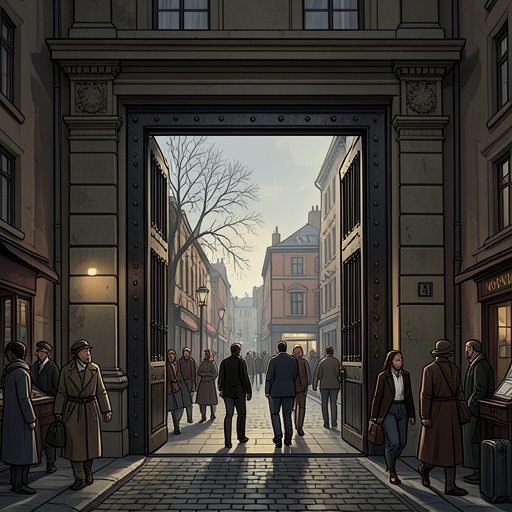
The first approach begins in an alley. Prince ducks through a low door and beckons Mary Lamb to follow. Inside, an old man sits by an inner door, ringed by candles. On recognizing Prince, he rises, slips the bolt, and lets him pass. The access is selective in practice: the doorkeeper controls the entrance, while Prince appears able to enter without difficulty. Mary follows at his invitation, moving from the alley into a place whose thresholds are guarded and whose routes are not immediately apparent.
The route upward is as irregular as the entrance. Mournful music accompanies their ascent of a mis-angled staircase; they pass through a hole in its floor and emerge into a long room beneath arching shadows. The details establish a club assembled out of awkward, enclosed spaces rather than an open public interior. Its architecture guides movement while withholding a clear view of what lies beyond. The low exterior door, the inner doorway, the crooked stairs, and the opening in the floor make access feel like a sequence of crossings.
The Room and Its Occupants
Mary estimates that the long room contains twenty or thirty people, perhaps more. Conversation remains low, film flashes in a far corner, and the atmosphere seems suspended in a slower rhythm, sustained by fever and the hope of magic. Prince calls it a quiet night and says there is nothing live. An old man brings them a bottle and two glasses, then complains that he hates the place and begins drinking quickly. The room is therefore not presented as a simple refuge or a uniformly welcoming gathering: Prince knows how to enter it, but another occupant expresses open distaste for being there.
The dancers give the room its most disturbing visible image. At first there are only two couples on the floor. One man, exceptionally tall and with lifeless-looking eyes, shuffles while leaning heavily on a small blonde woman; she seems to bear his weight as she hauls him around the littered floor. Mary watches them, then turns away from the agitation of a man speaking to her. The room’s drowsy social surface thus contains scenes of strain and distress. Its music and dancing do not settle into uncomplicated pleasure; they accompany an atmosphere in which the bodies and exchanges Mary sees remain difficult to interpret.
The Further Door
A second doorway complicates the club’s layout. A man steers Mary toward a low door almost lost in the darkest corner while the dancers continue moving and kissing. The girl notices the door opening; her response registers the crossing as a further descent, beyond what has already taken place. She laughs and stretches her shoulders as if preparing to fly, and the pair pass through. The door closes behind them. The scene gives this threshold a force distinct from the club’s entrance: the first door brings Mary into the room, while the second marks passage beyond it, into a place the narrative does not immediately explain.
Afterward, Mary asks Prince what lies behind that door as they drive back. His presence connects the hidden passage to the club’s wider network of access, but the question remains unresolved in the supplied scene. The doorway’s obscurity matters as much as its destination. Mary has seen it open and has crossed it, yet the account withholds a plain description of what it contains. The club consequently works not only as a setting but as a structure of partial knowledge, where one interior leads toward another and each passage raises the stakes of entering.
Return and Recognition
On the later return, the surrounding river appears altered or perhaps is another river. The water moves beneath mist; the place where the car stops is empty of people, and threadbare dogs occupy the land. Prince describes the site as dead and condemned. He then leads Mary across damp boards and into deeper shadows, where a door waits. The contrast with the earlier crowded room is sharp: a place once marked by talk, film, drink, and dancing is now approached through absence and abandonment. The text does not make every detail of the two visits identical, but the repeated riverside setting and the renewed passage through a door link them.
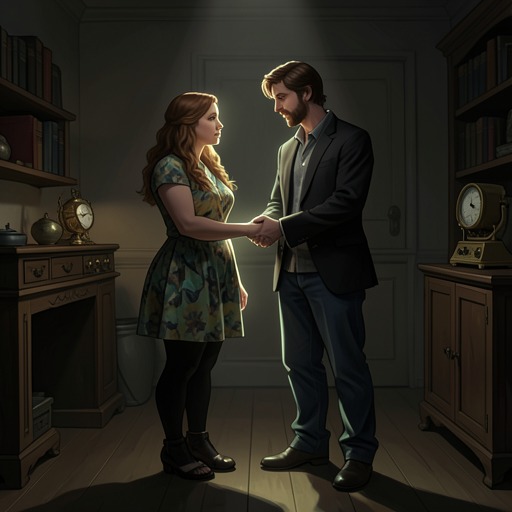
Prince tells Mary that they are going behind the door. She says she is tired; he acknowledges this, kisses her forehead, and urges her forward. Once the door closes, she realizes that Prince is no longer with her. The room beyond is long and narrow, tunnel-like, and lit by a red glow behind thin veils or curtains. A voice calls her Amy and asks whether it is really her. As Mary walks beneath a veil that catches in her hair, the fabric recalls an intimate pink dress. The club’s innermost space thus brings her to an encounter framed by recognition, though the excerpt does not identify the speaker or establish the full nature of the meeting.
Narrative Significance
The club’s arrangement turns enclosure into a narrative device. Its guarded entrance, hidden corner door, and narrow inner chamber make discovery spatial: Mary does not simply learn something about herself while remaining in a familiar setting; she is led through successive boundaries. The shift from the crowded room to the abandoned riverbank also changes the emotional register of the location, from uneasy public spectacle to solitude and anticipation.
The final address to Amy makes the room a threshold between Mary’s current name and a possible identity from her past. That connection is conveyed through concrete features—the repeated door, the veils, the pink remembered dress—rather than through an explanation of the club’s history. The location’s mystery remains unresolved, but its function is clear: it gathers concealment, passage, and recognition into one place, carrying Mary farther into an encounter with what she has forgotten.