Abandoned steam train station
Our Chemical HeartsThe Abandoned steam train station is a long-closed landmark concealed within the city, its elegant public platform giving way to dark rooms and a flooded underground level. Grace Town first brings Henry Isaac Page there as an unlikely refuge from ordinary routes and expectations. The station’s successive meanings—as a childhood hideaway, a place to feed fish beneath a star-filled roof, and the destination where Henry finds Grace alive—make it one of the story’s most consequential locations.
Setting and Access
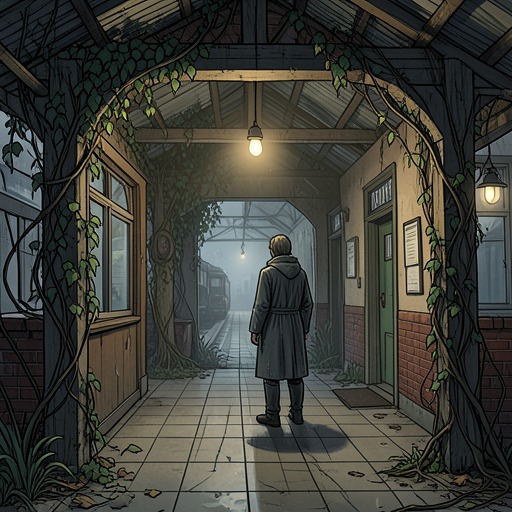
Before the subway was built, a steam train line ran through the business district; the station is described as the last of its kind in the city. It has been closed to the public for decades, but its status as a historical landmark means that people still look after it. That official care creates a striking contradiction: the building is forbidden and appears abandoned, yet it is neither sealed nor wholly neglected. The gates have not been locked for years, and the platform is largely clean of graffiti and overgrowth.
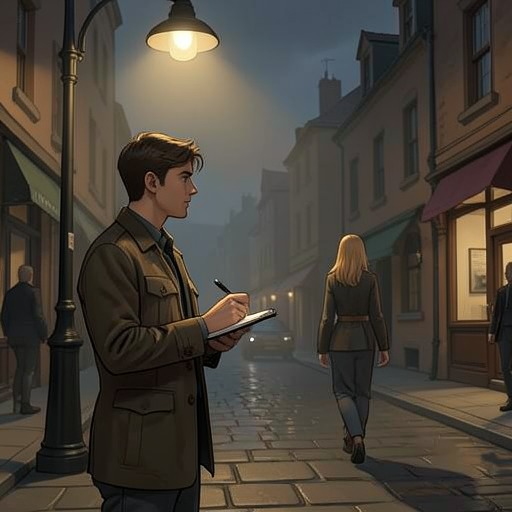
Grace leads Henry toward the station after nightfall. Their route is an adventure in itself: she cuts through grass beside a drain with her cane, and they follow it for ten minutes until it reaches a main road near a bus stop. Grace pays for their bus ride into the city. Later, she points down a hill, and a small building lit by sodium lamps soon emerges from the dark. The hidden approach makes the station feel removed from the surrounding city even though the former railway once passed through its commercial center.
The boundary is crossed with comic casualness rather than force. At the hedge, Grace sends her cane over first; when they reach the gates, she walks through them and shows Henry that they have long been unlocked. At the station door, she picks an old lock with a hairpin, joking that a hundred-year-old mechanism is easy to open. The sequence turns trespass into a practiced, almost domestic ritual, while making Grace the person who knows how to move through the building.
Architecture and the Underground Pool
Inside, Henry and Grace pass through a short, dim tunnel onto a single platform illuminated from above by burnt sodium lights. The station is unexpectedly intact: high arches of frosted glass span a black-and-white checked marble floor, while eggshell and emerald-green tiles line the walls. Henry compares its beauty to a film set; Grace explains that the landmark is still maintained despite its closure. Its preserved surfaces hold the imprint of an earlier public world, while the empty platform and disused rooms make that world feel inaccessible.
Grace takes Henry beyond the platform, through empty rooms without light, and down a cast-iron spiral staircase. A second domed glass roof appears above them, but one panel is shattered, opening a view to the stars. The basement is flooded, so they cannot descend all the way. Grace sits on the second-to-last step, removes her shoes, and puts her feet into the water. When she tosses a piece of bread onto its surface, it floats briefly before a fish pulls it under. The station’s concealed pool is thus revealed not as empty ruin but as a living habitat hidden beneath its historic shell.
The fish become part of the place’s recurring life. Later, after Henry, Grace, and Lola Leung decide to adopt a fish, they return to the station with a net and bread. Grace gathers a school of quicksilver fish at the foot of the stairs and catches one for the new pet. The fish is transferred into a plastic bag filled with water from the basement. The station supplies not only a spectacle for a nighttime visit but also the living creature around which the three friends build a small, shared domestic arrangement.
Grace’s Refuge and Cosmic Perspective
The station predates Henry’s visits to it as a secret place in Grace’s life. She tells him that a friend brought her there when they were children. They were both troublemakers, and breaking in made them feel rebellious; they returned often and talked for hours. In the present, Grace comes back when she wants to remember how insignificant she is on the scale of the universe. The building therefore carries an earlier companionship without disclosing the friend’s identity, and Grace’s solitary return continues a habit first made with someone else.
Under the broken dome, the stars give Grace a way to frame that insignificance. She describes the universe as a sequence of material processes rather than a magical design: dust and gas form a planet, chemistry gives rise to life, and generations live and die within chance. Yet this account does not make the scene emotionally barren. Grace calls the universe excruciatingly beautiful and says that space is the best cure for sadness she knows. The station’s damaged roof makes that scale visible from inside a place built by human history; its beauty comes together with decay, water, and the fish moving below.
Returns and Narrative Significance
The station changes meaning as Henry’s knowledge of Grace changes. At first he follows her into a place he does not know, watching her turn a cane, a hairpin, bread, and a flooded basement into instruments of exploration. On their later visit, he participates in the fish-catching and the shared plan to care for one. The station consequently becomes attached to a form of intimacy expressed through repeated visits and practical attention, rather than through a declaration about what the relationship is.
When Grace disappears, Henry remembers the station’s fishpond and recognizes it as the place where she might be. He leaves without waking his parents, drives into the city, climbs the cast-iron fence, sprains his ankle while rolling off the hedge, and picks the lock to reach the basement. There he finds Grace standing waist-deep in the still water, alive. His arrival reactivates the route and the hidden pool already established in earlier scenes: knowledge of the station gives his search a destination, and the basement’s water becomes the setting for a reunion shaped by alarm and relief.
Across these visits, the Abandoned steam train station is both a preserved remnant and a site of ongoing use. Its historical platform, unlocked entrance, broken dome, flooded stairs, and unseen fish give the characters a place where past companionship, present closeness, and immediate danger can converge. The station does not resolve Grace’s sadness or explain her choices; instead, it holds together her private practice of looking outward toward the stars and Henry’s later act of looking for her there.