Alistair Hink
Our Chemical HeartsAlistair Hink, Westland High’s English teacher and student-newspaper organizer, is both an early influence on Henry Page’s ambition to write and a steady adult presence in the newspaper’s increasingly difficult production. His devotion to language and the arts gives Henry a model for taking writing seriously; his editorial decisions later bring Henry and Grace Town together in a demanding shared responsibility. Hink’s encouragement is real, but so are his expectations: when the paper is at risk, he insists that it must still be published.
Identity and Background
Henry’s portrait of Hink is openly limited to what a student can observe about a teacher. Hink wears black turtlenecks every day, a choice that makes the dandruff on his shoulders especially noticeable. Henry also infers from Hink’s bare left hand that he is unmarried, but presents this as his own uncertain guess rather than established knowledge. The comic detail of the description reflects the distance between them at this point: Henry sees Hink first through schoolroom appearances and speculation, not through knowledge of his private life.
Hink’s more consequential characteristic is his passionate commitment to English. When a math class runs five minutes late and cuts into his lesson, he contacts the math teacher, Mr. Babcock, to argue that the arts deserve no less respect than mathematics. Students laugh under their breath, but Henry remembers the incident as the moment he began to love the idea of becoming a writer. Hink does not simply teach a subject in this episode; by defending its value in front of other adults, he makes a possible vocation visible to one of his students.
The Newspaper and Henry’s Ambition
Hink runs and organizes Westland High’s student newspaper, where Henry has volunteered since sophomore year with the hope of eventually becoming an editor. Henry already considers himself reasonably good at writing and describes his instinct for punctuation as a modest kind of talent. His involvement with Hink’s newspaper gives that ability a practical setting: writing becomes not just a school skill but work that has to be organized, edited, and brought to publication.
When the time comes to choose senior editors, Hink selects Henry and Grace because he considers both exceptionally capable writers. He intends to appoint them together, but Grace interrupts his announcement with a refusal. The moment exposes an important limit to Hink’s authority: he can offer her the position, but cannot make her accept it. He nevertheless treats her as a potential contributor rather than defining her by her reluctance, and later tells Henry that she has agreed to take the job.
Hink’s account of Grace’s change of mind also shows that he has only partial information. He credits Henry with persuading her and praises him for doing something kind, although Henry is surprised to learn she has accepted and questions whether he changed her mind. Hink reports that Grace herself said Henry had influenced her, but the exchange leaves clear that his understanding comes from what she told him, not from complete knowledge of what passed between the two students. His concern for her is genuine, while his explanation of her decision remains limited.
Guidance and Concern
Once Grace accepts, Hink turns the appointment into practical work. He tells Henry and Grace to begin planning their first issue promptly, warning that the December deadline will arrive sooner than it seems. He has encouraged junior students to volunteer as writers, especially those who need extracurricular activities for college applications, while acknowledging that their submissions may not all be usable. The advice combines idealism about the paper with an unsentimental grasp of the labor required to produce it.
Hink also helps establish the working arrangement: Henry, Grace, and Lola Leung are to use the newspaper office, and their computer log-in details are ready. His reference to Henry and Lola already knowing one another carries the easy familiarity of a teacher aware of student relationships, but his immediate focus is editorial. He expects the senior editors to organize the issue and involve the other students who can help make it.
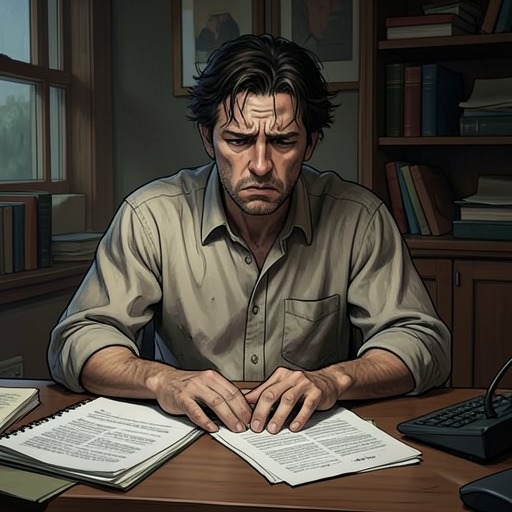
Later, Hink notices that Henry’s work at school is faltering. Henry has missed newspaper meetings, failed to complete required reading and homework, and handed in an overdue essay late or not at all. Hink has spoken with Mrs. Beady, Señor Sanchez, and other teachers; Mr. Hotchkiss has also reported that Henry is often distracted in math. Rather than treating any one lapse as the whole problem, Hink connects the reports and asks whether too many demands are accumulating. He reminds Henry that the school expects a great deal from him, perhaps more than from most students, and offers to look for ways to help if Henry cannot manage everything.
His attention extends beyond Henry’s grades to the newspaper’s progress. Because Henry and Grace have missed or rescheduled every meeting Hink arranged, the issue has no settled theme and not enough material. That delay also affects Lola, who cannot finish the design without content. Hink tells Henry to get the project under control and sets a clear limit: if the editors cannot sort it out by the end of the month, he will replace them. His support is therefore neither passive reassurance nor unconditional protection from consequences. He recognizes Henry’s difficulties but makes the responsibilities to the staff and publication explicit.
Deadlines and Editorial Resolve
The pressure becomes acute when the paper is close to its printing deadline. Henry argues that more material is available or nearly ready, including a feature on Magic: The Gathering, and says articles can be delivered to Lola within days. Lola answers that the remaining time is not enough for her to complete months of design work in a couple of days. In that exchange, the editorial problem is no longer simply a shortage of writing: the late material has left the designer without a workable schedule.
Lola tells Henry that printing is scheduled for Monday and that the printing has already been paid for. She says she would remove him immediately if the decision were hers alone, but that Hink still believes he can assemble something. She also invokes the newspaper’s thirty-five-year record of never missing publication. Hink is not present in this exchange, so his position is conveyed through Lola’s account; still, the contrast is revealing. He has not withdrawn his confidence in Henry, but that confidence operates alongside an institutional obligation to get the issue into print.
Narrative Role and Significance
Hink’s influence develops through a series of practical interventions rather than a single dramatic lesson. His defense of the arts helps Henry imagine a future in writing; his choice of senior editors gives Henry and Grace a shared project; and his follow-up turns that opportunity into deadlines, meetings, and accountability. When Henry’s performance slips, Hink notices through reports from several teachers and offers help. When the paper itself is threatened, he continues to believe Henry can contribute while maintaining that publication cannot simply be abandoned.
The characterization also stays close to Henry’s perspective. Hink’s dandruff, clothes, office arrangements, and schoolroom conflicts are filtered through Henry’s wry observations, while his actions disclose a more serious commitment to teaching and the newspaper. He is not shown as having full access to Grace’s circumstances or Henry’s private reasons for becoming distracted. Instead, he responds to what he can see: a student with promise falling behind, two editors failing to meet, and a publication whose work depends on several people. That combination of limited knowledge, encouragement, and firm standards makes Hink a consequential mentor without turning him into an all-knowing rescuer.