Grace Town
Our Chemical HeartsGrace Town’s story is shaped by the distance between the person others first see and the person she is trying to live with after a fatal car accident. She arrives at Westland High carrying visible signs of injury and grief, while withholding the history that gives them meaning. As Henry Page grows close to her, he must recognize that his image of Grace is only one version among several; Grace’s eventual recovery begins when she stops treating pain as a debt she owes the dead.
Identity and Introduction
Grace first appears in Mrs. Beady’s afternoon drama class ten minutes late on the second Tuesday of senior year. Henry initially expects a life-changing encounter to announce itself, but her entrance brings no romantic revelation. Instead, he notices her cane, her silence, and clothing far too large for her: jeans held up with a belt, a sweater, a checked shirt, a knit cap, and an anchor necklace. Her hair and general appearance also suggest that she is not taking care of herself. She sits at the back of the black-walled room with the cane across her thighs, speaks to no one, and leaves without drawing attention. Henry soon forgets she was there, a quiet contrast with the lasting importance she acquires in his life.
When Grace returns to school, her appearance has changed in a small but striking way: her hair is washed and brushed, though cut unevenly. Waiting outside Alistair Hink’s office, she sits with her knees drawn up and her cane between them, reading a battered book of poems. When Henry looks at it, she angles the pages so he can see them too. The gesture offers a rare opening without making her suddenly sociable. In Hink’s office, she interrupts his announcement that she and Henry have been selected as senior editors for the newspaper. Her clear, deep voice surprises Henry, who had mistaken her quietness for a more fragile nature. The scene establishes both her writing ability and her refusal to let others dictate the terms on which she participates.
The Accident and Its Continuing Effects
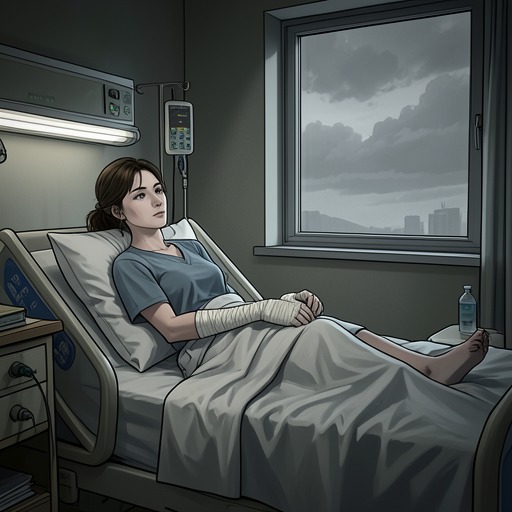
Grace tells Henry that a serious car accident happened about three months before. The car rolled repeatedly, and she spent roughly a month in hospital receiving treatment for her leg, including pins and skin grafts. She was mostly unconscious for a week, then endured a period when the pain made her wish she would die. Recovery meant learning to walk again, and the resulting scars and uncertain future for the pins remained part of her everyday life. She does not invite Henry to inspect her injuries; she gives him the facts and makes clear that disclosure does not entitle him to more.
Her mobility is not merely background to her characterization. At night, Henry and his friends see her at the East River track, trying to run without her cane. She returns to the starting line and attempts another short run, but the injured leg makes the effort difficult. She stops in distress and sinks to the ground. The episode reveals how urgently she wants to test her body, while also showing that determination cannot simply undo the injury. Later, when Henry sees the scarring and the difference in size between her legs, the extent of what she has lived through becomes harder to treat as an abstraction. He responds with tenderness rather than withdrawing from her. The story connects the injury to her guilt, but it also presents concrete limitations, medical treatment, and effort rather than making recovery a purely symbolic change.
Dom and the Withheld Truth
The decisive revelation comes after Henry has followed Grace’s behavior without understanding what it means. Her visits to a grave, her clothing, her attachment to a car, her attempts to run, and the songs Henry had taken to be theirs all point back to Dom. When Grace finally explains, she says that Dom was driving. She cannot finish the account of what happened to him, but Henry understands that Dom died in the crash. The disclosure reorganizes the details he has previously observed: the music was associated with Dom, not originally with Henry and Grace, and the clothing and places Henry interpreted as eccentricities belong to a life interrupted by loss.
The truth is not disclosed all at once. On the night of her birthday, Grace tells Henry to wait on the lawn and not enter her house. The drawn curtains and overgrown garden intensify his sense that parts of her life remain inaccessible, but the evidence does not explain the secrets he imagines. A man who has come to collect her car appears at the house, and Grace’s mother leaves after a tense visit. When Henry asks whether the woman was her mother, Grace answers ambiguously and says it does not matter. The exchange gives a glimpse of unresolved family distance without clarifying its history. Later, when Grace says she wants to tell Henry about Dom, she recognizes that he deserves the truth after having been kept outside so much of her grief.
Henry’s Love and Grace’s Grief
Henry’s relationship with Grace develops under an imbalance of knowledge. He loves her, but at first he knows more about his own imagined version of their connection than about the history she carries. Grace’s explanation of Dom makes that imbalance unavoidable. She says that she expected grief to ease as time passed and new memories accumulated, but she did not want it to become easier. She deliberately carried the weight of Dom’s death and some of his parents’ sorrow, believing that the pain was deserved. Her grief is therefore not only something she suffers; it is something she has turned into a chosen punishment.
By the end, Henry understands that he has loved several different images of Grace: the living person who still wore Dom’s clothes, slept among reminders of him, and pushed her injured body in an effort to prevent it from healing too quickly; the Grace preserved in photographs and Henry’s partial memories; and the whole, luminous figure he had helped assemble in his imagination. The distinction does not make his love false, but it exposes its limits. His idealized version cannot replace the person whose grief and choices he had not fully understood. Grace’s compliment to him, describing him as an extraordinary collection of atoms, is followed by her departure rather than a promise of a future together.
Recovery and Ending
After the Christmas break, Grace’s limp becomes less noticeable and she stops using her cane. She begins driving herself to school. Although she sometimes still wears one of Dom’s belongings, such as a knit cap, necklace, or jacket, she mostly returns to her own clothes. These changes accompany a deeper shift: she gradually stops treating continued suffering as proof of love or as a form of justice. Her recovery is not presented as forgetting Dom. Instead, the reminders remain while the self-punishment loosens its hold.
Grace and Henry eventually separate. They remove each other from social media, and they transfer custody of their pet, Ricky Martin Knupps II, to Ryan, who renames him Fish Fish. The practical ties between them end alongside the romance, although Henry continues to feel her absence, especially at New Year’s Eve and in the ordinary moments of waking alone. His love persists, while Grace’s grief remains bound to Dom. Grace’s arc thus resists a conventional romantic resolution: becoming more mobile and allowing herself some release from guilt does not mean that she becomes Henry’s partner. Her significance lies in that distinction. She is neither only the injured girl Henry first sees nor the idealized figure he builds from fragments, but a person whose recovery requires acknowledging the difference between remembrance and self-punishment.