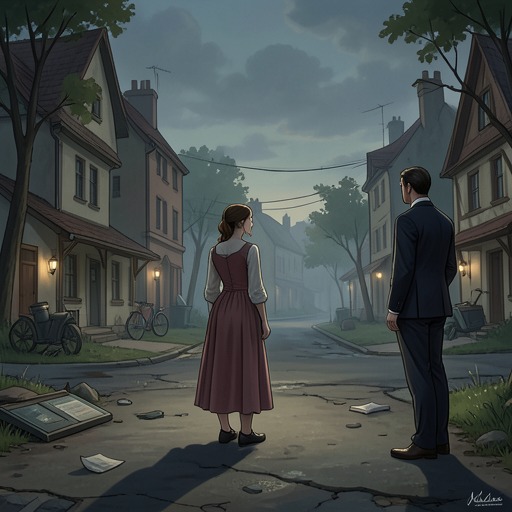
Grace Town and Dominic Henry Sawyer's first love and lasting relationship
Our Chemical HeartsGrace Town and Dominic Henry Sawyer’s first love began when Grace was nine and became the defining relationship of her childhood and adolescence. Dom and his family offered her a refuge from an unstable home; the life they imagined growing into together was cut short by the crash that killed him. For Grace, love, safety, bereavement, and guilt remained bound together, making the work of mourning inseparable from the question of whether she could continue living for herself.
Childhood and a Place to Belong
Grace’s first meeting with Dom took place against a childhood marked by neglect. Her father had died, her mother had been absent for three days, and there was no food left at home. After Grace called her uncle, he collected her but, unable to care for her, left her with Mary, a woman from work. He told Grace that Mary had a son around her age. Grace disliked boys, who had been cruel to her at school, but the boy she met at Mary’s house changed that expectation.
Dom was jumping on a trampoline when Grace arrived. He promptly invited the shy newcomer to play Mario Kart, taught her how to use a game console she had never seen before, and let her win. Later, they held hands while watching cartoons on a laptop in his tree house. Grace remembered the day as one of the best of her childhood and decided by its end that she would marry him. The ease of Dom’s welcome, and the presence of a family that treated her with care, mattered as much as the beginning of romance: Grace loved his family as well as Dom because their home showed her a kind of belonging she had not known.
A First Love and an Imagined Future
The childhood attachment was mutual and deepened as they grew older. Dom was the first boy Grace held hands with and kissed, and, as she later told Henry Page, her first and only everything until Henry. She did not describe their love as something she understood only in retrospect. She had known while they were together that it was extraordinary, and she had worried about losing Dom and his family even as she felt fortunate to have found them so young.
That certainty gave their future a particular weight after Dom’s death. Grace had imagined the two of them growing up together, going to college, and traveling the world. She understood their relationship as eight years of a love she had expected to last a lifetime; when Dom died, the future she had pictured seemed to die with him. Her memories did not make him flawless. She recalled his uneven habits, his tendency to pick his fingernails when nervous or watching sports, his affection for Katherine Heigl’s films, and his enthusiasm for Carl Sagan. These ordinary details sit alongside her conviction that Dom’s soul was extraordinary: she could recognize his imperfections and still regard him as singularly precious.
The Crash, Grief, and Guilt
Dom’s parents, Martin Sawyer and Mary, had become Grace’s family. She had moved in with them about a month before the crash, and after Dom died they insisted that she stay. Martin described her as practically their daughter, a bond that extended the loss beyond the death of her first love. Grace had feared that her troubled family circumstances might make them tire of caring for her; instead, they continued to offer her a home.
After the crash, Grace was hospitalized and too ill to attend Dom’s funeral. His family asked her to write something that could be read in her absence, knowing her as a writer, but she avoided writing the eulogy and had not written since. She explained to Henry that she could not make herself write it until she made herself try. The refusal was tied not simply to difficulty finding words for grief but to a secret she had never told anyone: Grace believed the crash was her fault. She said she had teased and distracted Dom after he told her to stop, and that they then ended up in the wrong lane. Henry called it an accident and rejected her blame, but Grace expected other people to answer her confession with explanations such as survivor’s guilt. Their disagreement exposes the distance between being reassured and being able to forgive oneself.
Grace also recalled that, during the first month after Dom’s death, people watched her for signs that she might kill herself. She resented being monitored and said she had not been depressed; she was angry. Her insistence that Dom alone had known her underscored how misunderstood she felt by those who feared for her, including Henry, who later admitted that he had also believed she might be dead. Her mourning therefore involved not only longing for Dom but resistance to other people’s assumptions about what that longing meant.
Keepsakes and the Continuing Bond
At the abandoned train station’s pond, Grace finally told Henry the story of Dom and the crash. She brought a small metal box containing objects from the shrine she had kept for him: the anchor necklace she had worn when Henry first saw her, a keychain bearing The Strokes’ name, and Dom’s Ramones shirt, which she had been unable to wash. The box itself was marked DOM GRADE 10. In the water, where her limp was barely visible, Grace and Henry held hands as she released the objects one by one into the depths; the box went last, settling among debris as fish moved around it.
The act did not establish that Grace had fully absolved herself. Henry wondered whether it meant redemption and whether she had forgiven herself, but he could not know. Its significance lies in the change of action: after preserving Dom’s belongings and withholding the story of her responsibility as she understood it, Grace told the truth and let the keepsakes go. She left the station wearing Henry’s jacket, then changed out of her damp white dress in the street and threw it into the gutter. The scene marks neither the erasure of Dom nor a simple end to grief; it makes room for the possibility of movement while leaving the future unsettled.
That uncertainty continues into the aftermath. When Henry later handed Lola Leung Grace’s envelope, he called it his redemption, and he described his recovery not as forgetting Grace but as a gradual change in the force of his attachment: a week later, she was no longer the first person he thought of on waking, and the wound had begun to heal. His account echoes the larger distinction in Grace and Dom’s relationship between a lasting bond and a future that cannot be restored. Dom remains her first love and the person around whom she once imagined her whole life, but the story’s ending allows her, and Henry, to survive without pretending that survival makes the loss disappear.