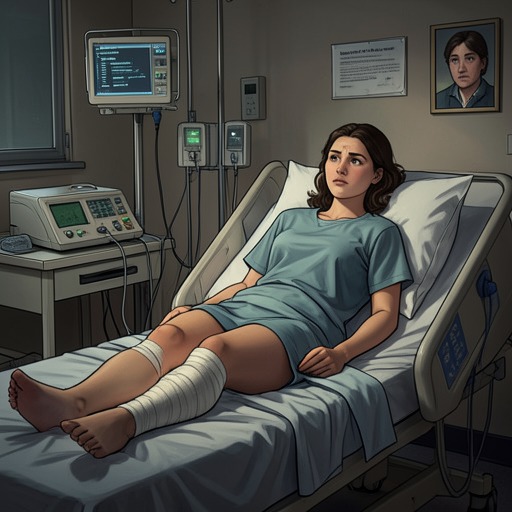
Grace Town’s injuries from the car crash
Our Chemical HeartsGrace Town’s injuries from the car crash are an enduring physical reality in her life, not merely the reason she first appears with a cane. Her damaged leg limits how she moves, bears scars from repeated grafting, and remains the focus of a painful attempt to run at East River High’s track. The narrative also connects the injury to Grace’s grief for Dom and to her belief that she owes a debt for surviving. Her later improvement matters, but it is gradual: the limp becomes less noticeable and the cane disappears, without the account claiming that the damage itself has been erased.
First Appearance and Mobility
When Henry Page first sees Grace Town at school in mid-September, she walks with a cane. She arrives ten minutes late to drama class, sits at the back of the black-walled room, and rests the cane across her thighs. Her entrance is quiet and unceremonious; Henry initially looks at her only a few times and has forgotten her by the end of class. The cane nevertheless establishes that her difference is immediately visible, before he understands its cause or the extent of the injury.
The injury affects more than how Grace is perceived. She walks with a pronounced limp, and later, when leaving Henry’s house, she has to stop every few steps to rest her leg. This gives her movement a practical cost and pace of its own. The contrast between the stillness of her first classroom appearance and the effort involved in crossing a hallway makes mobility part of the ordinary texture of her days, rather than a detail confined to a single medical explanation.
Scarring and Medical Treatment
The damage becomes more fully visible during an intimate moment with Henry. As he touches the scar tissue on Grace’s upper thighs, she explains that the two large red rectangles are where skin grafts were taken. The first graft did not take well, so surgeons had to return for more skin. The account then describes the much more extensive injury to her calf: skin and muscle have been gouged away, and a mesh of grafted skin covers the area. That leg is about half the size of the other, and its appearance is thin, raw, and delicate beside the fresh bruises and welts left by her latest visit to the track.
Grace also tells Henry that the pins in her leg have already been changed once. They might be removed in a few years, she says, though she is unsure; she compares the possibility of being put back together to Humpty Dumpty. Her uncertainty keeps recovery open-ended. Henry responds by kissing the angry red skin and telling her she is perfect, but the physical description remains specific: her ability to walk at all is striking in light of the damage, and affection does not make the scars, altered leg, or medical uncertainty vanish.
Running and Self-Inflicted Pain
One night, Henry and Murray Finch go to the track after Madison Carlson has sent them there. From the shadows, they see Grace alone beneath the lights. She is sweating and bent over, catching her breath. Without her cane, she limps back to the starting line, kneels, and tries to run. Her injured leg strikes the track with each step, deepening the grimace on her face; after roughly one hundred feet, she stops, screams, and pulls at her hair.
Grace then takes up the cane she left beside the track and strikes her injured leg with it repeatedly before sinking to the ground in tears. The episode shows both the limit of what she can physically manage and her deliberate use of pain against herself. It also makes clear that removing the cane for the attempt is not evidence that she has recovered: she has to return to it, and the attempt ends in renewed injury and distress. The narrative does not establish one definitive reason for what she does. Later, Henry wonders whether worsening the injury gives Grace a sense of control, keeps her connected to the accident and Dom, or reflects how much she hates herself. These are his possible explanations, not a motive Grace confirms.
Grief, Change, and Recovery
The injury carries a particular emotional weight in Henry’s understanding of Grace’s grief. He imagines that her damaged leg may be the last thing tying her to the accident and therefore to Dom, whom she loved. That connection is presented through Henry’s speculation, but the later account of Grace’s recovery places the physical change beside her changing relationship to grief: after Christmas, her limp becomes less noticeable, she stops using the cane, and she begins driving to school. Sometimes she still wears one of Dom’s things, such as a knit cap, necklace, or jacket, but mostly she wears her own clothes.
The narration describes this gradual shift as Grace paying a tithe and letting herself be redeemed from an imagined debt. That language makes recovery both bodily and symbolic, while stopping short of saying that physical healing settles the loss. Grace’s change is marked by less visible limping and greater independence in getting to school, not by a claim that her leg has returned to its former condition. The injury thus remains consequential even as it becomes less prominent: it has shaped how she moves, how she regards her survival, and how Henry tries to understand her, while her eventual progress belongs to a slow process rather than a sudden cure.