Grace Town’s post-accident leg injury and impaired mobility
Our Chemical HeartsGrace Town’s post-accident leg injury is both a concrete limit on her mobility and a recurring feature of how others encounter her. The cane with which she first enters school makes her injury visible before its history is known; later, the account of the crash and its treatment gives that first impression a physical history rather than reducing it to an unexplained sign of difference.
Injury and Early Mobility
When Grace first appears in the drama room, she arrives ten minutes late and walks with a cane. She sits at the back with it resting across her thighs, says nothing through the class, and leaves without drawing notice. The cane is a practical part of her presence, but the scene also establishes the contrast between the attention her injury might invite and her refusal to explain herself. Her mobility becomes more legible in the days that follow: she rises carefully, distributing her weight between the cane and her uninjured leg, and walks behind Henry Page even when he slows his pace to let her keep up.
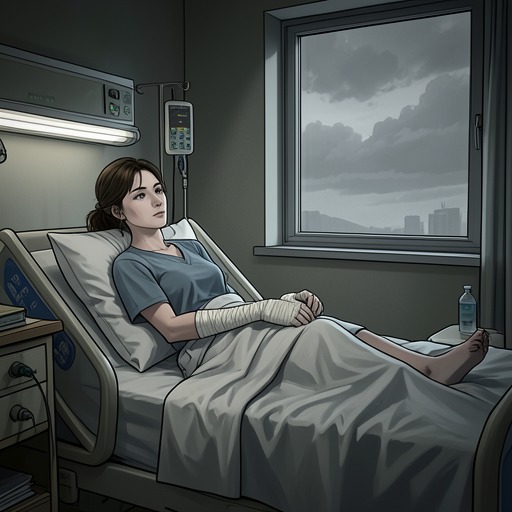
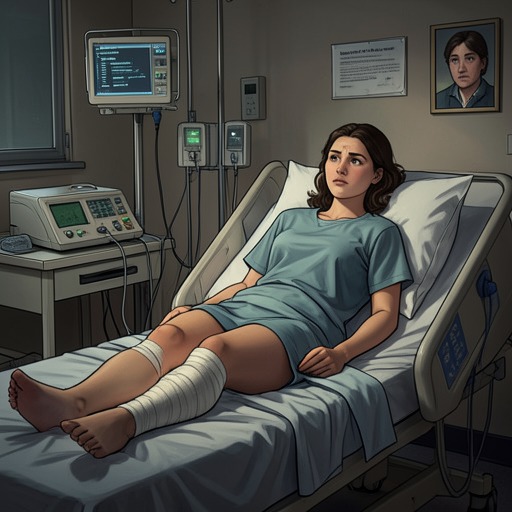
Grace later describes the accident as having happened about three months earlier. The car flipped seven times, and she spent about a month in hospital undergoing treatment that included pins and skin grafts. She was mostly unconscious for a week; during another week, the pain was so severe that she wanted to die. Afterward she began to recover and had to learn to walk again. Her account also mentions extensive scarring, while making clear that she does not want to show it. The disclosure supplies the medical and temporal context for the cane, the limp, and the careful way she manages her weight, without making her injury an invitation to inspect her body.
Her mobility is not constant in appearance or effort. In an uneven storm-water gully, Grace presses farther into the dark despite Henry’s concern about her leg, using her cane to sweep grass aside. Her limp grows more pronounced on the rough ground, but she does not stumble. The episode shows both the extra work her movement can require and her capacity to choose her own route; the cane serves not only as support but also as a tool for clearing the path.
Exertion, Pain, and Visible Scarring
One night, Henry Page and Murray see Grace at the East River track, trying to run without her cane. Dressed in her usual oversized clothes, she is sweating and bent over for breath; after resting, she limps back to the starting line and tries again. Her injured leg strikes the track with each uneven step. After about a hundred feet she stops, screams, pulls at her hair, and repeatedly hits the leg with her cane before collapsing in tears. The attempt exposes the distance between wanting to run and what her damaged body can manage, while her blows turn that frustration against the very limb she is trying to use. The scene also corrects Henry’s assumption that her pale, brittle appearance means she is incapable of exertion: she pushes herself into motion, but the cost is immediate and visible.
Her limp remains pronounced when she later joins Henry for recreational touch football. She winces as she walks, and says that rehabilitation is demanding; Henry recognizes that her explanation does not account for how readily she conceals difficulty. The injury is therefore present not only in the exceptional scene of her collapse at the track, but in ordinary movement and in the effort of taking part in an activity with other students. Her cane can be absent without the impairment being gone.
During her first sexual encounter with Henry, the scars and surgical aftermath become physically visible. Two large red rectangles on her upper thighs mark the places where skin was harvested for grafts; the first graft had not taken, so surgeons had to take more. The worst damage is on her calf, where skin and muscle were gouged away and the remaining flesh is covered by grafted skin. That leg is about half the size of the other, and fresh bruises and welts mark it from her recent attempt at the track. Henry’s recognition that it is remarkable she can walk at all registers the severity of the injury, while his tenderness toward the scarred skin answers the bodily exposure without treating the scars as a reason to turn away. Grace also tells him that doctors have already changed the pins once and may remove them in a few years, though she does not know what will happen. Recovery remains unfinished and uncertain even in this intimate moment.
After Christmas, Grace’s limp becomes less noticeable and she stops using her cane altogether. She begins driving to school, a change that marks greater mobility as well as a practical return to independence. The improvement is gradual rather than a sudden cure: she sometimes still wears Dom’s clothing, but mostly wears her own, and the narrative links her increasing freedom of movement with the easing of her self-imposed debt. Her later mobility changes how the injury appears, but does not erase the accident, the scars, or the painful work of learning to walk again.
The Injury in the Story’s Closing Movement
At the abandoned train station, Grace’s limp is barely discernible as she leads Henry Page into the pond and releases the keepsakes she has carried for Dom. The water changes how her movement appears, but the scene does not suggest that her leg has healed: it places a temporary easing of the limp alongside the deliberate act of letting go. After the box, marked with Dom’s school-year inscription, sinks among the fish, Grace wades out and climbs the steps, then leaves the station barefoot. Her body remains in motion, still bearing its history, while the scene shifts the emphasis from what the injured leg can endure to what Grace is choosing to release.
Recovery and the Limits of Visible Change
The injury’s recovery is narrated through changes others can see, but those changes do not establish that the damage has been undone. After Christmas, Grace’s limp grows less noticeable, she stops using the cane, and she starts driving to school; the account does not say that her scars disappear or that the pins are removed. By placing this gradual improvement beside the easing of her imagined debt, the story gives physical recovery emotional weight without making the two identical. The distinction matters: a cane can be put aside, and movement can become easier, while the past remains part of the body. The arc therefore resists a simple cure as its final measure, even as it uses mobility’s return to register a change in Grace’s life.