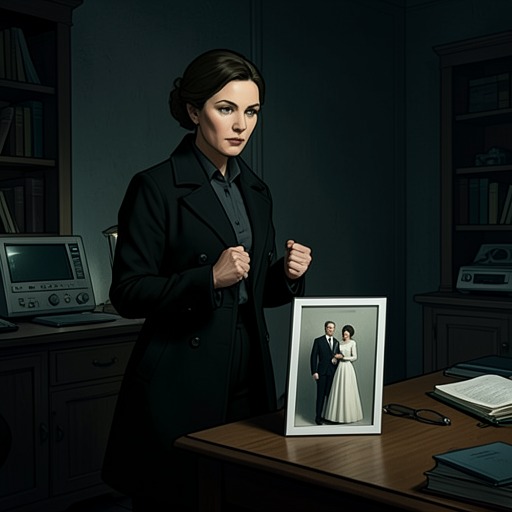
Grace Town’s survivor guilt and unresolved grief
Our Chemical HeartsGrace Town’s survivor guilt and unresolved grief govern how she remembers Dom, inhabits the present, and imagines what she deserves from the future. She knows their relationship was extraordinary and had expected to spend her life with him, yet after the crash that killed him she interprets survival not as chance but as a debt. Her efforts to preserve Dom and punish herself for his death give grief a daily structure; releasing some of those practices begins a change, but does not erase her attachment or resolve her pain at once.
Origins of the Grief
Grace’s grief is rooted in a bond that began in childhood. She met Dom when she was nine, at a time when her father had died, her mother was absent, and there was no food at home. Her uncle left her with Mary, and Dom welcomed her into his family’s home. Their first day together—playing Mario Kart and holding hands while watching cartoons in a tree house—became one of the happiest memories of her childhood. Grace says she loved Dom and his family, and that their care showed her a kind of home she had not known before. She decided that day that she would marry him.
The relationship deepened as they grew up. Dom was the first boy she held hands with and kissed, and the first person she loved. Grace describes him as her first and only everything until Henry Page. They had imagined growing up, going to college, and travelling together. Because their life together had begun so early, Grace did not regard their love as something she had only understood after losing it: she says she knew, while they were together, how extraordinary it was. That certainty intensifies the loss. In her account, she had not merely lost Dom; she had lost the future they had planned and the family whose acceptance had mattered so much to her.
Guilt, Silence, and Remembrance
For the first month after Dom’s death, other people watched Grace closely because they feared she might harm herself. She resented being treated as a danger instead of being allowed to mourn, and says Dom had been the person who understood her. She insists that her central feeling was anger, not depression. That distinction does not make her grief less profound; it shows how poorly other people’s assumptions fit her own experience of loss.
Grace also keeps the circumstances of the crash to herself. She tells Henry that she distracted Dom by teasing him after he had asked her to stop, and that they ended up in the wrong lane. She therefore calls the crash her fault, though Henry and others regard it as an accident. Her conviction helps explain why reassurance alone cannot settle the matter for her: she is not simply unaware of the possibility that she is mistaken, but afraid that others will dismiss her account as survivor guilt without hearing what she believes happened.
The loss returns through repeated acts of remembrance. Grace visits Dom’s cemetery almost every day, and once tells Henry that she will stop going for his sake. Henry is surprised to realize how much he had come to regard her visits, her clothing, and even her scent as part of a life still organized around Dom. In Dom’s room, he finds his belongings arranged among ordinary teenage clutter: books, a guitar, old records, a globe, a skateboard, trophies, and jewelry. A shirt Grace had worn still carries the scents of all three of them. The preserved objects reveal the extent to which the past remains present in her daily life; her grief is sustained not only by memory but by the things she has kept unwashed and unchanged.
Grief as a Debt
Grace interprets continued suffering as a form of repayment. Dom’s parents pay her medical bills and allow her to live in their house, and she feels that becoming happy with Henry would betray them after Dom died beside her. She believes that being sad makes her feel less guilty and is the least she can offer Dom and his parents. In this moral accounting, suffering becomes both punishment and proof of loyalty: she imagines that she must endure pain to make some kind of justice possible.
The logic is also present in her refusal to write. Before the crash, people valued her writing, and Dom’s family asked her to prepare words for his funeral. Grace did not write the eulogy and has not written since. She says words fail to express the scale of loving and losing someone like Dom, but also recognizes that she may not write again until she makes herself do it. Her silence thus holds more than an inability to describe grief: she has avoided a task that would require her to give the loss a form and face what she believes she did.
An earlier way of coping appears when Grace takes Henry to a place she visited with a childhood friend. Looking at the stars, she describes the universe as beautiful but governed by science and chance, not magic. She returns to the place to be reminded of her insignificance, and calls space the best cure she knows for sadness. This cosmic perspective does not undo her personal attachment. Instead, it places that attachment beside a universe that offers no promise of fairness or explanation—a contrast sharpened by her belief that she and Dom were exceptionally lucky to find each other so young, only to lose him.
Disclosure and Release
After Grace disappears on Dom’s birthday, Henry finds her and hears the history she has withheld. She recounts meeting Dom, the life they expected to share, her refusal to write his eulogy, and her belief that she caused the crash. Telling the story makes Henry a witness to the grief she had kept private, but it does not immediately change her belief that she owes Dom a lifetime of sadness. She explains that, after the first weeks, she expected time to soften the grief; when it did not, she realized that she had not wanted it to. She carried her own pain deliberately and took on some of Dom’s parents’ grief as well.
At the abandoned train station, Grace releases objects from Dom’s shrine into the underground pool: the anchor necklace she had worn when Henry first saw her, a Strokes keychain, the Ramones T-shirt she had been unable to wash, and finally the small metal box holding them. The gesture makes remembrance physical and deliberate. She lets the objects sink, but the scene does not establish that she has forgotten Dom or forgiven herself completely. Henry wonders whether this is redemption; Grace answers with the idea that a happy ending may only be a story that has not finished. The release is a turning point, not a guarantee of closure.
Gradual Change and Lasting Attachment
Grace later explains that meeting Henry had already interrupted the cycle of grief. During their first afternoon talking, she says, she went twenty minutes without thinking of Dom, a record for her, and afterward felt lighter. That night she slept for four hours without waking. The relief matters partly because it shows that new memories and relationships can create space around grief, but Grace’s account does not make Henry a replacement for Dom. She remains conscious of the difference between feeling relief and believing that she has earned permission to move on.
Over the following months, Grace’s recovery appears in small changes rather than a single resolution. After Christmas, her limp becomes less noticeable and she eventually stops using her cane. She begins driving to school and mostly wears her own clothes, although she sometimes still chooses something of Dom’s, such as a knit cap, necklace, or jacket. The continued use of some of his belongings sits beside her return to ordinary routines: remembrance and movement coexist rather than cancel each other out.
Grace and Henry ultimately separate, and their remaining ties gradually fall away. Her recovery is therefore not presented as a romantic resolution in which a new relationship cures the old loss. The narrative instead tracks a slow loosening of the self-punishment that had made sadness feel like an obligation. Grace’s grief remains part of her history, but it no longer dictates every visible detail of her life. The distinction between carrying Dom and sentencing herself to suffer for him is the central change her arc makes possible.