Grace Town's mourning for Dominic Sawyer
Our Chemical HeartsGrace Town's mourning for Dominic Sawyer is an intimate, uneven process that governs how she inhabits places, carries memory, and approaches a new relationship. Dominic remains present through the grave she visits, the music and clothes associated with him, and the choices she makes after his death; for a time, Grace's grief also makes her feel that she must keep suffering. Her eventual release of his keepsakes marks a change in that relationship, not proof that love or memory has disappeared.
Memory, Place, and Private Ritual
Grace's mourning is visible to Henry Page before he understands its cause. At the cemetery, Henry and his friends see her walking among the headstones with flowers in her hand. She kneels beside a grave already covered with blooms, then lies on her stomach in the grass, turning blades between her fingers while her lips move as if she is speaking or singing to someone beneath the earth. The group watches, transfixed, until Sadie Page insists that the moment was not meant for them. The scene establishes that Grace's connection to Dominic is not a performance for observers: it is a private practice whose meaning Henry can witness without yet knowing.
Grace also describes the Abandoned train station as a place where she goes to remember her smallness in the universe. A friend first brought her there when they were children; the pair used to break in and talk for hours. Now the scale of space helps her manage sadness. Her view of the universe is not magical or consoling in a conventional religious sense: its beauty lies alongside randomness and science. That sense of cosmic perspective offers a way to endure grief, but it does not make Dominic's absence less particular. The station is both a refuge from sadness and, later, the setting for a direct encounter with the objects that keep his memory close.
The Crash and the Meaning of the Loss
Grace's grief becomes legible to Henry when she breaks down and tells him that Dominic was driving. She had injured her leg; he did not survive. The revelation reorganizes details Henry has previously encountered—the cemetery, her clothes, her car, the track, the Abandoned train station, and The Strokes. What he had taken as signs of Grace's eccentricity or a developing romance also belonged to her life with Dominic. Even the song Henry had treated as shared between himself and Grace was, in her history, associated with the two of them.
Grace explains that she transferred schools to get away from places she and Dominic had shared and to try to hold herself together. She did not intend to like Henry, kiss him, or become involved with him; she also did not want to be defined as the girl whose boyfriend had died. Her wish for a fresh start therefore coexists with a loss she cannot simply leave behind. After she tells Henry, the subject goes unmentioned the following Monday. He searches for the crash report, but finds that Grace's name was not used, and hesitates to read the account. The silence between them is not resolution: both the unspoken history and Henry's uncertainty remain active.
A Bond Carried into the Present
Grace asks Henry to keep their relationship private while she decides what she wants, partly because dating so soon after Dominic's death would be considered poor taste. Henry recognizes that she is not his girlfriend and that they have kissed only twice, but still feels the strain of being kept secret. He avoids asking about Dominic, in part because he fears what he might learn and has treated Grace as a mystery rather than as someone mourning a previous love.
The date that follows makes the past feel physically present to Henry. After kissing Grace goodbye, he rides home wondering whether messaging her would seem like a cheap slight against her dead boyfriend. He imagines Dominic occupying the empty bus seat and recognizes that their relationship cannot become an ordinary romance simply by avoiding discussion of him. This ghostly presence is Henry's image of the conflict, but it has a material counterpart in Grace's attachment to Dominic's room and belongings.
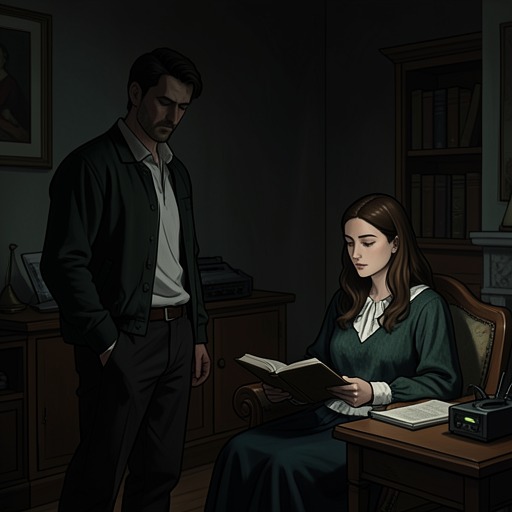
When Henry enters Dominic's room, he sees a life preserved in its objects: books, a guitar, old records, a globe, a skateboard, childhood trophies, and necklaces. He notices that Grace has not washed Dominic's clothes or sheets. A gray band shirt she wore to the movies has had its ketchup stain sponged away but has not been laundered; its fabric carries the scents of Grace, Dominic, and Henry. The discovery changes Henry's understanding of her habits. Dominic's presence is not only an idea he fears competing with; it is woven into the things Grace wears and the room where she stays. Henry concludes that Grace herself has become the living carrier of a relationship interrupted by death.
Anger, Childhood, and Being Known
After Grace disappears, Henry tells her that people had been worried about her. She reveals that she was placed on suicide watch during the first month after Dominic died, as others feared she might kill herself. She resented being watched so closely that she could not mourn in peace, and felt that Dominic, unlike those monitoring her, would not have mistaken grief for an intention to die. She insists that she was not depressed but angry. Her account distinguishes mourning from the assumptions others made about it, while showing how isolation followed from her belief that Dominic alone truly knew her.
Grace's account of meeting Dominic at nine gives that belief its history. Her father was dead, her mother had been absent for days, and there was no food at home. After her uncle left her with his colleague Mary, Grace met Mary's son, Dominic, who invited her to play Mario Kart and patiently taught her. They played games, held hands, and watched cartoons in his tree house. Grace remembers the day as one of the best of her childhood and says she decided by its end that she would marry him. Dominic and his family offered a form of welcome she had not known before. Her mourning therefore encompasses not only a lost boyfriend but also the person and family through whom she first experienced that care.
Release Without Erasure
At the Abandoned train station, Grace brings a small metal box containing things from Dominic's shrine: the anchor necklace she wore when Henry first saw her, a Strokes keychain, and Dom’s Ramones T-shirt, which she had been unable to wash. She leads Henry into the water and releases the keepsakes one by one. Last to sink is the box marked DOM GRADE 10. The act makes a visible change in how she relates to the collection she has preserved; it does not establish that she has stopped loving Dominic or reached a simple, final absolution.
In the following months, Grace's recovery appears through gradual changes rather than a single cure. Her limp becomes less noticeable after Christmas break, and she stops using Grace's cane. She begins driving to school. Sometimes she wears one of Dominic's things—a knit cap, necklace, or jacket—but mostly she wears her own clothes. The contrast matters: the past remains available to her, yet no longer determines every outward choice. Henry describes her imagined debt as being paid and her gold seams appearing, but the novel keeps that redemption tentative rather than treating grief as a ledger that can be conclusively settled.
Henry's own recovery offers a parallel measure of time. A week after receiving Grace's letter, she is no longer the first thing he thinks of on waking; the pain has begun to ease, and he knows he will survive. Their lives separate, but his account ends by acknowledging that he continues to love Grace as she loved Dominic. Her mourning thus changes form rather than vanishing: the story's movement is from grief that occupies rooms, clothes, and daily identity toward a life in which remembrance can remain without requiring the same acts of self-punishment.