Grace's Hyundai
Our Chemical HeartsGrace's Hyundai is at once a practical vehicle, a conspicuous personal object, and a trace of a friend whose presence persists in Grace's possessions. The small white car sits in the driveway of Grace Town's overgrown, gray-brick home, wearing a Strokes decal on its back windshield. Its keys carry the same band's paraphernalia, while the car and Grace's phone both turn out to have belonged to a friend. The car's significance emerges not from a dramatic journey but from these accumulated details: it makes Grace's attachment visible before Henry Page understands what that attachment means.
Appearance and Place in Grace's Life
The car is introduced against the stillness and neglect of Grace's house. Its solitary presence in the driveway contrasts with the wild lawn and drawn curtains; to Henry, the vehicle is one more strange detail about a girl who walks or hobbles the fifteen-minute trip to school despite having a license and a car available. He measures that apparent contradiction against his own image of high-school freedom: other seniors, he thinks, would relish driving to the mall or McDonald's, avoiding the bus, and going home in comfort. The Hyundai therefore registers first as a practical resource Grace does not seem to use in the expected way.
That expectation shifts when Grace tosses Henry the keys and goes to the passenger side. She expects him to unlock the car and drive, while he is surprised to discover that the keys are not an invitation for her to take the wheel. He has had his license for only a couple of months and has no car of his own. His hesitation makes the vehicle a small test of trust: Grace hands him access to a possession that matters to her, and he has to accept responsibility for it.
The Drive and the Car's Inherited Details
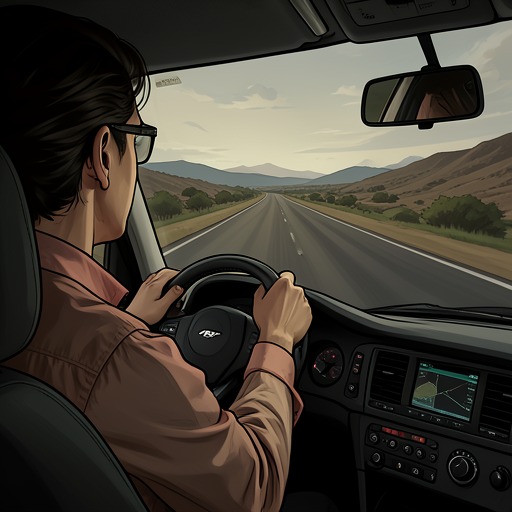
Henry gets into the driver's seat and finds that the interior smells, to him, like a teenage boy, an impression that confuses him because he associates the car with Grace. He admits that he is rusty, starts the engine, and makes an awkward joke about trying not to kill them both. Grace does not respond. The joke earns only Henry's own single, uncomfortable laugh before he reverses out of the driveway.
The trip home is no effortless display of teenage independence. Henry hunches over the steering wheel, sweats, and remains acutely aware that he is driving someone else's car after months without driving. He also remembers having barely passed his test with the help of a violently hungover second cousin who had to stop three times to vomit. The comic detail sharpens the stakes of the scene without making the drive consequential in itself: Henry is inexperienced, the car is not his, and Grace has nonetheless put him behind its wheel.
The Strokes markings provide a second clue to the car's history. Henry notices the decal, the decorated key ring, and the band's place on Grace's phone background, and assumes that she is a fan. Grace explains that a friend liked the band's music. The car is his old car, she says, and the phone is his old phone too. The repeated explanation alters the meaning of the matching objects: what looked like a collection of Grace's musical preferences is instead a set of inherited belongings, carrying a friend's taste into her present life. The evidence establishes the friend's connection to the objects, without making the car itself explain the full history of their relationship.
Disappearance, Return, and Narrative Significance
Later, Henry watches the street from a front windowsill, reading and waiting for the mystery of the disappearing car to be resolved. Just after sunset, as a lightning storm darkens the sky, a short, bald man gets out of a passenger seat and runs through the rain to Grace's Hyundai. He opens the door, looks up, sees Henry watching, and raises a hand; Henry mirrors the gesture. The man nods, gets in, turns the car around, and drives away through the downpour, his brake lights visible in the darkness. The passage does not identify the man, explain where the car had been, or say why he returned it, so the moment preserves rather than settles the mystery.
The episode follows Henry and his friends' visit to the cemetery, which Henry does not know how to discuss with Grace because doing so would expose that they followed her. Instead, he tries to put what he saw aside and follow advice to get to know her. The car's disappearance and return thus sit beside a larger gap in his understanding: the vehicle is an observable clue, but it cannot tell him what Grace has not chosen to explain. Its movement between the house and an undisclosed destination gives physical form to that uncertainty.
As an object in the story, Grace's Hyundai links routine mobility with memory and guarded intimacy. It allows Grace to ask Henry for a ride, exposes his inexperience, and offers a material clue to the absent friend whose old possessions remain with her. The car is neither simply transportation nor a complete key to Grace's past. Its decals, inherited phone-and-car pairing, and unexplained return make it a durable trace of a history that Henry can notice without yet being able to understand.