Henry Page–Lola friendship
Our Chemical HeartsThe friendship between Henry Page and Lola Leung is defined less by declarations than by the work they do for one another: taking charge in a crisis, making something together under pressure, and returning care when one of them is hurting. Lola’s brisk concern for their friends and Henry’s later participation in her recovery show a relationship built on practical loyalty. Their shared work on The Westland Redemption gives that loyalty a second form: collaboration that turns a failing school newspaper into a collective project.
Care in a Crisis
At the school field, Lola comes running after someone calls Henry’s name, but her attention immediately fixes on Murray Finch. She takes Murray’s head in her hands, turns it to inspect him, pushes back his hair, and anxiously checks whether he has a concussion or needs an ambulance. Her urgent examination contrasts with Murray’s joke about his broken heart. When Lola looks up at Henry and Madison Carlson, frowning, her concern is unmistakable: the moment is not simply an amusing aftermath for her, but a situation in which her friends might need help.
That concern becomes practical direction when Murray starts crying and vomits. Lola forbids the group from going to a party, insists that Murray get to his feet, and announces a plan: they will get Burger King, sober up, and go to Henry’s house to do something productive. She pushes Murray’s hair from his eyes without unkindness as he struggles upright. The insistence is firm, but it is also care in action—she notices that the group is in no state to continue the night and takes responsibility for getting them somewhere safer and more purposeful. Henry is included in this plan, not treated as a bystander to Lola’s intervention.
Making Something Together
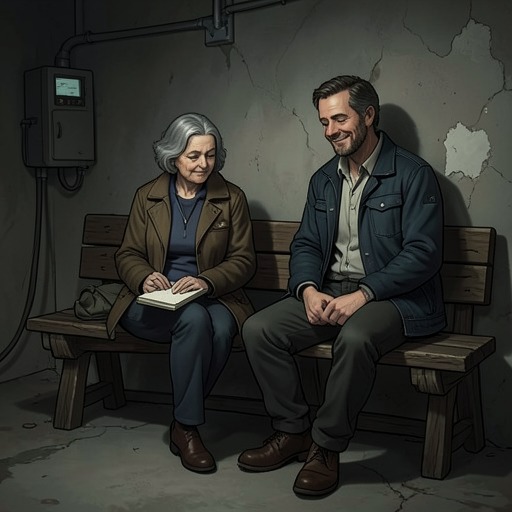
At Henry’s house, the proposed productive activity becomes an attempt to save the school newspaper. The prospects are poor: Henry already thinks it is too late to assemble a decent issue. Still, the friends settle into work in his basement. Henry consults a dictionary, Lola uses a random-word generator on the iMac, and Murray searches Urban Dictionary. Lola identifies “costumed” as a possible theme and develops it into ideas about the masks high-school students wear. Her contribution is not just a prompt for an article; she gives the stalled group a way to think about what the issue could be.
The rescue effort later expands into a larger invitation for students to submit stories of remorse in whatever form they can manage. Henry organizes the work, while Lola helps shape its final presentation. The finished issue makes visible both their different contributions and their ability to work together: Buck’s hand-drawn sketches sit beside Lola’s sleek design, and the students’ confessions range from funny to heartbreaking. Henry acknowledges that Lola has organized the disparate material so that it works as a whole. The result is not polished in every part, but its mismatched elements become evidence of a group effort rather than a reason to abandon it. The paper reaches the printer ahead of deadline, and at least 60 percent of the student body picks up a copy after its distribution. Lola and Henry have helped turn an emergency into a shared achievement.
Trust and Recognition
After Grace Town leaves, Henry gives Lola the envelope he has received from Grace and describes it as his redemption. Lola opens and reads it, then grins. The account does not disclose the envelope’s contents or explain her reaction further, so the significance of the exchange lies in what it does show: Henry brings Lola this private and emotionally important object, and she receives it with a response that suggests recognition. It is a small scene after the strain of the newspaper effort, but it places Lola among the people with whom Henry can share the meaning he is trying to make of what has happened.
Their partnership around the newspaper is also practical rather than effortless. Henry has to approve proofs, contend with the rules of the charter, and join Lola in petitioning the PTA for a vote on whether the issue can be released. The issue’s content breaches the school’s restrictions, and its fate depends on a deciding vote. Their work therefore continues beyond generating ideas or arranging pages: both remain involved as the publication faces the consequences of its unconventional contents. The issue’s eventual release, followed by a 15 percent increase in circulation, gives the collaboration a concrete outcome and helps Henry remain in charge of the newspaper for another issue.
Reciprocity After the Breakup
When Lola and Georgia break up without warning or explanation, Henry and Murray support Lola in a way that recalls her earlier care for them. The narration explicitly presents their effort as reciprocal: they pull Lola through her pain just as she had pulled them through theirs. Their support takes the form of insisting that she join ordinary shared activities rather than face the aftermath alone. They make her sing Christmas carols and drink eggnog, then take her, Madison Carlson, and themselves to the mall for a photograph with Santa. On Christmas Eve, they watch The Nightmare Before Christmas together, with Lola between Henry and Murray under the covers.
The recovery is gradual, not a sudden cure; the account stresses that they help, but not quickly. That qualification makes the friendship’s care more specific: Henry and Murray cannot erase Lola’s distress, yet they keep company with her through it and create occasions for her to take part in their lives. Taken together, the field, basement, newspaper office, and Christmas gatherings show Lola and Henry’s friendship as an ongoing exchange. Lola can direct and steady the group when it falters; Henry can join the effort to carry her through a difficult separation. Their bond is expressed in attention, shared labor, and returning presence rather than in any claim that one friend can solve another’s grief.