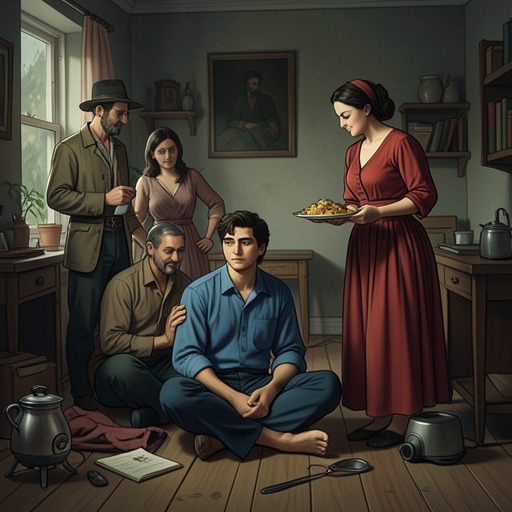
Henry's house
Our Chemical HeartsHenry's house is more than a backdrop to his life: its distinct spaces hold family rituals, private moments with Grace Town, and a late-night effort by friends to rescue the school newspaper. The house becomes a place to return to after witnessing someone else's grief, and later a setting where Henry turns a book into a personal act of release.
Domestic Setting
The house appears as a lived-in family home rather than a secluded refuge. When Henry Page and Grace arrive one afternoon, his parents are unpacking dinner ingredients in the kitchen, dressed in full Star Trek uniforms, including Vulcan ears. The incongruity of the costumes meets the pair at the threshold of ordinary family life; Henry's immediate dismay makes clear that his parents' domestic playfulness is familiar enough to embarrass him.
The house also serves as a destination after Henry and his friends witness Grace at Dom's grave. From a distance, they see her kneel among the flowers and speak or sing to the person buried there. Sadie Page recognizes the moment as private, and the group leaves, with Henry agreeing to be taken home. In this instance, the house is not where the grief unfolds but the place the group returns to after realizing they have crossed into a scene that was not meant for them.
Private Life and Intimacy
Henry's bedroom provides a more private setting. After Henry and Grace walk home together in the dark, they go downstairs without waking his parents. The passage marks a change in their relationship: the house's familiar domestic quiet gives them space to move from their public closeness into a more intimate encounter. The scene is framed around their arrival and the quiet of the sleeping household, rather than the family spaces where the day-to-day routine is visible.
Basement as a Gathering Place
The basement becomes an improvised newsroom after Henry, Lola Leung, and Murray Finch return from Burger King. Beneath the elk head, Henry sits with a dictionary while Lola uses a random-word generator on the iMac and Murray consults Urban Dictionary on his phone. Madison Carlson, who has followed them back to the house, is asleep in Henry's bed while the others try to find a theme for the struggling newspaper.
Their suggestions—first a theme about being costumed, then Murray's idea of species dysphoria—show the basement as a place where comic improvisation and practical work coexist. The friends are trying to generate material for the paper, even as Henry doubts they can put together a worthwhile issue in time. The room's cluttered, informal setup contrasts with the task's urgency: a dictionary, a computer, and a phone become their tools for a last-minute editorial rescue.
Backyard and Acts of Release
The house's outdoor spaces carry a different kind of work. In the backyard shed where Henry's father does carpentry, Henry finds gasoline, sets up the family's fire pit, and burns the pages of his book, You Are Stardust. He understands the act not as destroying the book but as freeing its atoms. The scene turns the familiar backyard into a place for a deliberate, private gesture, linking the material remains of Henry's writing to his thoughts about matter and impermanence.
Taken together, the kitchen, bedroom, basement, and backyard give the house several functions without making it a single, uncomplicated refuge. It accommodates family eccentricity, romantic privacy, friendship and collaboration, and Henry's personal reckoning. Its ordinary domestic spaces make these changes legible: the same home that receives him after an intrusive glimpse of Grace's grief also holds the conversations and actions through which he responds to loss.