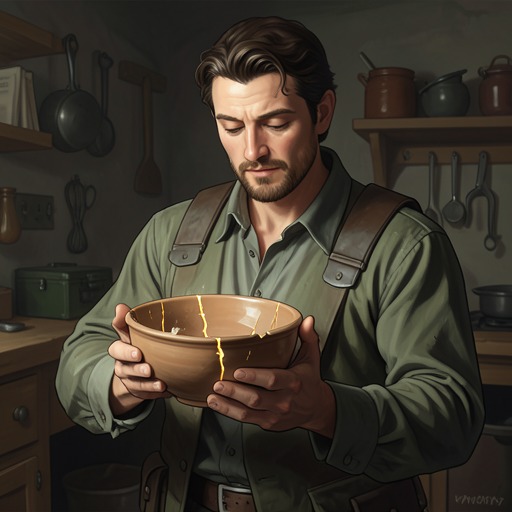
Henry's kintsugi bowl
Our Chemical HeartsHenry's kintsugi bowl belongs to a childhood collection of damaged, crooked, and otherwise unusual objects, but it becomes more than a treasured possession when Henry explains its golden repairs to Grace Town. The bowl offers a vivid image of beauty surviving breakage; Grace’s responses, however, turn that image back on Henry, questioning whether he sees her as she is or as someone he hopes to mend.
Place in Henry's Collection
The bowl is displayed in an antique cabinet that Henry’s great-grandfather had used for an absinthe collection and its drinking paraphernalia. After absinthe was outlawed in the Netherlands, the great-grandfather moved the cabinet and his family to the United States. A banner-shaped plaque on top bears the maxim “Moderation is for the dead,” a family relic whose defiant motto sits alongside Henry’s later interest in repair and damage. The cabinet is not simply a case for the bowl: it gives the object a setting already layered with inheritance, eccentricity, and the preservation of things that might otherwise be discarded.
Henry calls the display a cabinet of curiosities, not a collection of junk. He has been adding to it since elementary school, and by the time Grace examines it, it contains eleven Kintsukuroi pieces. Some came as gifts from Lola and Henry’s mother, while others were bought by Henry on eBay or Craigslist with his allowance. The bowl Grace handles is one among those pieces; the evidence does not identify its individual origin. Its companions clarify the collection’s principle of attraction: a silver bangle belonging to Sadie has a warped joint, and a Coke can bears a misprinted label. Henry gathers not pristine objects but things whose damage, deviation, or mistake makes them particular.
Repair as an Aesthetic Principle
Henry explains that he first learned about Kintsukuroi in an art book during middle school. He describes it as an old Japanese art form in which broken pottery is mended with gold, leaving the joined fragments marked by veins that remain visible across the surface. In his account, the repair does not conceal the break or restore the piece to an untouched state. Instead, the gold makes the history of damage part of what can be seen and valued. Henry sums up the idea as a belief that “some things are more beautiful when they’ve been broken.”
That explanation is personal without being presented as a confession. The bowls are Henry’s favorite objects in the cabinet, and he defends them with comic certainty when Grace calls the display broken junk. His enthusiasm makes the technique a ready-made way to understand injury: fragments can be joined, and the traces of fracture can become beautiful. Yet the image also has a limit. The bowl is a ceramic object that can be repaired by an identifiable craft; the conversation does not establish that human hurt works in the same way. Grace is alert to that difference, even before she later names it directly.
Grace Handles the Bowl
Grace picks up one of the repaired pieces and turns it over in her hands. Looking at it, she remarks, “It’s a shame people can’t be melded back together with gold seams.” Her statement shifts the exchange from Henry’s playful display to the possibility of human damage. Henry cannot tell whether she means herself, her mother, or someone else, and recognizes that he may never know: Grace Town likes being a mystery. The bowl thus becomes a focus for what remains unsaid, offering Grace a way to approach the idea of brokenness without identifying its source.
The change in tone is immediate. After the heavier thought, Grace puts the bowl back and jokes that the collection is only slightly less creepy than collecting Cabbage Patch Kids. Henry answers that the ladies love Kintsukuroi, but Grace tries and fails to fake a smile before asking whether they can make dinner because she is starving. The bowl has not resolved her distress or opened a full explanation; instead, its presence lets a moment of vulnerability surface and then recede into banter and an ordinary practical request. The contrast keeps the object from functioning as a neat solution to grief.
The Metaphor and Its Limits
Later, the gold-seam image becomes part of a direct disagreement about Henry’s attention to Grace. When he tells her he wants her all the time, Grace says she knows he thinks that, but she does not know which version of her he wants: the one she is, the one she was, or “the Kintsukuroi dream girl you think I’ll be a couple of months from now.” Henry answers by recalling her earlier point that people cannot be melded back together with gold seams. Grace insists that this is exactly her point, then turns and climbs the stairs painfully, step by step. The exchange makes her objection concrete: Henry’s fascination with the repaired bowl may encourage him to imagine a future, restored version of Grace rather than attend to the person before him.
On a later drive, the image returns in a lighter register. Grace tells Henry not to look at her as if he can see the gold veins forming before his eyes, then adds, “I’m still not a bowl.” This time the comment is playful rather than accusatory, but it preserves the boundary she established earlier. Henry accepts the correction, and they continue their drive north through the national park without stopping at the lookouts. The bowl’s lasting significance lies in this tension: its visible seams help Henry articulate an affection for what has been broken, while Grace’s refusal of the comparison warns that admiration for a repairable object is not the same as understanding a person.