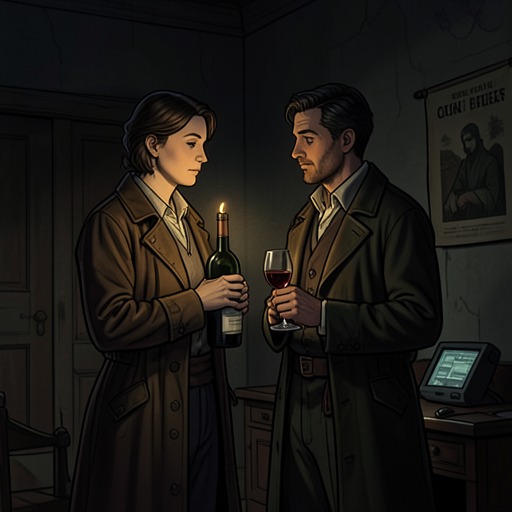
Heslin’s Party
Our Chemical HeartsHeslin’s Party is a senior-year social gathering that marks a decisive change in Henry Page and Grace Town’s relationship: after weeks of uncertain closeness, they share their first kiss and acknowledge, in a private message exchange, that their attraction is mutual. The party’s crowded, shifting spaces—from the football field to the host’s house and its dark side corridor—give their tentative connection room to become unmistakable, even as Henry remains unsure what the intimacy will mean afterward.
Rumor, invitation, and the football-field gathering
The event develops quickly. On Thursday, talk of a party escalates from rumor to lunchtime conversation, then becomes official when James Heslin posts the invitation on Facebook less than a day after the first speculation. The invitation reaches the whole senior year and some juniors. Henry describes his class as unusually sociable across familiar school cliques: the jocks and nerds sometimes spend time together, and most people are kind to one another. The announcement therefore lands not as an invitation to a closed faction but as a rare occasion when much of the year might gather at once.
Lola Leung and Murray Finch plan to attend, and Lola’s girlfriend, Georgia, is coming from another town. Henry is normally not much for parties, but this one matters to him because he wants Grace Town to go. He imagines sitting beside her amid the music, away from the quiet of the newspaper office and the quiet of her car. In a note on his phone, he frames his growing attachment through music: a person can first seem like an unfamiliar tune, then become a melody that feels inscribed in the body and soul. That reflection gives the coming party an emotional charge before it begins; Henry hopes not only to see Grace in a different setting, but to share an experience that might make their connection feel more like a song they both know.
Before the gathering at Heslin’s house, students assemble on the school football field at sunset and drink from a bathtub filled with mixed drinks. When Henry arrives, Grace is sitting by herself at the edge of the field, her cane across her lap, with two plastic bottles beside her. She greets him by the nickname Henrik, one of the Germanic or Russian names the two have given each other for reasons Henry cannot recall. He is delighted by the familiar address. The field scene establishes both the looseness of the night and the particular intimacy between them: Grace is apart from the crowd, but she and Henry already share private jokes and habits.
At Heslin’s house: music and changing ease
Henry is drunk by the time the group reaches the house and cannot remember how they got there or who carried the bathtub, with Murray inside it. He likewise cannot identify exactly how he and Grace came to sit next to each other at a patio table. A succession of people changing seats leaves them side by side, their legs touching. As the evening goes on, Grace becomes more talkative and affectionate than Henry has seen her when sober. She laughs at jokes, smiles at him, and joins in; even when no one is addressing her, she seems more present in the gathering. Henry notices other people noticing her, too. The contrast is not simply between the reserved Grace he usually sees and a different person at the party: the night makes visible a lighter, more socially engaged manner that he has not often witnessed.
Their physical ease also changes. At school, accidental touches during newspaper work are followed by Grace drawing back, even though they sit close enough for such contact to happen. At the party, that retreat does not recur. Their touches become more frequent, and a playful exchange ends with Grace covering Henry’s mouth while he pretends to resist. Their bodies remain close as they laugh. For Henry, these gestures seem to answer the question he has been carrying about whether Grace likes him, although he still cannot know what she will want once the evening ends.
When a cover of the Strokes song “Someday” begins, Grace recognizes it as Henry’s favorite and calls it their song. She takes his hand and leads him onto the crowded makeshift dance floor in the living room. The scene offers Henry a sudden view of Grace as the more uninhibited person suggested by her old profile pictures: she dances, removes her oversized flannel shirt, and moves with a confidence he has not seen from her in their ordinary school encounters. Henry is mostly watching until Grace notices and takes his hand again, trying to draw him into the dancing. He finally dances with her. He wants to kiss her while their song is playing, but before he acts, Lola Leung arrives with Georgia and dances between them. The interruption turns the moment into a missed opportunity; the group keeps dancing together, while Henry privately regrets what might have happened.
The first kiss and its aftermath
Later, once the others have returned to their own companions, Grace and Henry are alone together again. They hold hands while moving through the crowd, waiting for the effects of the alcohol to recede. In the dark corridor along the side of the house, Henry leans against the bricks to steady himself; before he has time to understand what is happening, Grace kisses him. The kiss lasts for two songs. Henry’s earlier uncertainty falls away in the moment, and he takes her response as confirmation that his feelings are not one-sided. The setting matters: their first kiss does not happen on the dance floor, in front of their friends, or to the song Henry had hoped would accompany it. It happens out of the crowd’s immediate view, after the interruption, when the two find their own space again.
Grace then says she should go home. Henry offers to walk her, and she agrees. He retrieves their bags and coats from a bedroom whose door bears a warning against sex, while Grace calls her parents to say she is walking home. On the walk, neither holds the other’s hand; instead, they return to brainstorming possible newspaper themes, speaking as if the party’s kiss has not just changed the terms between them. When they reach her home, Grace says goodbye and tells him she will see him on Monday. The separation keeps the kiss from becoming a simple declaration of what their relationship is: they have crossed into physical intimacy, but the ordinary school week and the unresolved question of what follows remain ahead.
Still drunk and walking toward Murray Finch’s house, Henry messages Grace. Their joking exchange uses the married-couple names Mr. and Mrs. Knupps, but it also makes the mutual attraction explicit: Grace tells him she would not have chased him if she did not feel the same way. Henry falls asleep at Murray’s house, alone and fully clothed, thinking of Grace. The message gives him the answer the party itself could not settle. The night has not established a public relationship or removed every ambiguity between them, but it has turned an imagined possibility into a shared admission.
Significance in their relationship
The party’s sequence is built from approach and interruption: Henry hopes to be beside Grace, finds himself next to her by chance, follows her onto the dance floor, loses the moment when Lola joins them, and later kisses her when they are alone. Each shift in space changes what he believes is possible. The event’s public setting briefly lets Henry see Grace welcomed and noticed by others, while their most consequential exchange takes place away from the crowd. That contrast anticipates the tension between his desire for their relationship to be visible and their continued uncertainty about what it is.
For Grace, the party displays a more openly affectionate side without proving that alcohol alone explains her behavior or that the night resolves her difficulties. For Henry, the gestures and the later message offer real evidence of reciprocity, but not a promise about the future. Heslin’s Party therefore functions as a beginning rather than a resolution: the first kiss changes their relationship, while the Monday goodbye and the teasing text leave its status unsettled.