Kintsukuroi as a relationship metaphor
Our Chemical HeartsKintsukuroi is a Japanese art of repairing broken pottery with seams of gold, an image Henry Page adopts to think about damage, beauty, and intimacy. In his account of the technique, shattered pieces are joined rather than concealed, leaving the repaired object marked by bright veins. The metaphor offers Henry hope that what has been broken can become beautiful in a new way, but its recurrence also reveals the limits of applying an artful repair to a person or a relationship.
The Art and Henry’s Collection
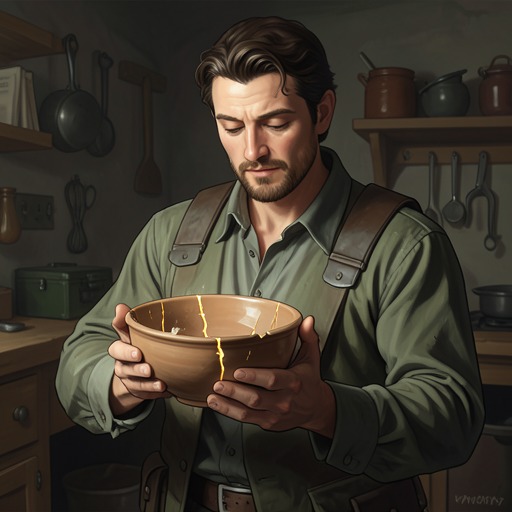
Henry explains Kintsukuroi to Grace Town while showing her the cabinet of curiosities he has filled since elementary school. He first read about the technique in an art book in middle school. By the time Grace sees the collection, it contains eleven Kintsukuroi pieces: some gifts from Lola over the years, some from Henry’s mother after art-acquisition trips to Japan, and others Henry bought on eBay or Craigslist with his allowance. The collection gives the idea a material presence in his life before it becomes a way to describe his feelings.
The cabinet also holds objects that are broken, crooked, or otherwise imperfect: a silver bangle whose joint has warped, given to Sadie Page, and a Coke can with a misprinted label. Henry’s interest therefore extends beyond repaired pottery to things whose flaws remain visible. Kintsukuroi belongs to a larger habit of valuing the damaged and unusual, not merely to an abstract lesson he invents for Grace. The objects make that preference concrete, while the gold seams distinguish repair from simply pretending that nothing broke.
Grace handles one of the bowls and responds to the idea by considering whether people could likewise be joined with gold seams. Her remark turns Henry’s explanation from a description of craft into an expression of personal pain. He cannot tell whether she means herself, her mother, or someone else in her life, and the uncertainty remains unresolved. When the exchange shifts from light teasing to a heavier mood, Grace puts the bowl back and tries to return to joking. The scene establishes both the metaphor’s emotional reach and the distance between Henry’s curiosity about her and what she chooses to disclose.
A Metaphor Between Henry and Grace
For Henry, the repaired bowl suggests that breakage need not cancel beauty. That idea becomes entangled with his attraction to Grace: he is drawn to what is blemished or cracked, and later recognizes that this preference helps explain why he fell for her. Yet Grace identifies a problem in the metaphor when she tells him that she cannot know which version of her he wants: the person she is now, the person she used to be, or an imagined future version made whole in Henry’s eyes. Her concern turns Kintsukuroi into a question about whether he sees her as she is or as a hoped-for transformation.
The contrast matters because Henry’s metaphor can make damage seem like the prelude to a more beautiful result. Grace’s response resists that implication: she has already pointed out that people cannot be put back together in the same manner as pottery. The bowl can be held, examined, and repaired into a finished object; Grace remains a person whose experience Henry does not fully know. His symbolic language gives him a way to approach her suffering, but it can also substitute an appealing image of recovery for attention to the uncertain person in front of him.
The Limits of Repair
After a painful encounter with Grace, Henry recognizes the boundary he had been avoiding: human beings cannot be mended with gold seams. He imagines that the relationship is slipping away and that he cannot fix it. His longing to find a way to make Grace love him sits uneasily beside his recognition that repair is not something he can impose. The earlier promise of the metaphor gives way to helplessness; the damaged relationship cannot be treated as a bowl waiting for Henry to restore it.
Later, Henry looks back on the relationship as something he had come to regard as more beautiful because it had repeatedly broken and been put back together. That retrospective belief is immediately qualified. Repeated breakage can reach a point at which repair is no longer possible, just as paper cannot be folded endlessly without losing the capacity to fold again. Kintsukuroi thus changes from a straightforward emblem of resilience into a measure of limits: beauty after damage is imaginable, but neither repair nor repetition guarantees that a relationship can endure.
Meaning at the Ending
Even as Henry acknowledges those limits, he returns to Kintsukuroi. He thinks of his own newly broken state alongside Grace’s, and hopes that his shattered pieces might be joined so that the resulting scars can glisten. The distinction between hope and outcome is important: the passage presents his wish for healing, not proof that either person has been repaired. The image lets him imagine a future beyond the immediate hurt without claiming that the relationship itself can be restored.
Across these scenes, the metaphor moves from a technique Henry explains, to a language Grace uses to suggest human vulnerability, to an idea Henry must reconsider when love cannot be repaired by desire alone. Its gold seams hold together two meanings that never fully reconcile: damage may become part of an object’s beauty, yet treating a person’s pain as the material for an ideal love can obscure who that person is. Kintsukuroi gives Henry a vocabulary for valuing imperfection, but its most consequential lesson is that people are not pottery, and hope for healing is not the same as the power to mend someone else.