Sawyer family home
Our Chemical HeartsThe Sawyer family home is a refuge built around a complicated continuity: after Dominic Sawyer dies, his parents keep Grace Town in their household, and Dominic’s room becomes hers without ceasing to bear his imprint. When Henry Isaac Page is invited inside, that overlap becomes concrete. The house offers hospitality, but its central room makes visible how thoroughly Grace’s life remains entangled with the person she has lost.
A Home That Takes Grace In
Martin Sawyer tells Henry that Grace had moved in with him and Mary about a month before the crash. After Dominic’s death, they insisted that she stay. Martin explains their decision through Grace and Dominic’s long relationship and describes her as practically his daughter. The home is therefore not simply somewhere Grace happens to be living: it is a place where Dominic’s parents have extended family care to the person closest to him.
That welcome is conveyed alongside a small hesitation. Martin initially offers Dominic’s room as somewhere Henry can wait, then falters and acknowledges that it is Grace’s room now. The correction is brief, but it captures the household’s changed circumstances without suggesting that the change is complete. The room has a new occupant and a new practical name, while the family still recognizes it through Dominic. Martin’s pause marks the difficulty of holding those truths together.
Grace’s earlier circumstances sharpen the significance of that welcome. In her account of meeting Dominic at nine, she recalls that her father was dead, her mother had been away for three days, and there was no food in the house. Her uncle collected her and left her with Mary, a woman from his workplace. The account presents the Sawyer household as connected to a childhood moment when Grace’s care depended on adults beyond her immediate family. Later, after Dominic dies, Mary and Martin again insist that Grace remain with them. The home’s importance thus rests not only on her relationship with their son but also on the care they continue to offer her.
Dominic’s Room and Its Objects
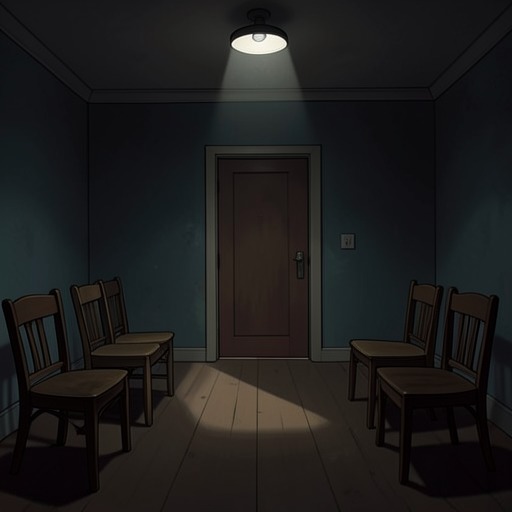
The room Henry enters is described through ordinary, accumulated possessions rather than through any grand memorial design. A crumpled checked duvet lies at the foot of the bed. The room contains a bookcase of familiar fantasy novels, an acoustic guitar on a chair, old vinyl beside a record player, a globe, a skateboard, a backpack, a desk and laptop, sports magazines, and childhood trophies. A chalkboard, a canvas bearing a portrait of Mozart, and souvenirs from distant places add to the assortment. On the dresser are Dominic’s leather necklaces, with anchors, crosses, and skulls, as well as his deodorant.
The details establish Dominic through the varied evidence of a life: childhood trophies sit among the things he used or collected as a teenager, and the room’s disorder resembles Henry’s own. That likeness gives Henry a point of recognition, but the objects also make Dominic distinct. His books, music, jewelry, and other belongings occupy the room as material particulars, not as an abstract memory supplied by someone else. The everyday character of the space makes the absence it registers more immediate.
Henry searches the room for signs of Grace and finds almost none among Dominic’s belongings. There is no clothing, footwear, or makeup that would mark the room as conventionally hers. The only item bearing her name is an envelope on the dresser: Henry’s letter to Grace, still unopened. The contrast is precise. Martin calls the room hers, and she lives there, yet Henry cannot find the ordinary personal objects he expects to signal her presence. The unopened letter adds a second kind of absence: even where Grace’s name appears, Henry’s attempt to reach her has not been answered.
Henry’s Discovery
The room becomes the setting for Henry’s recognition that Grace’s residence in the Sawyer home has not loosened her attachment to Dominic. He is holding one of Dominic’s shirts when Grace appears in the doorway. The moment shifts the room from an inventory of the dead boy’s possessions to a direct encounter with the living person who occupies it. Henry’s perception of Grace is shaped by grief: he sees her as spectral and profoundly burdened, rather than as someone simply settled into a new home.
That perception belongs to Henry’s response, not to the household’s stated account of Grace. Martin has described an act of care and kinship; Henry’s attention to the room instead measures how little of Grace seems visible within it. The distinction matters. The home can shelter her, and Martin can consider her practically a daughter, without that shelter itself resolving her loss. The room offers a place to stay, but its contents continually connect her to Dominic.
Domestic Shelter and Unresolved Grief
The Sawyer family home holds two meanings at once. It is a family home whose occupants choose to keep Grace close, and it contains a bedroom still crowded with the material traces of Dominic’s life. Martin’s change of wording—from offering Dominic’s room to recognizing it as Grace’s—expresses the altered household in miniature. The room’s name has changed; its contents, as Henry encounters them, still testify to the son who lived there.
For Henry, the unopened letter and the absence of Grace’s personal belongings make the room a place of discovery rather than reassurance. For the Sawyer family, Grace’s presence follows from years of closeness and from their own insistence that she remain after their son’s death. The home therefore resists a simple division between past and present: it makes room for Grace without requiring Dominic’s things, or the family’s bond with him, to disappear. Its significance lies in that unresolved coexistence of care, memory, and continuing grief.