“Whether I shall turn out to be the hero of my own life”
Out Stealing Horses“Whether I shall turn out to be the hero of my own life” is more than a remembered literary opening for Trond: it gives words to the fear that a person might lose the right to inhabit their own life. The passage joins a childhood memory of reading David Copperfield to a present conversation about being displaced, then turns the novel’s question toward Trond’s unresolved history with Lars. In the book, the promise that the pages will show who becomes the hero offers a kind of safety; life, Trond recognizes, provides no such assurance.
The phrase recalled
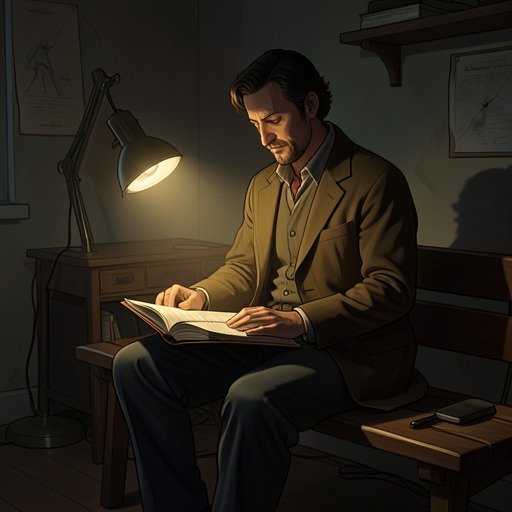
The expression returns during a conversation in which Trond has been describing his quiet routine: he listens to the radio in the morning and reads in the evening, mostly Dickens. The woman he is speaking with remembers him at home, seated with a book and so absorbed that, when she tugged his sleeve to ask what he was reading, he did not seem to recognize her at first. His serious reply was simply “Dickens.” As a child, she took the unfamiliar name to mean that he was reading a special kind of book, perhaps one that only their household possessed.
Her recollection gives the phrase a history of being read aloud as well as read silently. Trond sometimes read to her from David Copperfield, a book she later read for herself as an adult. She remembers that he never seemed to tire of it. The opening line therefore reaches the present carrying the intimacy of an old domestic scene: an absorbed reader, a child pulling at his sleeve, and a book whose significance she could not yet understand. The memory is not only about the novel’s words; it preserves an early version of Trond as she saw him, distant in concentration but close enough to share the pages aloud.
A fear of being displaced
When the woman suggests that Trond read the book again, she recalls why its opening lines frightened her. They seemed to allow that a person might not be the leading character of their own life. She imagines this loss as a ghostly existence: someone else occupies her place while she can only watch, resent, and envy, unable to return. Her image is of falling from an aeroplane into empty space while another person remains fastened into her seat, although she still holds the ticket.
The force of the image lies in its division between rightful place and actual possession. The seat is hers, and the ticket remains in her hand, yet neither gives her the power to reclaim her life. The opening question in David Copperfield thus carries, for her, a threat rather than a literary promise: a person may find that the story continues without them in the part they believed was their own. Her fear is vividly imagined, but the scene also marks how little Trond knew of it. He is startled to learn that she had been thinking this way and reflects that she had never told him because he was not there when she needed to talk.
From the novel to Lars
The passage then shifts from her fear to Trond’s own recurring encounter with the opening lines. He has read them and continued through the novel almost rigid with terror, needing to discover whether everything would eventually fall into its rightful place. In the book, it does; the reassurance arrives only after a long wait. Trond draws a firm distinction between that resolution and real life: the security he finds in the novel cannot be assumed outside it.
That difference gives the phrase its particular weight in his thoughts about Lars. Trond admits that he has not had the courage to ask the obvious question: “Did you take the place that was rightfully mine? Did you have years out of my life that I should have lived?” The question is not presented as something Lars has answered, or even as something Trond has asked aloud. It remains a withheld confrontation, brought into view by the language of the novel. Its parallel with the woman’s imagined displacement is striking: in both cases, the fear is that another person has occupied a life or a place that should have been one’s own. For Trond, however, the thought attaches itself to a specific relationship and to years he cannot recover or verify by asking the question only in his mind.
The limits of a reassuring ending
The discussion of the phrase also opens onto Trond’s uncertainty about his father. He is certain that his father stayed by the river because that was what he wanted; he does not imagine him fleeing to make a new life elsewhere. Yet the certainty of that belief does not resolve the difficulty surrounding Lars. Trond notices that Lars has never mentioned his father during the time they have known each other. He considers whether Lars is trying to spare him, or whether neither of them can bring their thoughts about the people involved together into words. He recognizes the latter silence as familiar from almost his whole life.
The remembered opening of David Copperfield therefore supplies a question, not a verdict. The novel lets Trond wait for a world in which matters fall into place; his real circumstances leave him without the same guarantee and without the courage, so far, to demand an answer from Lars. Meanwhile, the woman’s recollection makes clear that the phrase has mattered to more than one person: she feared being removed from her own life, while Trond reads the possibility of displacement through his own history. Its significance lies in that convergence—and in the gap between holding the ticket and being able to return.